Author Spencer Thorne
March 24, 2026

Nobody looked at Angry Birds and thought: what this really needs is a real money layer. Except, apparently, a one-person indie strategy studio from Montreal that had never made a casino game before. That is exactly the background Coreffect Interactive brings to Angry Balls, an “Only on Stake” exclusive that is either a stroke of lateral thinking or one of the stranger IP-adjacent moves in recent iGaming memory. Probably both.

Coreffect Interactive launched in 2020 and spent its first few years building PC strategy titles — a chess-with-lasers puzzle game, a Roman city builder — on Steam. Physics-driven systems are clearly in their DNA, so the pivot to iGaming is less random than it first appears. The casino angle, though, is a genuine surprise. When a studio best known for Chess With Lasers turns up as a Stake exclusive partner, you check the name twice. Their outside perspective is the most interesting thing about this release, and it shows in the mechanics.
Angry Balls is a burst game, not a slot. There are no reels, no paylines, no tumbles. The core loop is: pull back a slingshot, pick your angle, fire a spiky ball at a fortification packed with coins. Every coin you destroy pays out a multiplier value based on your bet. The goal is to break through the structure and collect as many coins as possible before the round ends.
Between the launch point and the fortification sit bonus power-up symbols. Hit them and they activate — and crucially, they stack. Split spawns two additional balls, so you end up with three flying simultaneously toward the coins. Ghost lets the ball pass through walls. Grow increases the ball’s size. Landing all three in a single shot is the kind of moment that reminds you why physics-driven formats can work in gambling: you can see it happening in real time, and the chaos of it is genuinely exciting.
Clear every coin on the screen and you trigger the Bonus Wheel, which spins to add an extra multiplier on top of whatever you collected. It’s a clean escalation mechanic — the session doesn’t just end, it rewards a clean sweep.
The angle you choose to shoot from is not cosmetic. Different angles affect both RTP and max win potential, which is the most genuinely distinctive feature in the game and also its most significant player-safety concern (more on that below).
Two enhanced modes are available as paid buy-ins:
Neither mode changes the core mechanic. They change the layout conditions you’re firing into.
The headline RTP is 96.51%, which sits above the industry average — a reasonable position. The complication is that this figure shifts depending on which angle you select and which mode you’re playing. Higher volatility settings pull it down to approximately 95.93%. The range isn’t catastrophic compared to some multi-configuration slots, but the mechanism is unusual: here, a player’s in-round choice — which angle they fire from — determines their expected return. There is nothing in standard slot play that works quite like this, and most players will not realise the trade-off they’re making when they adjust their aim.
Always check the specific angle and mode RTP before committing to a bet level. This is not a footnote — it is the central math decision of every round.
The max win across all modes is 37,168x. In Max Treasure Mode at 100x the base bet, the effective stake to unlock that ceiling is meaningful, so keep your bet sizing in context. Bet range runs from $0.10 to $1,000, which is a generous ceiling and suits the high-roller segment that Stake’s audience skews toward.
The physics feedback is genuinely satisfying when a shot connects cleanly, breaks through multiple layers, and coins start cascading. There is something Angry Balls does that almost no other burst or crash game does: it makes you feel the outcome rather than just watch a multiplier tick up. The Split power-up landing at the right moment and sending three balls simultaneously into a packed structure is the kind of thing that will have you replaying the round in your head.
The frustration, though, is real. Round layouts are randomised, which means you occasionally fire with a well-chosen angle only to discover, after release, that this particular layout had almost nothing in range. The slingshot pulls back with skill-game energy; the result sometimes lands with lottery energy. That gap — between the active, engaged feeling of play and the RNG-determined outcome — is the central tension the game never fully resolves.
The Stake exclusivity is the other structural problem. Angry Balls is only accessible if you have a Stake account. For the vast majority of the global iGaming audience, this game simply does not exist. Coreffect Interactive built something genuinely unusual and then distributed it to a fraction of the market. The upside is that the Stake Engine integration is smooth and the demo on Stake is the full-feature version — you can test every angle and mode before committing real money, which is the right call for a format this unfamiliar.
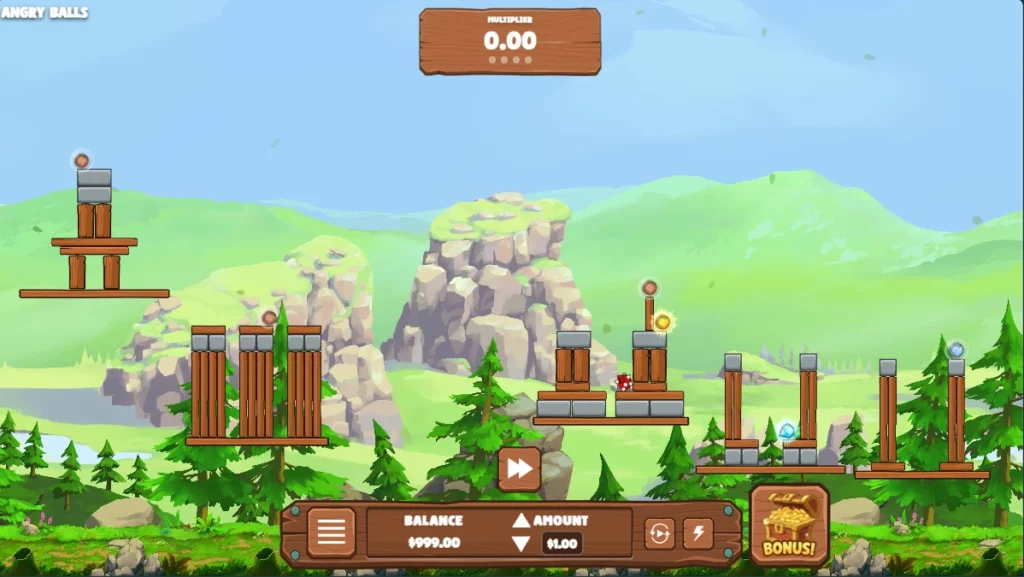
Players who have exhausted the standard slot rotation and want something that feels physically different will find Angry Balls genuinely refreshing. The arcade nostalgia element is real — anyone who spent time with the original Angry Birds will be firing the slingshot within about thirty seconds of loading the game. It fits well for casual sessions where you want quick, low-complexity rounds with occasional big moments.
Players looking for deep session control, predictable volatility pacing, or access outside Stake will be disappointed. And if the thought of an angle selection that quietly changes your RTP without a clear on-screen warning bothers you — it should, and it’s worth factoring in.
One practical advantage of Angry Balls being a Stake exclusive is that the demo is hosted directly on Stake’s platform with the full feature set intact — every angle, every mode, both bonus buy options. That means you can test the slingshot mechanics, get a feel for how different angles affect trajectory, and run through Bomb Mode and Max Treasure Mode before committing a single cent. For a format this unfamiliar to most players, that access matters more than it would for a standard slot. The physics-driven loop takes a round or two to click, and the angle-RTP relationship is something you genuinely need to experience firsthand before it makes sense as a decision. Use the demo for exactly that. Head to stake.com, load the free play version, and spend time with the angles before sizing your real money bets. The house edge does not change between demo and real play — but your understanding of the game absolutely will.
Angry Balls is not a great game, but it is a genuinely interesting one, which is a rarer thing. Coreffect Interactive had no business making a casino game this playable on their first attempt, and the physics-driven format has more personality than the majority of burst games built by studios with decades of iGaming experience. The Stake exclusivity will stop most players from ever seeing it, which is a waste. For those who can access it: play the demo first, understand the angle-RTP relationship before putting money on it, and treat Max Treasure Mode as the occasional swing it is rather than the default mode. The 100x buy-in deserves that kind of respect.
Angry Balls is a physics-based burst game developed by Coreffect Interactive, exclusively available on Stake. Players fire a slingshot at coin-filled structures to collect multipliers, with power-ups and bonus wheel mechanics layered on top of the core shot mechanic.
The standard RTP is 96.51%, which is above the industry average. However, it varies by shooting angle and mode — higher volatility configurations pull it down to approximately 95.93%. Check the specific angle and mode RTP before each session; this is not a fixed number.
The max win is 37,168x your bet, accessible in Max Treasure Mode, which costs 100x your base bet to activate. In standard mode, the ceiling is lower; Bomb Mode caps at 7,951x.
You pull back a slingshot, choose an angle, and fire a spiky ball at a fortification loaded with coins. Each coin has a multiplier value. Power-up symbols between the launch point and the structure (Split, Ghost, Grow) can be collected mid-flight and stack within a single shot.
Minimum bet is $0.10, maximum is $1,000. Given the 100x cost of Max Treasure Mode, players sizing up for the top ceiling should calculate accordingly.
Angry Balls is an “Only on Stake” exclusive — it is not distributed across other aggregators or casinos. Demo play is available on Stake with the full feature set active.
Both are physics-adjacent burst games exclusive to Stake, but they play very differently. Chicken Road is a step-by-step risk/reward decision game with a clear cash-out mechanic. Angry Balls is a single-shot physics event with more visual chaos and higher peak potential. Chicken Road has more moment-to-moment player control; Angry Balls has more spectacle when it works.