Author Spencer Thorne
March 27, 2026

| Developer | InOut Games |
| Game Type | Instant Arcade Shooter |
| RTP | 94% (single configuration) |
| Volatility | Player-adjustable via Autoplay presets |
| Max Win | €10,000 / £10,000 per round |
| Min Bet | €0.01 |
| Max Multiplier | x48+ (King Chicken, Tier 8) |
| Mobile | Fully optimised — HTML5 |
| Licence | Curaçao (IOGr B.V.) |
| Demo Available | Yes |
InOut Games built Chicken Shoot on a simple premise: what if a shooting gallery had real money on the line? It is a question the studio had a credible reason to answer — its Chicken Road franchise had already demonstrated that arcade-adjacent formats with simple controls and fast rounds could pull serious player numbers. Chicken Shoot takes that energy and points it in a different direction. Instead of guiding a chicken across traffic and deciding when to cash out, you are the threat. You aim, you shoot, and whatever multiplier is printed on the bird you hit goes straight onto your stake.
The result is a game that feels immediately distinct from the crash-game crowd InOut has built its name on. No escalating tension, no cash-out moment, no agonising second-guess. Just a crosshair, a field of flying chickens, and the knowledge that the rarest ones are worth a lot more than the common ones.
InOut Games launched in 2024 and moved fast. The studio’s portfolio now runs to over 30 titles, built almost exclusively around instant-play mechanics: crash games, mines, plinko, chart-index games, and — with Chicken Shoot — arcade shooters. More than 3 million players engage with InOut titles monthly, according to the studio’s own figures. That growth came primarily off the back of Chicken Road, which became one of the more-cloned games in the instant-game space. Chicken Shoot is the studio’s attempt to demonstrate range. The crash mechanic works. Can a shooting gallery?
The business logic is sound. Shooting games have a different psychological profile from step-crash titles. They feel more immediate, more visceral, and — critically — more skill-adjacent, even when the outcome is entirely RNG-determined. That perception of agency is worth something in player retention terms, and InOut clearly knows it.
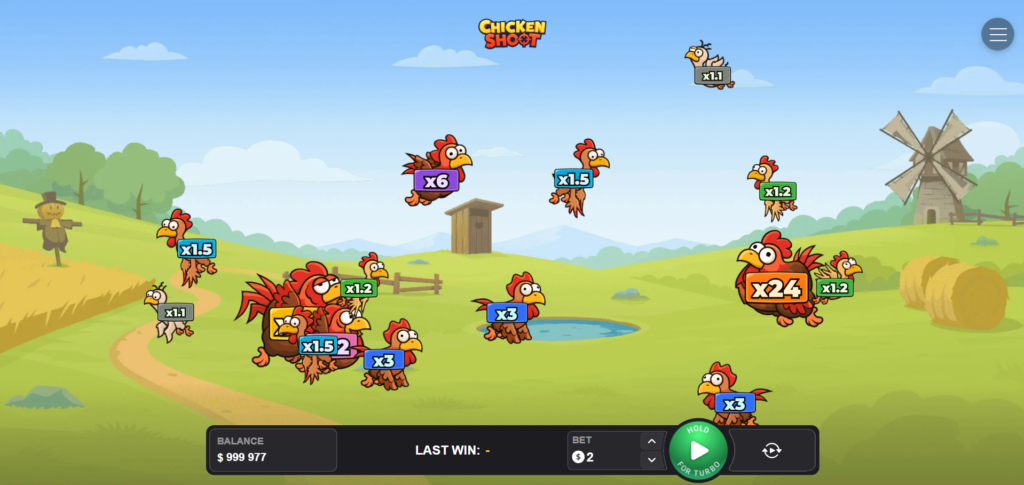
The setting is a farmyard. Chickens fly laterally across the screen — common birds carrying small multiplier tags, intermediate targets with higher values, and rare golden specimens that carry the serious prizes. Each bird displays its multiplier value clearly above it as it moves. The crosshair tracks your cursor or touch input and fires on click or tap. When a shot connects, the bird explodes into a feather burst, a gold coin animation fires, and the multiplier is added to your total. When time runs out, the round closes and you collect your stake multiplied by whatever you accumulated.
The art style is clean and cartoonish — straightforward to read at speed, which is the right call for a game where you are tracking multiple targets simultaneously. Multiplier tags are legible at a glance. The win state triggers a score popup and a satisfying visual confirmation. Nothing about the presentation gets in the way of the game.
Audio-wise, the soundtrack is upbeat without being intrusive. Shot sounds and feather-burst effects provide clear feedback on hits. The sound design does exactly what it needs to do: confirm actions and keep energy up across a fast round.
The base loop is straightforward. Set your stake, the round begins, chickens fly across the farmyard in waves, and you shoot as many as you can before the timer closes. Every hit contributes its multiplier to your running total. Your final payout is stake × accumulated multiplier. Miss a shot or let a valuable bird escape and it is simply gone — there is no retry, no second chance, and no cash-out decision mid-round.
That last point is worth sitting with. Chicken Shoot does not give you in-play strategic control the way a crash game does. In Chicken Road, every step is a decision. In Chicken Shoot, the decision-making happens before the round starts — which chickens to prioritise, which multiplier tier to chase, and how your session bankroll maps to that ambition. Once you are in the round, you execute. There is something refreshing about that. It is a cleaner, faster experience than managing a live cash-out decision under pressure.
This is the feature that genuinely differentiates Chicken Shoot. The Autoplay system lets you pre-configure which tier of chicken to target, effectively setting your own volatility profile before the round begins. There are four presets:
The practical effect of this system is that Chicken Shoot accommodates genuinely different playing styles without requiring different game modes. A low-stakes player farming x1.5 birds and a jackpot chaser hunting King Chickens are technically playing the same game, but they are having entirely different sessions. That is smart design. It mirrors what the difficulty selectors do in Chicken Road without requiring the same mid-round tension.
One caveat: the Autoplay system makes targeting decisions for you, but in manual mode your own reflexes and judgment determine which birds you pursue. The skill-adjacent feel of the game is real in that mode — even if the RNG governs which birds appear and in what sequence.
RTP: 94%. This is the number that players who do their research will notice, because it is below the industry standard. The typical benchmark for online casino games sits around 96% — Chicken Road’s headline RTP runs to 98% in its most generous configuration. Chicken Shoot’s 94% is not scandalous on a per-round basis, but over a long session the difference compounds. For a player running 200 rounds, the gap between 94% and 96% is not trivial. There is only one configuration reported, which means no multi-tier RTP concern — but it also means there is no higher-RTP option available on any platform. What you see is what you get, and what you get is below average. Check the game information panel on your casino before playing to confirm the figure in your jurisdiction.
The maximum win is capped at €10,000 per round regardless of stake or multiplier achieved. That is a fixed currency ceiling, not a multiplier cap. A player staking €200 and hitting x48 would theoretically be looking at €9,600 — comfortable within that ceiling. But a high-roller staking €500 hunting the same bird hits the €10,000 cap and leaves upside on the table. The ceiling is relatively modest for a game that explicitly courts jackpot chasers through its Extreme Autoplay preset. That tension is a real drawback for big-stake players.
Min bet of €0.01 keeps the floor accessible for casual players and those testing the Autoplay presets without material exposure. The game runs on a certified RNG and Provably Fair technology, verified through hash comparisons available post-round. Curaçao-licensed, HTML5-built, available in demo mode without registration.
Chicken Shoot’s demo is available without registration on licensed casino platforms, and it is worth using before committing real money — not as a formality, but because the Autoplay presets behave differently enough across tiers that a few free rounds will tell you things the description cannot. Run the Beginner preset for ten rounds and you get a concrete feel for how often x1.5 birds actually appear and how quickly small hits stack. Switch to Extreme and you will immediately understand why the jackpot-chasing approach demands a serious bankroll buffer — the gaps between King Chicken appearances are real, and seeing that in demo costs nothing. The demo runs on the same certified RNG as the real-money version, so the frequency distributions you observe are representative. One practical note: use the demo to stress-test your session budget logic. If your planned real-money stake would drain uncomfortably fast on Extreme Autoplay in free play, that is a signal to either drop a preset tier or increase your buffer before switching to live funds.
| ✅ PROS | ❌ CONS |
| Autoplay targeting system is a genuine differentiator — effectively customisable volatility | 94% RTP is below the industry standard ~96% benchmark — a meaningful long-session drag |
| Fast rounds with no in-play decision fatigue; clean execution loop | €10,000 max win cap limits appeal for high-rollers using larger stakes |
| Accessible floor (€0.01 min) suits a wide bankroll range | No in-play cash-out decision — agency is front-loaded to pre-round settings only |
| Fully mobile optimised — touch controls responsive and accurate | Counterfeit copies circulating on unlicensed sites with rigged payout rates — verify the InOut Games badge |
| Provably fair / certified RNG; demo mode available without registration | Single RTP configuration — no higher-RTP option available on any platform |
| Visual clarity — multiplier tags readable at speed, hit feedback immediate | Round outcome entirely RNG-governed despite the skill-adjacent feel — the crosshair is cosmetic |
Against Chicken Road (same studio), Chicken Shoot trades in-play agency for pre-round strategy. Chicken Road gives you a decision at every step — stay or cash out. Chicken Shoot gives you the Autoplay preset before the round starts, then runs itself. Players who enjoy the psychological tension of a live multiplier building while they decide whether to hold or fold will prefer Chicken Road. Players who want to set their risk profile once, execute cleanly, and move to the next round will find Chicken Shoot the better fit.
Against Mission Uncrossable (Roobet/INOUT) and Uncrossable Rush (Evoplay/SlotCatalog), Chicken Shoot is simpler but faster. Uncrossable Rush operates on a lane-by-lane mechanic where each advance is a decision; its step-crash structure gives players genuine in-round control. Chicken Shoot lacks that depth but delivers a cleaner, lower-friction round experience. For players who find step-crash titles too slow or psychologically taxing, Chicken Shoot offers a viable alternative at the cost of strategic nuance.
Against Forest Arrow (also InOut), the studio’s other shooter title, Chicken Shoot has the advantage of a higher accessible max multiplier tier at x48+ versus Forest Arrow’s x1000 ceiling — though Forest Arrow’s three difficulty modes serve a similar function to Chicken Shoot’s Autoplay presets. The real difference is theme and pace. Chicken Shoot is faster and more chaotic. Forest Arrow is more measured.
Chicken Shoot is a well-executed format that does something rare: it gives players a meaningful pre-round strategic choice, then delivers instant, clean results without fuss. The Autoplay targeting system is the best thing about this game — it turns what could have been a pure reflex exercise into something with a genuine decision layer, even if that decision happens before the shooting starts.
The 94% RTP is the problem you cannot talk your way around. For a game that positions itself as a casual, fast-round option for players who want frequent action, a below-average RTP is a punishing long-session tax. It does not ruin the game, but it does mean that players running extended sessions at any stake level are fighting an above-average house edge. That warrants an explicit mention every time you load it up.
If you want the Chicken Shoot experience and you are playing for fun across a defined session budget — especially in Beginner or Intermediate Autoplay preset — it delivers exactly what it promises. If you are a high-roller expecting the €10,000 cap to reward a big stake, or a session grinder sensitive to RTP drag, you will get more value from Chicken Road or Mission Uncrossable.
Set a session budget before you open the game, and treat it as the total you are comfortable losing — not as a target to recover from. Chicken Shoot’s fast rounds make it easy to cycle through a bankroll quickly, especially on Extreme Autoplay where dry stretches between hits can run long. Use the demo mode to get familiar with how the Autoplay presets actually behave before committing real money. And verify the InOut Games provider badge on the loading screen — counterfeit versions of this game circulate on unlicensed sites with rigged payout rates. Only play on properly licensed platforms.
Chicken Shoot is an instant arcade casino game by InOut Games. Players use a crosshair to shoot flying chickens on a farmyard backdrop, with each hit adding the bird’s multiplier to their stake. Rounds are timed and the payout is stake × accumulated multiplier.
The RTP is 94% — a single configuration that applies across all platforms. This sits below the industry standard of approximately 96%, which is a meaningful long-session disadvantage. There is no higher-RTP version available. Always confirm the figure in your casino’s game information panel before playing.
The maximum win is €10,000 / £10,000 per round — a fixed currency cap. The highest multiplier tier is the King Chicken (Tier 8) at x48 or above, but your total payout cannot exceed the €10,000 ceiling regardless of stake or multiplier achieved. High-rollers staking large amounts should note that this cap limits their upside relative to other games in the instant-game category.
The Autoplay system lets you pre-configure which tier of chicken to target before the round begins — effectively setting your own volatility. Four presets are available: Beginner (x1.05–x1.5, low variance), Intermediate (x1.5–x3, balanced), Advanced (x12, infrequent but worthwhile hits), and Extreme (x24–x48+, jackpot hunting with long dry stretches). You can also play manually and select your own targets in real time.
Chicken Shoot was developed by InOut Games, a Curaçao-licensed B2B studio that launched in 2024. The studio’s portfolio includes the Chicken Road franchise, Forest Arrow, Penalty Unlimited, and Chicken Road Bonus, with over 30 instant-play titles built in HTML5.
Chicken Shoot suits casual players who want short, decisive rounds without in-play decision pressure, mobile-first players who appreciate clean touch controls, and those who enjoy setting a risk strategy before the action starts. It is less well-suited to high-rollers whose stakes push against the €10,000 cap, long-session grinders sensitive to RTP, or players who want the live cash-out tension of a crash or step-multiplier format — for those, Chicken Road is the better call.
Both are from InOut Games, but the strategic moment is different. Chicken Road gives you a decision at every step of a run — advance and risk, or cash out and secure. Chicken Shoot front-loads strategy into the Autoplay preset before the round starts, then executes automatically. Chicken Road has a higher headline RTP (up to 98% in its most generous configuration) and offers more in-play agency. Chicken Shoot is faster and lower-friction. Which is better depends entirely on whether you want to manage risk live or set it up front.