Author Spencer Thorne
May 28, 2026

| Game name | Chicken Shot |
| Developer / provider | BGaming |
| Game type | Casual instant-win / pick-a-multiplier (commonly miscategorised as a crash game) |
| RTP | 97.00% (source: BGaming official game page; verified May 2026) |
| House edge | 3.00% |
| Volatility | Low (provider-stated) |
| Max multiplier | ×64 |
| Max win | Reported at $256,000 (at the ×64 ceiling on the maximum stake) |
| Min / max bet | €0.10 – €4,000 per round (per published spec sheets) |
| Risk-level settings | No discrete “risk modes” — risk is chosen per click by which chicken/multiplier you target |
| Provably fair | No (not a cryptographic provably-fair game) |
| Third-party audit | Yes — BGaming’s RNG is certified by iTech Labs and BMM Testlabs (provider-level certification) |
| Auto-cashout | No cash-out mechanic exists; an autoplay/auto-target mode does |
| Mobile compatible | Yes |
| Exclusive to one casino | No — distributed across BGaming’s operator network |
| Demo available | Yes |
| Release date | 26 May 2026 (verified: BGaming, VegasSlotsOnline) |
| Licence of casinos offering it | Varies by operator; BGaming distributes to 3,000+ casinos across multiple jurisdictions. Always confirm your chosen casino holds a licence valid in your country before depositing. |
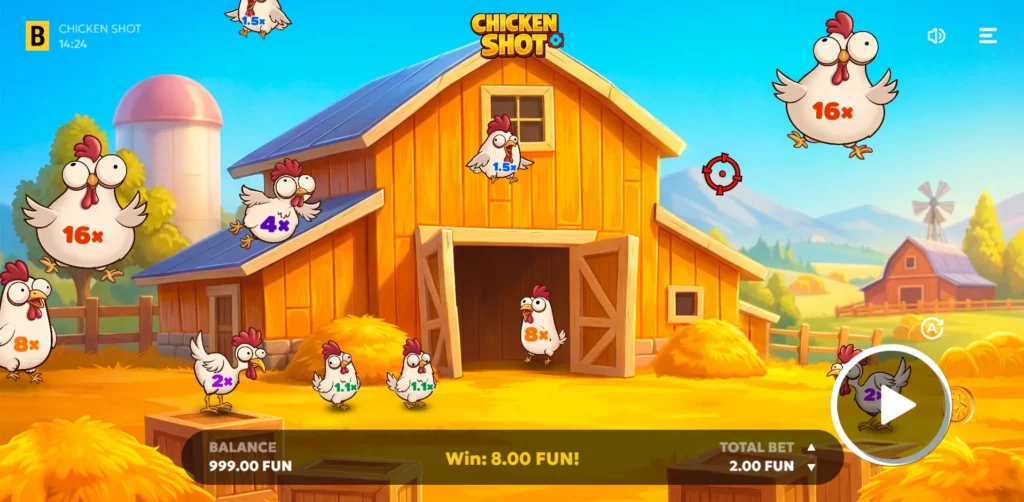
Chicken Shot is a casual instant-win game in which a player sets a stake, fires at a flying chicken that carries a fixed multiplier, and either wins that multiplier on the stake or loses the stake outright on that shot. That is the entire loop. There are no reels, no rising line to watch, and no decision about when to stop — the only decision is which chicken to target, because each one advertises a different multiplier and a correspondingly different chance of paying out. Larger multipliers are rarer; smaller ones land far more often. BGaming’s published figures put the low-end ×1.1 target at an 88.18% success rate and the top ×64 target at just 1.52%.
It is worth correcting a category error that runs through almost every listing of this game: Chicken Shot is not a crash game in the mechanical sense. A crash game — Aviator being the archetype — shows a multiplier climbing in real time, and the player’s skill expression is the timing of a cash-out before the curve “crashes.” Chicken Shot has no climbing curve and no cash-out window. You pick a fixed multiplier, you fire, and the result is instant. It sits in BGaming’s “Casual” vertical alongside its Plinko and scratchcard titles, and it is closer in spirit to a fast scratchcard than to Aviator. Aggregators file it under “crash” because of the chicken theme and the instant-win pacing, not because the mechanics match.
The honest summary up front: Chicken Shot is a competent, polished, deliberately small game. Its strength is clarity — there is nothing to misunderstand, the maths is transparent, and the 97% RTP is generous for the casual category. Its limitation is also its design: the ×64 ceiling and low volatility mean there is no path to a large, life-changing result, and the fast tap-to-fire rhythm makes it very easy to burn through a bankroll without noticing. It suits a player who wants a light, low-stakes diversion with honest odds. It does not suit a player chasing big multipliers, and it offers nothing to a player who values the cash-out skill element of true crash games.
The headline figure is a 97% RTP, which means a 3% house edge. In plain terms: across a very large number of rounds, the game is designed to return €97 for every €100 staked, keeping €3. That €3 is not a fee taken once — it is shaved off every wagered euro, every round, indefinitely.
The most useful thing to understand about Chicken Shot’s maths is that the house edge is identical no matter which chicken you pick. Take BGaming’s own published hit rates and multiply them out:
Every multiplier tier is calibrated to return roughly the same ~97%. Your choice of chicken therefore does not change your expected loss — it only changes your variance. Picking the ×64 chicken does not give you a worse “deal” than the ×1.1 chicken; it gives you the same long-run return delivered in rarer, larger lumps. This is a genuinely important point that the standard spec-sheet reviews list the hit rates for but never actually spell out: there is no “smart” chicken to pick from an expected-value standpoint. There is only the risk profile you prefer.
The realistic cost of play follows the standard formula:
Expected loss per hour = house edge × rounds per hour × average stake
The variable that makes this game expensive is the round count. Chicken Shot is a tap-to-fire game with no spin animation to slow you down. Assuming an active manual pace of one shot every six seconds — a conservative estimate; autoplay is faster — that is roughly 600 rounds per hour.
At a 3% edge and 600 rounds/hour:
| Stake per round | Expected loss per hour |
|---|---|
| €0.20 (low) | 0.03 × 600 × €0.20 = €3.60 |
| €1.00 (medium) | 0.03 × 600 × €1.00 = €18.00 |
| €10.00 (high) | 0.03 × 600 × €10.00 = €180.00 |
Two caveats make the real numbers worse, not better. First, autoplay can push the pace toward ~900 rounds/hour, scaling every figure above by roughly 50%. Second — and this is the figure no marketing copy will show you — at the game’s €4,000 maximum stake, the same formula gives a theoretical expected loss of 0.03 × 600 × €4,000 = €72,000 per hour. That a “cheerful farm” casual game permits a stake ceiling capable of that hourly burn rate is, in this reviewer’s view, the single most important number on the page.
The “low volatility” label describes the default experience of a player picking low-multiplier chickens: frequent small wins, a slowly bleeding balance, few dramatic swings. But volatility in Chicken Shot is player-selected, not fixed. A player who only ever fires at the ×64 chicken is having a high-volatility session inside a “low volatility” game — they will lose roughly 98 shots in 100 and occasionally land a 64x. The provider’s volatility rating reflects expected behaviour, not the maths of the top tier.
At 1.52%, the top multiplier lands about once in every 66 attempts on average. To reach a coin-flip (≈50%) chance of seeing at least one ×64, a player needs roughly 45 consecutive attempts — the maths being ln(0.5) ÷ ln(1 − 0.0152) ≈ 45. Crucially, there is no compounding route to the ceiling: unlike a crash game, where one lucky round can run to 1,000x or beyond, Chicken Shot’s biggest possible single-round outcome is the ×64 chicken. The maximum win is structurally capped, not just statistically unlikely.
This is the section most listings skip, and it contains the most important correction in this review.
Chicken Shot is not a provably fair game in the cryptographic sense. “Provably fair” is a specific technical claim — it means the player is given a hashed server seed before the round, combines it with a client seed and a nonce, and can independently verify after the fact that the result was not altered. That is the model used by crypto-native crash and dice titles, and it requires no trust in the operator at all. Chicken Shot does not offer this. There is no player-facing seed, no nonce, and no per-round verification tool.
What Chicken Shot does have is certified RNG. BGaming states on its own responsible-gaming page that its random number generator carries an official RNG evaluation conducted by iTech Labs and BMM Testlabs — two long-established, independent testing laboratories. This is the traditional, audit-based trust model: an accredited lab statistically validates the RNG and confirms the live RTP matches the declared figure, and the player trusts that certification rather than verifying individual rounds themselves.
The practical distinction matters. With a certified-RNG game you are trusting BGaming and its auditors; with a provably fair game you trust no one and check the maths yourself. For a brand like BGaming — distributed to over 3,000 casinos and certified by reputable labs — the certified-RNG model is reasonable, and there is no evidence of fairness problems with the studio’s output. But a player who specifically came to “crash games” for the self-verification feature should know that Chicken Shot does not provide it, despite being shelved next to games that do.
Because the game is two days old, there are no documented disputes over Chicken Shot outcomes — not because the game has proven itself, but because there has not yet been time for any to surface. A fairness verdict on a two-day-old title can only be provisional.
Fairness verdict: acceptable, on the strength of BGaming’s iTech Labs / BMM Testlabs certification and clean studio reputation — but explicitly not independently verifiable per round, and without any live track record yet.
A round consists of: set stake → target a chicken carrying a displayed multiplier → fire → instant resolve. The RNG determines whether that specific shot connects for the displayed multiplier; if it does, the payout is stake × multiplier and is credited immediately. If it does not, the stake is lost on that shot. There is no in-round progression — each shot is an independent event with its own fixed odds.
Chicken Shot has no menu of discrete risk modes (the Easy/Medium/Hard framing some marketing sites use is a description of targeting behaviour, not a built-in toggle). Risk is selected organically: low-multiplier chickens (around ×1.1, ~88% hit rate) for grinding small frequent wins, mid chickens for balance, and the ×64 chicken (~1.52%) for variance. Because, as shown above, every tier returns ~97%, the “risk system” is purely a variance dial.
There is no auto-cashout in Chicken Shot, because there is no cash-out — that concept belongs to crash games. What exists is an autoplay mode that fires automatically at a chosen target profile. This is a convenience/pacing feature, not a discipline tool. In fact, by removing the small friction of each manual click, autoplay tends to increase spending velocity rather than restrain it — the opposite of what an auto-cashout does in a true crash game.
There are none. No free rounds, no bonus games, no progression, no multiplier ladders, no buy-feature. This is by design — Chicken Shot is a deliberately minimal casual title, and that minimalism is one of the few things genuinely worth praising about it.
No. Chicken Shot does not do anything that pick-a-multiplier instant-win games and scratchcards have not done before. Its differentiation is presentation (a lively, well-animated farm shooter wrapper) and BGaming’s production polish — not mechanics. That is not a criticism in itself; plenty of successful casual titles compete on feel rather than novelty. But a reader should not expect a new idea here.
Here is where honesty has to override the template. There is no genuine player community footprint for Chicken Shot yet. Searches across the usual sources — Reddit’s gambling and crash-game subreddits, Bitcointalk’s gambling boards, casino-community forums, and streamer commentary — return nothing specific to this title beyond automated new-release listings. That is exactly what you would expect for a game that has existed for two days.
What does exist online are early write-ups from affiliate and review-aggregator sites, almost all derived from BGaming’s launch materials rather than extended play. The recurring observations across those are worth noting, with the caveat that they are publisher-adjacent rather than independent player consensus:
This is the comparison readers will search for, and the most instructive, because it shows what Chicken Shot is not.
| Chicken Shot | Aviator | |
|---|---|---|
| Mechanic | Pick a fixed multiplier, instant resolve | Watch a rising multiplier, cash out before it crashes |
| RTP | 97.00% | 97% (widely documented) |
| Max multiplier | ×64 (hard ceiling) | Effectively uncapped per round; ~×10,000 max win |
| Skill element | Choosing a variance level | Timing the cash-out; running two simultaneous bets |
| Provably fair | No (certified RNG) | Yes (server seed / client seed / nonce) |
| Social features | None | Live shared rounds, chat, public big-win feed |
Same RTP, very different games. Aviator by Spribe rewards nerve and timing and lets a single round run to enormous multipliers; Chicken Shot removes timing entirely and caps the upside. A player who likes the cash-out tension and the verifiable fairness of Aviator will find Chicken Shot flat by comparison. A player who finds the cash-out pressure of Aviator stressful and just wants to tap and resolve will prefer Chicken Shot.
Within BGaming’s catalogue, Chicken Shot competes with the studio’s Plinko titles, several of which carry higher RTPs (Plinko 2 has been documented at 99%). For a player who simply wants a low-stakes, high-RTP casual filler from the same trusted studio, those Plinko variants arguably offer a better mathematical return with comparable simplicity.
The chicken theme is crowded — Inout Games’ Chicken Road (a road-crossing, cash-out-style game with a provably fair implementation and a far higher win ceiling) and BGaming’s own slot Chicken Rush (a ×5,000 max-win video slot) share the aesthetic but not the mechanic. Players drawn in by the theme should be aware they are quite different products with very different upside.
Positioning statement: Chicken Shot is a solid, niche casual title — well-made and fairly priced at 97% RTP, but mechanically modest and structurally capped. It is not a leader in the crash space because it is not really a crash game, and it is not the best casual game even in BGaming’s own range. It is a competent supporting act.
To be clear, the provider itself is not a red flag — BGaming is well-documented, widely distributed, and lab-certified. But several things deserve flagging before any deposit:
No evidence of rigging, mis-stated RTP, or provider misconduct surfaced in research. The flags above are about fit and structure, not integrity.
Play this game if you are a casual, low-stakes player who wants a fast, visually pleasant diversion with transparent, generous-for-the-category odds, and who plays in short, budgeted sessions rather than long grinds. The 97% RTP and the clarity of the loop genuinely suit this profile.
Consider an alternative if you want meaningful upside or a return-per-euro advantage — instead try a higher-RTP BGaming casual title such as a Plinko variant (documented up to 99%), which gives you the same studio polish with a thinner house edge and a less compounding-hostile structure.
Avoid this game if you are a multiplier-chaser or a high-roller. The ×64 ceiling will frustrate the former, and the disproportionate €4,000 stake limit combined with rapid pacing will work against the latter — the game’s structure rewards small, slow play and punishes scale.
Play the demo first if you have never played a pick-a-multiplier instant-win game. Use it specifically to feel how fast rounds resolve and how quickly a notional balance moves when you are not spending real money. That pacing — not the mechanics, which take ten seconds to learn — is the thing the demo will teach you, and it is the thing most likely to catch you out later.
Chicken Shot earns a measured 6.5/10 — a competent, honestly-priced casual game held back by a modest ceiling and a stake structure out of step with its tone. The single strongest reason to play it is the combination of a clear 97% RTP and a clean, polished loop that does exactly what it says with no hidden mechanics. The single biggest reason for caution is pacing: fast resolution and friction-free autoplay make it unusually easy to outspend your intentions, and the €4,000 maximum stake sits uncomfortably against a ×64-capped farmyard shooter. It is definitively right for the budgeted, short-session casual player who values transparency over upside, and wrong for anyone chasing big multipliers or the verifiable, run-it-up tension of a real crash game. On balance this reviewer recommends it only with those conditions attached — as a light side game, played small, by someone who already knows when to stop.
And the one thing most readers will not have known going in: in Chicken Shot, every chicken pays the same. The ×1.1 and the ×64 return an identical ~97% over time — the only thing your choice changes is how lumpy the losing feels on the way down. There is no clever target, no edge to find, no “right” chicken. Once you see that the maths is flat across the board, the game reveals itself for exactly what it is: a variance dial with a friendly face.
Chicken Shot has an RTP of 97.00%, as listed on BGaming’s official game page (verified May 2026). That equals a 3% house edge — generous for the casual category.
No. Chicken Shot does not use a cryptographic provably-fair system with player-verifiable seeds. It relies on BGaming’s certified RNG, independently evaluated by iTech Labs and BMM Testlabs. You trust the certification rather than verifying each round yourself.
The maximum multiplier is ×64, with a reported maximum win of around $256,000 — reached only by landing the ×64 chicken (≈1.52% chance) at the maximum stake. The upside is hard-capped; there is no compounding route above ×64.
Both have a 97% RTP, but they are different game types. Aviator is a true crash game with a rising, near-uncapped multiplier, a cash-out skill element, and provably fair verification. Chicken Shot is an instant-win game where you pick a fixed multiplier with no cash-out and a ×64 ceiling. Choose Aviator for upside and self-verification; choose Chicken Shot for simplicity.
Yes. A demo version is available, letting you try the game with no real-money risk. It is the recommended way to feel how fast rounds resolve before staking anything.