Author Spencer Thorne
May 14, 2026

| Game name | Chicken vs Zombies |
| Developer / provider | InOut Games (owned by IOGr B.V.) |
| Game type | Crash / step-based minigame |
| RTP | 95.5% (stated by developer across all difficulty modes; source: InOut Games, verified by SlotCatalog, October 2025) |
| House edge | 4.5% |
| Volatility | Low (Easy) to Extreme (Hardcore) — player-selectable |
| Max in-game multiplier | Approximately ×20,000 (in-game cap); theoretical Hardcore ceiling ×3,608,855 |
| Max win (monetary) | Up to $20,000 USD per round (casino-dependent; figure varies by platform and currency) |
| Min / max bet | $0.01 / $200 per round |
| Difficulty modes | Easy (30 zombies), Medium (25), Hard (22), Hardcore (18) |
| Provably fair | Yes — SHA-256, server seed + client seed + first three round bets |
| Third-party audit | Not published — no GLI, eCOGRA, or iTech Labs certificate publicly available |
| Auto-cashout | No — manual cashout only, by deliberate design |
| Mobile compatible | Yes — HTML5, browser-based, no app download required |
| Exclusive to one casino | No — distributed to 20+ casino partners |
| Demo available | Yes |
| Release date | October 23, 2025 |
| Provider licence | Curacao eGaming (reference 1668/JAZ), held by IOGr B.V. |
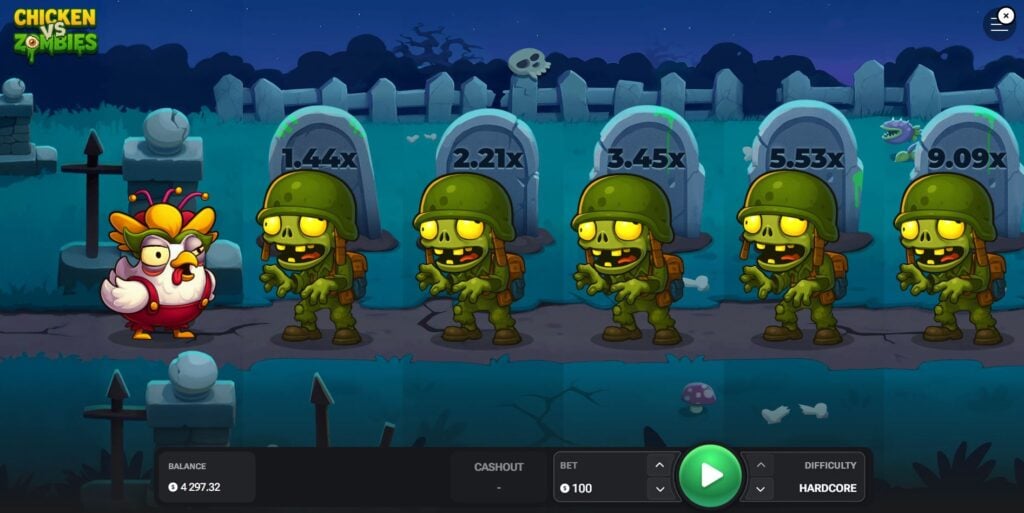
Chicken vs Zombies is a step-based crash game by InOut Games in which a player places a fixed bet, selects a difficulty level, then clicks forward through a row of zombie-occupied tombstones one position at a time. Each successfully defeated zombie reveals the multiplier locked into that position and presents a binary decision: click “Cash Out” to collect the current multiplier applied to the bet, or click “Go” to advance to the next zombie and risk losing everything. A single zombie defeat ends the round with no payout. There are no reels, no bonus spins, no wild symbols, and no passive waiting — every moment in the game is an active decision.
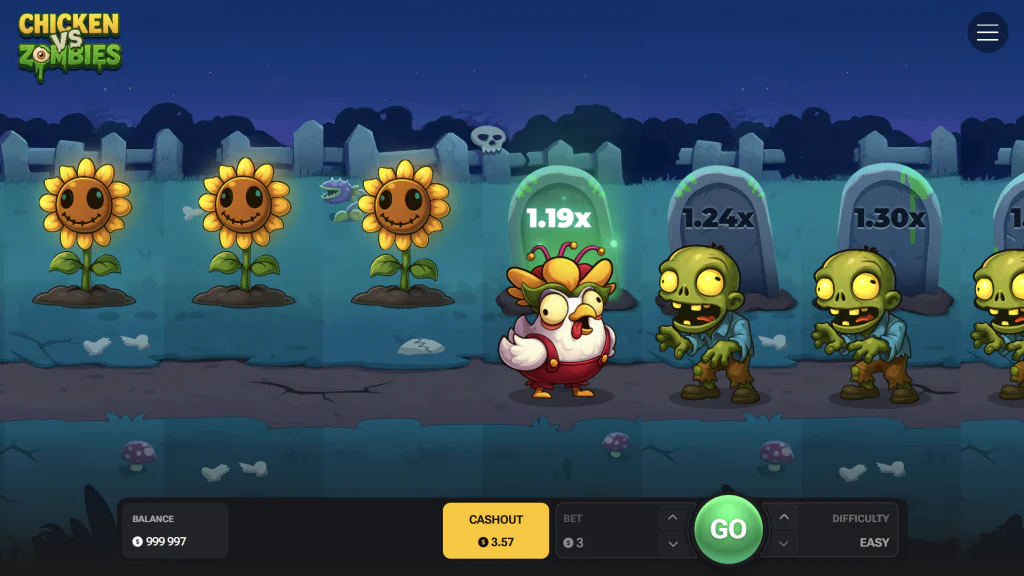
The game belongs to the step-betting subgenre of crash games, pioneered by InOut’s own Chicken Road (released 2024), itself descended from the broader crash mechanic popularised by Aviator (Spribe, 2019). Where traditional crash games ask players to cash out before an abstract multiplier crashes, step games replace the continuous curve with discrete decision points. Each tombstone displays its multiplier value before the player advances, making the risk-reward calculation transparent in a way that classic crash games are not. Chicken vs Zombies wraps this mechanic in a Halloween graveyard aesthetic with cartoon zombie types — farmers, pot-heads, athletes, and military variants at higher difficulties — directly inspired by the Plants vs. Zombies video game franchise. Defeated zombies transform into sunflowers: a visual nod that is an intentional homage, confirmed by independent reviewers.
The honest summary: Chicken vs Zombies delivers a genuinely engaging step-betting experience with premium visual quality, a functional provably fair system, and a uniquely manual-only cashout that distinguishes it from its crowded genre. Its 95.5% RTP is acceptable for the format but sits below InOut’s own flagship titles and below Aviator. No third-party RNG audit has been published. For players who want total manual control, visible multipliers at every step, and a game with strong design craft, this is among the better options in the step-betting category. Players prioritising the highest possible RTP or multilateral social features will find better alternatives.
The RTP of 95.5% means that, across a statistically significant number of rounds, the game returns 95 cents for every dollar wagered. That does not mean any given session returns 95.5%. Over 10 rounds, the outcome is entirely unpredictable. Over 10 million rounds aggregated across all players, the return converges on 95.5%. The house edge — 4.5% — is the portion the casino retains as revenue. It is built into the probability of each zombie encounter, not into any fixed crash point.
Expected loss per hour — the working:
Formula: Expected loss = House edge % × Rounds per hour × Average bet size
Chicken vs Zombies is a manual-click game. Each round requires active clicking through multiple steps plus bet setup, making it slower than pure crash games like Aviator. A reasonable estimate for an engaged player is 60 rounds per hour on average, accounting for both quick losses on step one and longer runs on Easy mode.
These figures are theoretical averages. In practice, session outcomes are highly volatile, particularly on Hard and Hardcore modes. A player might win $400 in 20 minutes on Hardcore or lose their entire session budget in the same time. The theoretical average is not a guarantee for any individual session length.
What difficulty level changes is not the RTP — it stays at 95.5% across all four modes — but the distribution of outcomes. Easy mode (30 zombies) produces frequent small wins. The multiplier at step one is ×1.01, meaning a single zombie defeat returns a 1% profit. Hardcore mode (18 zombies) starts at ×1.44 on step one. Reaching step 10 on Hardcore produces a multiplier that would require roughly 25 steps to achieve on Easy. Players who consistently push deep on Hardcore face a lower probability of surviving each individual step; those who cash out after one or two steps on Easy will see a much smoother variance curve, but will earn almost nothing per round.
The theoretical maximum multiplier on Hardcore is stated as ×3,608,855, but this requires surviving all 18 zombies. The practical in-game cap applied by most casino partners is ×20,000, with a monetary ceiling around $20,000 per round. The probability of surviving all 18 Hardcore steps approaches mathematical improbability over any realistic session length — no documented community event of a full Hardcore clear has surfaced at the time of writing.
Chicken vs Zombies uses a SHA-256 provably fair system. Before each round, the game generates a server seed and hashes it using SHA-256. The player has access to a client seed (a hexadecimal string such as f62bf0529ee4389f, displayed in the settings panel). The outcome of each round is determined by combining the server seed with the client seed and the first three bets placed in the round — a slightly unusual implementation that involves live round data rather than a purely pre-round seed pair.
To verify a round: after playing, access the bet history panel, click the shield icon on any bet, and copy the server seed and client seeds. The SHA-256 hash of the pre-round server seed can be checked against the seed revealed post-round to confirm no manipulation occurred. The settings menu also allows the player to change their client seed at any time.
One technical note worth flagging: the inclusion of the “first three bets of the round” in the seed calculation — rather than purely pre-round seed values — means the outcome determination involves round-start data. InOut has not published a formal technical white paper explaining this mechanism in full cryptographic detail. Players who want to verify the system independently can access bet history and use any SHA-256 online tool, but the absence of a developer-published algorithm specification is a gap.
No third-party RNG audit from any recognised testing laboratory — GLI, eCOGRA, or iTech Labs — has been published for InOut Games or Chicken vs Zombies as of May 2026. InOut holds a Curacao eGaming licence (1668/JAZ), which is distributed through a sub-master arrangement. Critically, the Curacao sub-master licensing framework does not mandate independent game testing as a condition of operation, unlike regulated markets such as the UK (UKGC), Malta (MGA), or Sweden (Spelinspektionen). By comparison, Aviator by Spribe has published GLI and iTech Labs certifications confirming its RNG and RTP against independent statistical standards.
This does not make Chicken vs Zombies unfair. The provably fair system, when implemented correctly, provides player-verifiable transparency that traditional RNG audits do not. However, these are fundamentally different trust models. Provably fair puts the verification tool in the player’s hands but requires the player to check it themselves. Third-party audits provide institutional verification from an independent body. Currently, Chicken vs Zombies offers the former without the latter.
Fairness verdict: Acceptable — provably fair system confirmed, but institutional third-party audit absent. Players prepared to use the in-game verification tool have meaningful transparency. Players who rely on lab certification badges should note their absence.
No documented complaints of outcome manipulation or disputed game results were found in community research at the time of writing.
Each round begins with bet selection and difficulty selection. The player presses the lime-green Play button, which deducts the bet from the balance and presents the chicken at the first tombstone. The tombstone displays the multiplier unlocked by defeating that zombie. The chicken fights; if the RNG resolves in the player’s favour for that step, the zombie is defeated, a sunflower appears in its place, and the multiplier is now active. The player chooses: cash out (orange button, always visible) or press Go for the next step. If the RNG resolves against the player on any step, the round ends immediately with no payout. Each step is an independent probabilistic event. There is no memory of previous steps, rounds, or sessions within the game’s RNG.
Easy (30 zombies) produces the longest possible run and the smoothest multiplier progression. Step one returns ×1.01. The multiplier curve climbs gradually, so early cashouts yield near-zero profit. This mode suits players who want extended sessions with low individual-round stakes.
Medium (25 zombies) accelerates the curve marginally. The risk per step is slightly higher; the multipliers at equivalent step counts exceed Easy mode values.
Hard (22 zombies) represents a meaningful difficulty jump. The probability of clearing step one is lower than on Easy. Players who reach step eight or nine are in statistically uncommon territory with meaningful multipliers.
Hardcore (18 zombies) starts at ×1.44 on step one. The bust probability on any individual step is high. The multiplier curve is exponential. Hardcore creates the most extreme variance profile available in the game — most rounds end within the first two to three steps. A player who reaches step six or seven in Hardcore has already beaten the statistical distribution for that difficulty tier.
There are none. This is a deliberate design decision, not a technical limitation. InOut explicitly designed Chicken vs Zombies to require active manual intervention at every decision point. The consequence for players is that every round demands continuous attention. The consequence for the game’s engagement profile is that the psychological mechanism — the tension between the known current multiplier and the unknown next step — is maximally activated. Players cannot remove themselves from the decision by pre-programming a cashout at ×2 and looking away. In sessions where emotions run high after losses, the absence of a discipline tool that auto-cashout provides in games like Aviator is worth noting.
One quality-of-life feature most reviews miss: a spacebar hotkey can be toggled on in the settings menu, allowing keyboard-based play (press Space to initiate rounds or advance steps). Sound and music are independently adjustable. Fullscreen mode is available. Bet history is accessible mid-session and displays bet amount, achieved multiplier, seed data, and win amount for every historical round.
There are none beyond the core mechanic. No free round triggers, no progressive jackpot, no loyalty multiplier, no wild positions on the path. This is intentional minimalism.
Community intelligence for Chicken vs Zombies is limited by the game’s recent launch date (October 2025). No established reddit megathreads or Bitcointalk discussion chains had accumulated critical mass at the time of research. What exists comes from early-adopter reviews and platform feedback.
Independent review site ClashOfSlots, one of the more analytically rigorous crash game aggregators, noted in its assessment that Chicken vs Zombies is “pretty much identical” to Chicken Road 2 — an InOut title with the same mechanics and the same payouts across all four difficulty levels, with the zombie theme as the differentiating element. This observation, which no other review has surfaced, raises a legitimate question about whether InOut is releasing meaningfully different games or theming variations of the same mathematical model. Players who have played both titles and noticed this have described the same cashout structures and the same volatility feel across difficulties in both games.
On the positive side, players who have reviewed the game consistently single out the visual production quality as a step above InOut’s prior titles. Comments describe the artwork as “premium,” the animations as “clean,” and the zombie character designs as giving each difficulty a distinct personality. The sunflower-replacement-on-defeat mechanic, an homage to Plants vs. Zombies, is mentioned approvingly across player comments on several demo-hosting sites.
The manual-only cashout has divided player opinion along predictable lines. Players who actively enjoy the decision-making process of step games report higher engagement than with passive crash games. Players who prefer systematic auto-cashout strategies — setting a target and removing emotion from the decision — are frustrated by its absence. One observation noted across player commentary: the absence of auto-cashout tends to produce larger individual losses on sessions when players push past their intended exit point, a pattern consistent with the documented psychology of loss-chasing in manually controlled risk games.
Warning: InOut’s official channels have noted the appearance of counterfeit and cloned versions of Chicken vs Zombies on unlicensed platforms. These copies may look similar to the original but lack the provably fair system and verified RNG. Players should access the game only through verified casino partners connected to InOut Games via official API.
Aviator is the crash game standard against which every entry in the genre is measured. Its RTP of 97% is 1.5 percentage points above Chicken vs Zombies’ 95.5% — a difference that compounds meaningfully across long sessions. At $10 per bet, 80 rounds per hour: Aviator’s expected loss is $24/hour versus Chicken vs Zombies’ $36/hour. Over a four-hour session, that gap is $48 in theoretical favour of Aviator.
Mechanically, the games are structurally different. Aviator is a single continuous multiplier watched in real time — often alongside other players in a shared social space with live chat, leaderboards, and public bet visibility. Chicken vs Zombies is a solitary, sequential, step-by-step game with no social layer whatsoever. The psychological experience differs: Aviator produces reactive tension (when do I cash out before the crash?), while Chicken vs Zombies produces deliberative tension (do I take one more step?).
Aviator has published GLI and iTech Labs RNG certifications. Chicken vs Zombies has not. Aviator uses three client seeds from three different players, making no single party able to influence the outcome alone — a slightly stronger fairness guarantee than InOut’s implementation. Aviator offers auto-cashout. Chicken vs Zombies does not.
Players who prefer the higher RTP, the social element, the institutional audit trail, and auto-cashout discipline tools should choose Aviator. Players who want visible multipliers at every step, player-controlled volatility selection across four modes, and a game that demands active decision-making rather than reactive cashout timing should find Chicken vs Zombies more engaging.
The comparison within InOut’s own catalogue is instructive. Chicken Road, InOut’s flagship title and SiGMA Awards 2025 nominee in the Best Crash Games category, carries a 98% RTP — 2.5 percentage points higher than Chicken vs Zombies. The mechanical structure across both games is virtually identical, as noted by ClashOfSlots. At medium stakes, the annual expected loss differential between playing Chicken Road and playing Chicken vs Zombies at equivalent volume is material.
Players who are committed to InOut’s step-betting mechanic should be aware that Chicken Road delivers the same gameplay loop at a meaningfully better return rate. The zombie aesthetic and upgraded visual design of Chicken vs Zombies may be worth the RTP cost for players who value presentation. For players who care primarily about long-run return, Chicken Road is the more mathematically favourable choice within the same provider’s catalogue.
Market positioning: Chicken vs Zombies sits as a strong-quality niche alternative within the crash/step-betting segment, with superior presentation over its InOut stablemates but an RTP that places it behind both the genre’s market leader (Aviator) and the provider’s own better-returning title (Chicken Road).
BC.Game licensing history. The casino featured in this review’s brief — BC.Game — voluntarily withdrew its Curacao gaming licence in December 2024, one day before the Curacao Gaming Control Board was set to rule on its potential revocation. This followed a bankruptcy order from a Caribbean court relating to claims from unpaid players. BC.Game has denied wrongdoing, transitioned to an Anjouan licence, and as of August 2025 proceedings to reverse the original bankruptcy ruling were reportedly underway. Players considering BC.Game as a platform should review its current licensing status independently before depositing. The game itself (Chicken vs Zombies) is available at multiple other casino partners and is not exclusively tied to BC.Game.
No third-party RNG audit. InOut Games, founded in 2024, has not published a GLI, eCOGRA, or iTech Labs audit certificate for any title in its catalogue. The Curacao sub-master framework under which InOut operates does not require independent game testing. InOut’s SHA-256 provably fair system is a genuine player-verifiable transparency mechanism, but it is not a substitute for institutional RNG certification when assessing the mathematical accuracy of the 95.5% RTP claim over millions of rounds.
The RTP gap within InOut’s catalogue. Players who discover InOut through Chicken vs Zombies should know that the provider’s other step-betting titles carry higher RTPs. Chicken Road is stated at 98%. Playing Chicken vs Zombies over Chicken Road at identical stakes and session lengths produces a theoretically higher expected loss purely because of the house edge difference.
Bonus contribution uncertainty. No standardised bonus wagering contribution data for Chicken vs Zombies has been publicly documented across casino partners. Players using welcome or reload bonuses should verify with individual operators whether crash/step games from InOut contribute to wagering requirements and at what percentage. Many casinos restrict crash game bonus contributions to 10% or exclude them entirely.
No auto-cashout. This is not a red flag in isolation, but it is an important player protection consideration. Crash and step game sessions are fast-paced. Without a pre-programmed exit tool, the psychological pull of “one more step” is the primary mechanism governing cashout decisions. Players with a history of difficulty enforcing session limits should note this explicitly.
No evidence of the game being rigged, of systematic payout failures, or of outcome manipulation was found in research. The provably fair system is verifiable. Complaints that do exist are consistent with normal high-volatility losses in a game where the player controls the risk level.
Players who approach gambling games analytically and want their risk decisions to be fully visible before committing to each step will find Chicken vs Zombies purpose-built for them. The multiplier on every tombstone is displayed before the player advances. The difficulty mode is set before the round begins. Nothing is hidden or revealed after the fact. If this type of deliberate, step-by-step decision structure appeals — and a 95.5% RTP is acceptable — this game delivers exactly what it promises with production quality that exceeds most of its direct competitors.
Players who want the same step-betting mechanic with a better long-run return rate should consider Chicken Road, InOut’s 98% RTP flagship. The gameplay structure is effectively identical. The zombie aesthetic and premium visuals of Chicken vs Zombies are the practical differentiator. If those visuals are not a priority, the mathematics favour Chicken Road.
Players who value the social dimension of crash gaming — live chat, shared bet visibility, real-time leaderboards, the knowledge that other players are cashing out at the same moment — should play Aviator instead. Chicken vs Zombies is entirely solitary. There is no multiplayer element, no community session, and no awareness of what other players are doing. Aviator’s 97% RTP and GLI/iTech Labs audit certification make it the stronger all-round choice for the broadest audience.
Players who are new to step-betting games entirely should use the demo mode before committing any real funds. In demo play, the full mechanics, all four difficulty modes, the sound design, and the cashout decision pressure all operate identically to real-money play. The specific things to focus on in the demo: how quickly the urge to advance one more step activates even when a profitable cashout is available, and how the game feels after three consecutive first-step losses on Hardcore. Both are accurate previews of real-money emotional dynamics.
Chicken vs Zombies earns its place in the step-betting genre on the strength of genuine craft: the visual quality is a clear step forward for InOut, the provably fair system is functional and player-accessible, and the four difficulty modes give meaningful strategic variation. The deliberate exclusion of auto-cashout is its most defining feature and its most legitimate point of debate — it creates a more immersive decision-making experience but also removes a key player protection mechanism that responsible gambling guidance consistently recommends.
The strongest reason to play this game is the combination of visible, pre-displayed multipliers and player-selectable volatility: no other step-betting game wraps these mechanics in comparable production quality at this level of transparency. The biggest reason for caution is the 95.5% RTP — 1.5 percentage points below Aviator and 2.5 percentage points below InOut’s own Chicken Road — combined with the absence of any published third-party RNG certification. The provably fair system is a genuine alternative trust model, but players accustomed to institutional audit certifications should be clear-eyed that none exists here.
This game is definitively right for step-betting enthusiasts who prioritise visual quality, manual control, and player-verifiable fairness over the highest possible RTP. It is not the right choice for players who want social features, auto-cashout tools, or the strongest audit credentials in the crash game segment. The standout finding from this review: Chicken vs Zombies carries a lower RTP than the provider’s own flagship title Chicken Road, which offers the same mechanic, the same four difficulty modes, and the same provably fair system at 98% versus 95.5%. Most players considering Chicken vs Zombies do not know this. They should.
Rating: 7.5 / 10 — High production quality and genuine fairness transparency, offset by a below-average RTP for the category and the absence of institutional third-party certification.
The Return to Player is 95.5%, confirmed by the developer (InOut Games) and independently noted by reviewers including SlotCatalog. This applies uniformly across all four difficulty modes — Easy, Medium, Hard, and Hardcore. The house edge is 4.5%.
Yes. The game uses SHA-256 cryptographic hashing. Each round’s outcome is generated by combining a server seed, a client seed, and the first three bets of that round. Players can verify any round’s result in the bet history panel by checking seed values against the SHA-256 hash published before the round began.
The theoretical maximum multiplier on Hardcore mode is ×3,608,855. In practice, casino partners apply a monetary cap that is typically around $20,000 USD per round. The in-game multiplier cap applied by most platforms is approximately ×20,000.
Aviator by Spribe has a 97% RTP versus Chicken vs Zombies’ 95.5%. Aviator is a continuous multiplier crash game with multiplayer social features, auto-cashout, and published GLI/iTech Labs RNG certifications. Chicken vs Zombies is a single-player step-betting game with manual-only cashout, four difficulty modes, and no social layer. Players who want the highest RTP and institutional audit trail should choose Aviator. Players who want visible multipliers at each step and manual decision-making control may prefer Chicken vs Zombies.
Yes. A full-featured demo version with virtual credits is available through the game’s launch platform and partner casino lobbies. The demo runs on identical RNG mechanics to the real-money version.
4.5%, equal to 100% minus the 95.5% RTP. This applies to every bet across every difficulty mode.
No. InOut deliberately excluded auto-cashout to ensure every cashout decision remains manual. Players must click the cashout button actively after each step.