Author Spencer Thorne
September 15, 2026

Almost every review of Cock-a-Doodle Cash calls it a crash game, and at least one prominent industry review describes a continuously rising multiplier that climbs until the round crashes. The game does not work that way. There is no rising curve at all. Every multiplier you can ever be paid is printed in the paytable before you press Play, from the 1.02x of the first Beginner lane to the 10,000x at the end of the Insane track. What Platipus has actually built is a step-multiplier road-crossing game with fully published fixed paytables.
| Detail | Information |
|---|---|
| Developer / provider | Platipus |
| Game type | Step-multiplier instant win (crash-adjacent, not a true crash game) |
| RTP | 96.00% (source: in-game rules panel, Game Settings section) |
| House edge | 4.00% |
| Max multiplier | 10,000x (Insane difficulty, step 16) |
| Min stake | $0.20 |
| Max stake | $20.00 |
| Risk level settings | Yes (Beginner, Easy, Medium, Hard, Insane) |
| Provably fair | Not documented |
| Auto-cashout | Yes (via Autoplay, cash out at a set multiplier) |
| Demo available | Yes |
| Mobile compatible | Yes |
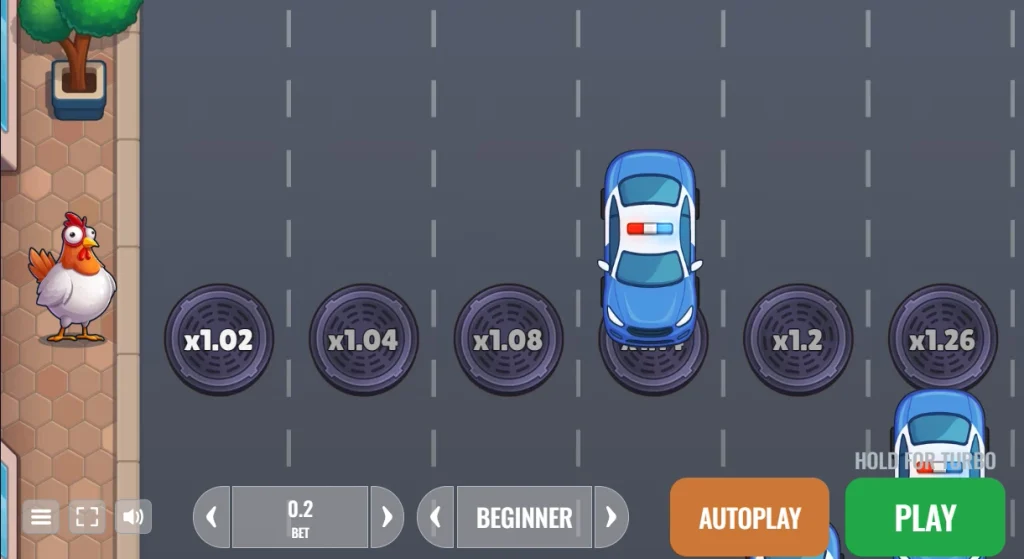
Cock-a-Doodle Cash is an instant-win game from Platipus, the Malta-based studio better known for its video slots, with in-game rules dated November 2025 and a wide rollout through aggregator lobbies in early 2026. You place a bet, a cartoon chicken sets off across a multi-lane road, and each lane it crosses locks in a higher multiplier from a fixed paytable. Press Cashout at any point and you collect your stake multiplied by the value of the last lane crossed. If a car hits the chicken first, the round ends and the stake is lost.
Mechanically this Platipus chicken game sits in the same family as the wave of chicken road crossing titles that followed Chicken Road rather than in the crash genre it is usually filed under. In a true crash game a multiplier curve rises continuously and terminates at a randomly drawn point, so any cash-out value is theoretically possible. Here the outcomes are discrete. On Beginner there are exactly 24 possible multipliers, on Insane exactly 16, and nothing in between them can ever be paid.
A round begins when you set a stake between $0.20 and $20.00, choose one of five difficulty levels, and press Play. The chicken then advances lane by lane. At each lane the server-side random number generator resolves a single question: does the chicken cross safely or is it hit? A safe crossing moves your position one step up the paytable; a hit ends the round with the stake lost. The result is communicated instantly on screen, since the chicken either reaches the next manhole cover showing the new multiplier or a vehicle appears in its lane. You can press Cashout after any successful step. A round also ends automatically in your favour if the chicken reaches the final lane of the chosen difficulty, at which point the game pays the top multiplier without asking.
Difficulty determines both the length of the road and the danger per lane. Beginner has 24 steps and a paytable running 1.02, 1.04, 1.08 and so on up to 20x at the end. Easy has 22 steps up to 100x, Medium 20 steps up to 500x, Hard 18 steps up to 2,000x, and Insane 16 steps up to 10,000x. The trade-off is mechanical rather than cosmetic: because every difficulty must deliver the same overall return, the bigger jumps between multipliers on harder tracks have to be paid for by a higher probability of being hit on each individual lane. The first Insane lane already pays 1.4x, which tells you the risk of failing it is many times higher than the risk of failing the first Beginner lane, which pays only 1.02x.
Autoplay runs a chosen number of rounds at fixed settings and supports a cash-out-at-multiplier value, which is the game’s auto-cashout. Its limitation is that it can only stop at a multiplier that exists in your difficulty’s paytable, and it changes nothing about the underlying odds; it only removes the temptation to deviate from a plan. Autoplay also offers stop-on-win and stop-on-loss limits, and holding the Play button or space bar activates a faster Turbo mode.
The in-game rules state the Cock-a-Doodle Cash RTP plainly: for any bet, the total payout of the game is 96.00%. That figure comes directly from the developer’s rules panel rather than from an aggregator, and it means the house retains approximately $4 of every $100 wagered over a large number of rounds, at every difficulty level. Platipus publishes one blended figure and does not break the RTP out per difficulty, so a player has to take on trust that Insane returns the same 96% as Beginner.
The Cock-a-Doodle Cash house edge is 4%, and the hourly cost follows from the formula: expected loss per hour equals house edge multiplied by rounds per hour multiplied by average stake. Road-crossing rounds are short, and with Turbo mode shorter still, so 100 rounds per hour is a realistic assumption for continuous play; a slower, more deliberate player might manage 50. At a $1 average stake over 100 rounds, the expected loss is 0.04 x 100 x 1, which is $4 per hour. At a $5 stake under the same assumptions it is $20 per hour.
Volatility is what makes individual sessions feel nothing like those averages. If we assume the 96% return applies at every cash-out point, the implied chance of surviving the first Beginner lane is roughly 0.96 divided by 1.02, about 94%, while the implied chance of surviving the first Insane lane is roughly 0.96 divided by 1.4, about 69%. That derived figure means nearly one Insane round in three ends before the first multiplier is banked. A player on Insane can therefore lose twenty consecutive stakes and then land a single result that wipes out days of losses, while a Beginner player grinds tiny gains punctuated by occasional total losses. Short-term profit is entirely consistent with a game whose mathematics are unfavourable long-term, which is precisely why win streaks feel more meaningful than they are.
One further detail in the rules deserves attention: winnings are truncated to two decimal places rather than rounded, so a $0.01 bet at a 1.18x multiplier still pays $0.01. At micro-stakes this truncation quietly shaves the effective return below the headline 96%.
Cock-a-Doodle Cash publishes no provably fair mechanism. There is no server seed, no client seed, no nonce, no hash commitment before the round and no verification page afterwards. The honest classification is not documented rather than a confirmed no, but the practical effect is the same.
What that means in practice is that fairness rests on institutional rather than cryptographic guarantees. Platipus operates as a licensed B2B studio whose random number generators go through independent testing laboratories as a condition of entering regulated markets, and the game’s outcomes are resolved on the studio’s servers. It is a materially weaker guarantee than a full seed-commitment scheme, where the operator publishes a hash of the server seed before the round and the player can recompute the outcome afterwards and confirm nothing was altered. In this game you are relying on the licensing and audit chain, not on anything you can check yourself.
The strongest thing about Cock-a-Doodle Cash is its transparency about outcomes. Every possible payout on every difficulty is printed in the paytable, and the overall RTP is stated in plain language inside the game rather than left to third-party databases. Compared with continuous crash games, where the payout distribution is hidden inside an algorithm, a player here can see the entire decision tree before staking anything. The advertised 10,000x ceiling is also reachable within the published limits: a $20 stake completing the Insane track pays $200,000, comfortably inside the stated maximum win, which is more honest than the common industry pattern of headline multipliers that a win cap makes unreachable.
The five difficulty tracks are real variants rather than reskins. The paytables differ in length, spacing and top value, which produces meaningfully different session shapes, from the almost flat Beginner curve to the brutal Insane one. The practical toolset is also complete for the genre: a free demo mode, an auto-cashout tied to autoplay, stop-on-win and stop-on-loss limits, and a documented disconnection policy that resolves interrupted rounds rather than voiding them silently.
The absence of any provably fair mechanism is the most significant gap, particularly because the game competes directly with road-crossing and crash titles that do publish seed-commitment schemes. A close second is the single blended RTP figure: with five difficulty levels that play very differently, publishing one 96% number gives players no way to confirm that the mode they actually play returns what the game claims.
Third-party data around the game is also inconsistent. Aggregators variously list stakes of 0.1 to 50 while the in-game rules state 0.20 to 20.00, and at least one major review describes a continuously rising multiplier that does not exist in the game. Limits are operator-configurable, so treat the in-game rules panel as the only authoritative source. Finally, there is almost no genuine player community discussion to draw on; the main aggregator listing carries no player comments, so recurring real-money complaints or praise cannot be assessed.
The player who gets the most from Cock-a-Doodle Cash is one who values seeing the odds structure before committing and enjoys making many small decisions per session. On Beginner or Easy with stakes around the $0.20 to $1 range, that player gets long rounds with frequent small banked wins, a session cost in the low single digits of dollars per hour at the expected-loss level, and full visibility of every possible outcome. A flat-stake approach with a preset loss limit suits this profile well.
A player who cares primarily about verifiable fairness, or who wants the open-ended spectacle of a multiplier that can theoretically run to extreme values in a single round, should consider an alternative. This game caps at fixed paytable values and offers no player-side verification, so someone who wants to audit their own results should look for titles with a documented server-seed and client-seed scheme, and someone chasing uncapped curves should look at true crash formats.
The player who should avoid this game entirely is one who knows they chase losses or struggles to stop during fast sessions. The combination of Turbo mode, rounds that can resolve in seconds, and an Insane track where roughly three rounds in ten end on the very first lane is engineered pressure toward rapid re-staking, and no difficulty setting changes the 4% cost of that turnover.
Cock-a-Doodle Cash is built for fast play. Rounds are short, Turbo mode makes them shorter, and losses can accumulate far more quickly than in slower casino formats because the stake is re-committed many times per hour. Using the auto-cashout at a fixed multiplier can impose discipline on individual rounds, but it does not change the underlying house edge or the cost of high turnover. Set a loss limit before you start playing, not after a losing streak, and treat the stop-on-loss setting in Autoplay as a floor rather than a target. If gambling is causing you problems, or you are worried it might be, free confidential help is available through GambleAware (begambleaware.org), GamCare in the UK (gamcare.org.uk), the National Council on Problem Gambling in the US (ncpgambling.org, 1-800-522-4700) and Gambling Therapy internationally (gamblingtherapy.org). 18+ only.
Cock-a-Doodle Cash is a competently built, unusually transparent step-multiplier game presented in a crash game’s marketing clothes, and judged as what it actually is, it holds up reasonably well. The strongest reason to play it is that the entire payout structure is published up front, including a top multiplier that is genuinely reachable at the maximum stake, which is more than most of the genre offers. The most important reason for caution is that nothing about its fairness is player-verifiable: there is no provably fair mechanism, and even the 96% RTP is a single blended figure across five very different difficulty modes. It is the right game for a deliberate, low-stakes player who wants visible odds and frequent decisions, and the wrong game for anyone who needs cryptographic verification or struggles with fast-paced formats. On balance it is worth playing with those specific caveats, at stakes sized to a 4% cost on everything you turn over. The fact almost no other review mentions is the truncation rule: winnings are cut, not rounded, to two decimal places, so at micro-stakes the game quietly returns slightly less than its headline RTP.
The RTP is 96.00%, as stated in the game’s own rules panel under Game Settings. Platipus publishes this as a single figure covering all five difficulty levels, with no per-difficulty breakdown.
No provably fair mechanism is documented. The game publishes no server seed, client seed or hash commitment, so players cannot verify individual outcomes and instead rely on the studio’s licensing and independent RNG testing.
The maximum multiplier is 10,000x, paid for completing all 16 steps of the Insane difficulty. At the $20.00 maximum stake that equals $200,000, which sits within the game’s stated maximum win limit, so the advertised ceiling is genuinely reachable.
You stake between $0.20 and $20.00, pick one of five difficulty levels, and a chicken crosses a road lane by lane, with each safe crossing locking a higher fixed multiplier from a published paytable. You can cash out after any step; a car strike loses the stake, and reaching the final lane pays the top multiplier automatically.
The Cock-a-Doodle Cash house edge is 4%, the difference between the 96% RTP and full return. In practical terms the game keeps about $4 of every $100 wagered over the long run, at every difficulty level.
Yes, a free Cock-a-Doodle Cash demo is available at many casinos and game portals carrying Platipus titles, with no registration needed at several of them. The demo runs the same paytables and difficulty levels as the real-money game, so it is a sensible way to learn the pacing before staking anything.
There are five difficulty levels: Beginner (24 steps, up to 20x), Easy (22 steps, up to 100x), Medium (20 steps, up to 500x), Hard (18 steps, up to 2,000x) and Insane (16 steps, up to 10,000x). Harder tracks pay bigger multipliers per lane but carry a higher chance of being hit on every step.
No strategy changes the 96% RTP or the 4% house edge, because every lane is resolved by the RNG regardless of when you cash out. Cashing out earlier reduces variance and stretches a bankroll, while pushing deeper raises both the potential payout and the chance of losing the stake, but the long-run cost per unit wagered is identical either way.
There is no evidence the game is rigged, but players cannot personally verify it either, because no provably fair scheme exists. Outcomes are resolved by a server-side RNG from a studio that supplies licensed, independently tested markets, so fairness rests on regulation and auditing rather than on player-checkable cryptography.