Author Spencer Thorne
April 23, 2026

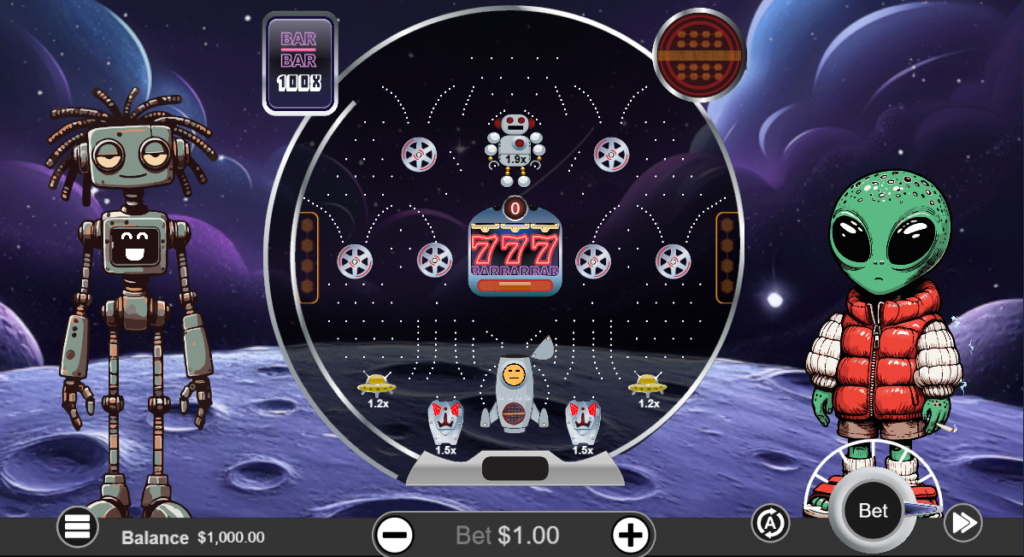
Pachinko Planet is a single-launch ball-drop game in which a player sets a stake, fires one ball into a vertical, space-themed peg field, and is paid a multiplier based on which payout cup the ball settles in. The round resolves in seconds. There are no spinning reels, no qualifying phases, no live host, and no cashout decision to make once the ball is launched — the multiplier is determined the instant the round begins, and the falling animation is the cosmetic delivery of that result.
Mirror Image Gaming positions Pachinko Planet inside what Stake has trademarked as the “burst games” category — fast, clip-friendly, single-event mini-games that sit between traditional slots and crash titles like Aviator. Mirror Image is one of a small group of indie studios that have built titles on the Stake Engine, the in-house remote gaming server (RGS) Stake opened to third-party developers in April 2025. The game is closely related to Mirror Image’s own Tiki Pachinko (released the same month, with a higher 3,000x max win) and conceptually adjacent to Stake’s own Plinko, BGaming’s pachinko-style titles, and Pragmatic Play’s Plinko+.
Honest summary upfront: Pachinko Planet is a polished, visually distinctive 30-second-per-round burst game with a 96% RTP, a 1,000x ceiling, no auto-cashout, no skill component, and a fairness architecture that — although competently engineered — is not the per-round verifiable model that informed crypto-casino players associate with the Stake brand. It is built for the player who wants a quick, clip-worthy bounce, not for the player who wants the lowest house edge or the deepest provable fairness. The verdict gets fuller treatment at the end of this review; that summary is the headline.
A 96% return-to-player figure means that, across the lifetime of the game’s pre-generated outcome distribution — which Stake Engine fixes during development and audits before launch — Pachinko Planet pays back 96 cents per dollar wagered on average. The remaining 4 cents per dollar is the house edge. Crucially, RTP is a long-run statistical average, not a session promise. Over 50 rounds, you might be up 40x or down to zero. Over 50,000 rounds, your actual return will converge on 96%.
A burst game like Pachinko Planet resolves in roughly 4–6 seconds per round including the ball-drop animation. Assuming a player who is engaged but not aggressively spamming, around 600 rounds per hour is realistic. A turbo-leaning session can push closer to 900–1,000.
Using the formula expected loss per hour = house edge × bets per hour × stake, at 600 rounds/hour:
At the higher 1,000-rounds-per-hour cadence those figures rise to €8, €40 and €200 respectively.
For perspective: a player who fires Pachinko Planet at €1 per ball for a one-hour session should plan around the assumption that, on a typical run, they will be down approximately €24 — but variance can push the actual outcome to anywhere between a triple-figure loss and a multi-hundred-euro win on a single fortunate cup landing. The 4% edge is the long-run cost of admission.
The advertised 1,000x ceiling is the largest single-round payout the game’s outcome distribution permits. Because Stake Engine games are pre-simulated, the probability of that outcome is fixed and known to the developer — but neither Mirror Image Gaming nor Stake have published the bust-probability curve or per-cup hit frequency for Pachinko Planet. The published Stake Plinko comparison gives a useful anchor: on Stake’s own provably fair Plinko at 16 rows / high risk, the centre 1,000x cup carries roughly a 1-in-65,536 chance of being hit, per the binomial distribution of independent peg deflections. Pachinko Planet is unlikely to be more generous on its top cup, given the 4% edge has to come from somewhere.
Medium-high volatility means the game is built to deliver long stretches of small or sub-1x cup landings between occasional triple-digit-multiplier hits. For a player budgeting in 30-minute sessions, the realistic experience is closer to “slow bleed punctuated by the occasional surprise” than “steady drip of small wins”. The visual pacing is engineered to make the slow-bleed phases feel kinetic — which matters more for emotional bankroll management than the math suggests.
This is the part of Pachinko Planet’s story that virtually no other review covers honestly, because it requires understanding the difference between two technically distinct fairness models that often get lumped together under the word “fair”.
Stake.com runs two parallel game architectures. Its in-house Stake Originals — Plinko, Crash, Dice, Mines, Limbo and friends — use the classic provably fair commitment scheme: the server publishes a hashed server seed before each round, the player can adjust their client seed, a per-round nonce increments, and the result is computed via HMAC-SHA256. After the round the player can rotate the seed and verify, mathematically, that the outcome was committed to before they bet. This is the model that built Stake’s reputation.
Stake Engine — the third-party RGS that Stake opened to outside studios in April 2025 and that Pachinko Planet runs on — is a different model. According to the documented platform architecture, Stake Engine games are built around pre-generated outcome distributions: every possible game result is generated in advance during development, stored as a static math file with weighted probabilities, and the RGS selects an outcome at the moment of the bet using a weighted lookup. This is deterministic, the math is known to Stake before the game goes live, and the long-run RTP is locked in by design — but the player cannot independently verify any individual round the way they can on Stake Plinko.
For Pachinko Planet specifically, this means: the cup the ball “lands in” is decided at the moment you press launch. The bouncing animation that follows is a visual rendering of that pre-decided result, not a live physics simulation that the result is read off. There is no published verifier tool that lets a player input seeds and recompute their own ball path.
It does not mean the game is rigged. The Stake Engine model is mathematically equivalent in long-run RTP to a live RNG pull and is genuinely audit-friendly at the math-file level. It is the same broad approach Pragmatic Play uses for Spaceman and Evolution uses for Cash or Crash — fair, but trust-the-platform rather than verify-it-yourself.
What it does mean is that the strongest fairness claim a Stake-brand player typically associates with Stake Originals — “you can verify every single round yourself” — does not apply to Pachinko Planet. A reader who chose Pachinko Planet because they thought it carried Stake’s full provably fair guarantee should know they are getting the platform-trust fairness model, not the cryptographic-verification one.
No public third-party RNG certification or independent fairness audit was located for Pachinko Planet specifically, or for Mirror Image Gaming as a studio, in research conducted for this review. This is not unusual for a recently launched game from an indie studio distributing through a third-party RGS — the audit chain typically sits with the operator and the RGS, not the individual studio — but the absence is worth flagging because it cannot be cited.
A Stake forum thread from September 2025 discussing a different Stake Engine title (Crazy Cards by GG Enterprises, also a Stake Engine game) records a player who disputed a payout, waited approximately two weeks for review, and reported being told by Stake support that the game’s visual animations are essentially decorative — the actual result is what the math file says. This is the architecturally honest answer for a pre-generated-outcomes RGS. It is also the answer most players do not expect from a casino brand built on per-round verification, and it is worth knowing before depositing.
Fairness verdict for Pachinko Planet: acceptable at the platform-trust level, unverified at the individual-round level. Trusted if you trust Stake and the Stake Engine architecture as institutions; not provably fair in the cryptographic sense if that is what you came for.
A player sets a stake (Stake.com’s pachinko-category bet ranges typically run from sub-€0.10 to a per-game cap of around €1,000, though Pachinko Planet’s specific upper limit is set by the operator). The player presses launch. A single ball is fired into a space-themed vertical board and travels through a field of bumpers and pegs styled as gravity fields and orbital obstacles. The ball settles into one of a series of payout cups at the base, each labelled with a multiplier — the lowest losing the stake, the highest topping out at 1,000×. The round closes, the next can begin immediately.
There is no sequence of decisions to make once the ball is launched. There is no skill input. There is no risk-level toggle in the way Stake Plinko offers low/medium/high risk presets — Pachinko Planet ships with one fixed payout distribution.
Players migrating from crash games like Aviator may look for an auto-cashout setting and not find one. This is not an oversight; it is a platform constraint. Stake Engine’s published platform rules prohibit early cashout, gamble mechanics, and progression features — every game must be stateless, with each bet independent of every previous outcome. Pachinko Planet therefore could not include an auto-cashout slider even if the studio wanted one. This same constraint is why no Stake Engine title has a Bustabit-style cash-out lever.
Pachinko Planet’s Stake.com lobby presents three live tabs alongside the game itself — Big Wins, Lucky Wins, and Challenges. These display recent high-multiplier hits across all players globally, the largest hits relative to bet size, and time-limited Stake-promoted challenges (such as “land a 100x+ on Pachinko Planet for a share of a prize pool”). This is the metagame layer most reviews ignore: the game is not just designed to be played, it is designed to be watched and shared, with the leaderboards and Stake’s own promotional structure pulling the player back in. Mirror Image Gaming explicitly builds for this — their published studio brief talks about content that is “designed around the share-worthy moment” and “engineered virality”.
Pachinko Planet does not have free spins, bonus buys, or bonus rounds in the slot sense. There is no equivalent to Drop the Boss’s Chaos Mode buy or Crazy Pachinko’s Top-Up phase. The single-round payout structure is the entire feature set. For a player accustomed to feature-rich slots, this minimalism reads as either elegant simplicity or thin content depending on temperament.
Two genuinely distinctive elements stand out. First, the studio’s “burst game” framing — single-event, clip-length, character-driven mini-games — is a category Mirror Image Gaming is credited as having pioneered, and Pachinko Planet executes it with more visual personality than the comparatively sober Stake Originals Plinko. Second, the game is mechanically engineered for the streaming and short-video audience in a way the older generation of casino games is not — the round length, the visual peak moment, and the payout reveal are all framed for screen-record. Neither of these is a mathematical edge for the player. Both are real differentiators of design intent.
A Stake community forum thread from November 2025 titled “Is it just me or Stake Engine games are just trash?” is direct: the original poster argues that the Stake Engine titles have “an obvious repeating script”, that the player can predict whether a round will win or lose by watching the on-screen stats panel, and that this kills the suspense the games depend on. This is one player’s opinion, but it is consistent with the architecture — pre-generated outcomes selected at bet-placement do, by definition, mean that the result exists before the animation plays. Whether that is “fair” depends entirely on which fairness model the player thinks they are buying into.
A separate September 2025 Stake forum thread documents a player who disputed a payout on a Stake Engine title (Crazy Cards by GG Enterprises) and reports a roughly two-week resolution timeline ending with Stake support describing the animation layer as visual entertainment rather than the source of truth on the result. This is procedurally consistent with how a pre-generated-outcomes RGS works, but it surfaces a community insight worth recording: the dispute path on Stake Engine games leans on the math file as the authoritative record, not on what the player believes they saw on screen.
Stake-affiliated streamers and clip channels promote burst games — including the Mirror Image catalogue — as part of Stake’s broader content push. Independent, non-affiliated streamer commentary on Pachinko Planet specifically is thin to date, partly because the game launched in October 2025 and is still in its early commercial life, partly because streamer attention in the burst-game category has concentrated on titles with higher max-multiplier ceilings (Drop the Boss at 5,000x, Brick Breaker at 16,200x).
Public-facing review aggregators (Trustpilot, Sitejabber) rate Stake.com itself in the 1.3–1.6-star range across thousands of reviews, with the most common complaints being withdrawal delays, account closures and customer-support responsiveness rather than game-fairness specifically. These criticisms are about the operator, not Pachinko Planet, but they are part of the trust environment a player enters when depositing to play it.
The most important comparison for any Pachinko Planet player to internalise. Both games sit on the same lobby, both let a ball drop through pegs to a multiplier cup, both cap at 1,000x.
A player who plays both at €1 per round for an hour at 600 rounds/hour gives up roughly €24 to Pachinko Planet versus roughly €6 to Stake Plinko. Stake Plinko is, on every objective metric, the better-value pachinko-mechanic game on the same platform. Pachinko Planet wins on visual personality and the burst-game share-clip feel; it loses on every number that matters to bankroll.
The genre baseline. Aviator is a true crash game (cashout-when-you-want before the plane flies away), not a single-round drop-and-pray pachinko. The mechanics are different enough that it is not really a like-for-like, but for a player choosing between them as their fast-mini-game habit:
Aviator is the better game for a player who wants per-round verifiability, an active timing decision, or the lottery-ticket appeal of a theoretically uncapped multiplier. Pachinko Planet is the better game for a player who finds Aviator’s cash-out anxiety stressful and prefers a passive launch-and-watch loop.
Mirror Image Gaming’s other October 2025 pachinko release. Same studio, same RGS, same Medium-High volatility band, near-identical 3.99% house edge — but Tiki Pachinko caps at roughly 3,000x rather than 1,000x. For a player who specifically wants the burst-game pachinko aesthetic and is choosing between the two MIG titles, Tiki Pachinko offers a higher ceiling at almost identical cost. Pachinko Planet is the choice if the space theme is more compelling than the Hawaiian one.
Pachinko Planet sits in the burst-game pachinko subcategory as a competently built, visually polished but mathematically unremarkable title. It is not the leader of the category, even within its own studio’s catalogue. Its most honest description is: a solid second-tier choice for players already committed to the burst-game aesthetic.
The single most important thing for a prospective player to understand: Pachinko Planet looks like a Stake game and sits in a Stake lobby, but it does not use Stake’s own provably fair system. A player who depositing because they trust Stake’s fairness reputation should know they are getting the platform-trust version, not the per-round-verification version they get on Plinko or Crash. This is not hidden, but it is not foregrounded by the game lobby either.
The same Stake lobby offers Plinko at 1% house edge with the same 1,000x ceiling. A player choosing Pachinko Planet over Plinko is, in effect, paying a 3-percentage-point premium for visual and thematic preference. Whether that is worth it is a personal call. The math is unambiguous.
Although Mirror Image Gaming lists multiple aggregators as distribution partners, the headline operator and the dominant traffic source for Pachinko Planet is Stake. Stake exited the UK market on 11 March 2025 following UKGC enforcement action against its white-label partner TGP Europe. Pachinko Planet released in October 2025 — after this exit — and has therefore never been legally available to UK players via Stake.com. UK players who can reach the game via VPN are doing so outside the regulatory perimeter and forfeit the consumer protections of a UKGC licence.
No independent third-party RNG audit specific to Pachinko Planet or to Mirror Image Gaming as a studio was located in research. Stake operates under the licensing of its various jurisdictions and its broader certification chain, but there is no certificate to point to that says “this specific game has been independently audited”. For most players this will be acceptable; for risk-averse players it is information worth having.
Mirror Image Gaming’s own materials describe themselves as a Fortune Engine studio and credit The Fortune Engine as their “strategic technical partner in Burst Game mechanics” who maintains “the mechanics and game-math databases that sit under every Burst Game we ship”. This is normal in modern indie iGaming and is not a red flag in itself, but it does mean that the entity the player sees branded on the game (Mirror Image Gaming) is the creative and visual layer, while the actual math and probability distributions are the work of a different company. Players who care about provenance should know which entity owns which part of the stack.
Burst games on Stake.com are categorised as eligible for the platform’s rakeback and challenge promotions. Stake.com does not run a traditional welcome-bonus-with-wagering-requirements model, so the question of “what percentage does this game contribute to wagering?” applies less than it does at conventional online casinos. At third-party operators that distribute Stake Engine games via aggregators, contribution rates will vary by site and should be checked in the bonus terms before play.
You are a casual burst-game player who already enjoys the pachinko/plinko ball-drop aesthetic, who session-budgets in the €5–€30 range, who plays for the visual hit of a satisfying cup landing rather than for the lowest possible house edge, and who is comfortable with platform-level fairness rather than per-round cryptographic verification. Pachinko Planet is well-suited to short, low-stakes sessions where you want a game that resolves fast, looks distinctive, and doesn’t demand decision-making.
You want the same pachinko-style ball-drop experience at the lowest possible cost — instead try Stake Plinko, which sits in the same lobby, offers the same 1,000x ceiling, and runs at a 1% house edge with full per-round provable fairness. Or, if you want a higher ceiling within Mirror Image’s own catalogue, try Tiki Pachinko (3,000x) at a near-identical edge.
You are a value-focused player who tracks RTP across titles — the 4% house edge will work against you faster than it would on Plinko (1%), Aviator (3%), or any of the higher-RTP burst options. The same applies if per-round verifiable fairness is non-negotiable for you: Pachinko Planet’s deterministic-lookup fairness model is fine but it is not what you came for.
You have never played a single-launch pachinko-mechanic game before. Use the free demo on Stake.com to test what 50 ball drops feel like before committing real currency. Pay particular attention to the ratio of sub-1x cup landings to wins — that ratio is what the medium-high volatility classification translates to in practice, and it is the single most useful piece of information the demo gives you about whether this game suits your temperament.
Burst games like Pachinko Planet compress session time more aggressively than traditional slot play. Where a slot might run 400–600 spins per hour, a burst game can clear 600–1,000 rounds per hour — and the faster the rounds, the more bankroll passes through the house edge per hour. This compression is the single largest behavioural risk specific to the burst-game category, and it is worth naming explicitly: the game is engineered to feel quick and clip-friendly, and that pace is also what accelerates spending velocity.
Practical tools that genuinely help:
A note on local legality: online casino games including pachinko-style burst titles are legal in some jurisdictions and not others. Online casino is, for example, illegal under French law — the only legal online gambling categories in France are sports betting, horse racing and poker, all under ANJ licence. UK players have not had legal access to Stake.com since March 2025. Check the legal status of online casino in your jurisdiction before depositing — this is informational content, not a recommendation to play in markets where it is unlawful.
If gambling is causing you or someone you know harm, support is available worldwide. The international resource directory at GamCare (gamcare.org.uk) and Gambling Therapy (gamblingtherapy.org) operate free, confidential help in multiple languages. Most regulated markets also operate national helplines and self-exclusion registers — search for the body in your jurisdiction.
Pachinko Planet is a competently built, visually distinctive burst-game pachinko title that does what it sets out to do: deliver a fast, share-friendly, single-launch ball-drop experience with the visual polish of an indie studio that genuinely understands modern audiences. The strongest reason to play it is the design execution — Mirror Image Gaming has built one of the better-looking entries in the burst-game category and the metagame layer of Big Wins, Lucky Wins and Challenges does what it is designed to do.
The biggest reason to be cautious is the 4% house edge — high for the category, and especially conspicuous given it sits in the same lobby as Stake Plinko at 1% house edge with an identical 1,000x ceiling. Players who know to compare on RTP will struggle to justify the choice on math alone. Combined with the fairness-architecture distinction (deterministic lookup, not per-round verifiable), Pachinko Planet is best understood as a design-first, math-second proposition.
This game is right for the player who has decided that the burst-game aesthetic is worth a small premium over the leanest available alternatives — and who values pace and visual personality above the lowest possible cost of admission. It is wrong for the player who walked into the Stake lobby expecting Stake Originals’ fairness model and pricing.
Recommended for the right audience, with caveats. Not recommended as a default pachinko choice when Stake Plinko is one click away.
The most surprising thing surfaced in research for this review: the math file is the source of truth, and the falling ball is, in the words a Stake support agent used in a documented payout dispute on a sister Stake Engine title, “visual entertainment”. For a player who thought the bouncing was the result, that is a meaningful piece of architectural honesty to know about.
The RTP of Pachinko Planet is 96%, confirmed on both Mirror Image Gaming’s official catalogue and Stake.com’s game lobby. The corresponding house edge is 4.00%.
achinko Planet is not provably fair in the per-round verifiable sense that Stake Originals like Plinko and Crash are. It runs on Stake Engine’s pre-generated outcomes architecture — outcomes are determined by a deterministic weighted-lookup math file, fixed in advance and audit-friendly at the platform level, but not independently verifiable by the player on a round-by-round basis.
The highest possible single-round payout on Pachinko Planet is 1,000× the player’s bet, per Stake.com’s pachinko category page. Mirror Image Gaming’s sister title Tiki Pachinko caps at roughly 3,000×.
Pachinko Planet has a 96% RTP and a 1,000× max multiplier; Aviator runs at 97% RTP with a theoretical 1,000,000× ceiling and full per-round provable fairness via SHA-256 hashing. Aviator gives the player a cash-out timing decision; Pachinko Planet does not. They are different mechanics rather than direct competitors.
Yes — Stake.com offers a free demo mode for Pachinko Planet, advertised on the game’s lobby page. Mirror Image Gaming also lists the title under their “free to play demo mode” catalogue.
The house edge on Pachinko Planet is 4.00%, displayed directly on the Stake.com game lobby. This is four times the 1% house edge of Stake’s own Plinko, which sits in the same category with the same 1,000× max win.
No credible evidence has been surfaced that Pachinko Planet is rigged. It runs on Stake Engine’s pre-generated outcomes RGS architecture, which is deterministic, mathematically equivalent in long-run RTP to a live RNG pull, and audit-friendly at the math-file level. It is not, however, provably fair in the per-round cryptographic verification sense that crypto-casino players often associate with the Stake brand — and players who confuse the two fairness models may feel misled even when the underlying game is operating exactly as designed. The honest framing: not rigged, but not the verification model some players assume.
No, not legally via Stake.com. Stake exited the UK market on 11 March 2025 following UKGC enforcement action. Pachinko Planet released in October 2025 — after this exit — and has therefore never been available to UK players via the platform under licence.