Author Spencer Thorne
May 5, 2026

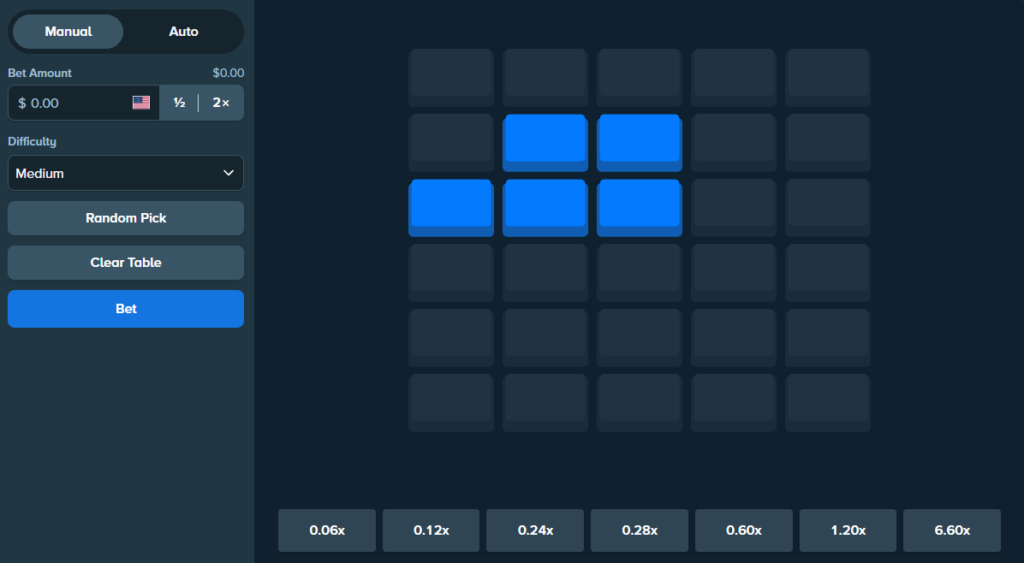
Bars is a pick-and-reveal minigame on a 5×6 grid where the player chooses between one and five of the thirty bars, locks them in, and clicks Bet — every bar then flips at once and the player’s payout is the sum of the multipliers under their chosen bars, multiplied by their stake. There is no live decision after the bet is placed; once the bars are selected, the result is fully determined by the round’s seed. A round can be completed in two clicks, which is the entire point of the game.
The minigame sits inside Stake’s Originals catalogue — the in-house collection that includes Crash, Mines, Plinko, Dice, Limbo, Diamonds, Dragon Tower, Pump and others. Bars is not a crash game in the strict sense; it has no rising multiplier, no cashout decision, and no real-time risk progression. It belongs to the same lineage as Stake Diamonds and Stake Cases — instant-result, RNG-driven minigames inspired loosely by scratchcard and pull-tab mechanics. The developer has positioned it as a fast, low-friction option for sessions that don’t justify the longer round structure of Crash or Mines.
The honest summary upfront: Bars is a perfectly competent low-ceiling minigame, but it sits awkwardly inside Stake’s own catalogue. Its 2.00% house edge is double the 1.00% edge on Stake’s flagship Originals (Mines, Crash, Plinko, Limbo, Dice), and its 3,000x maximum is the smallest ceiling of any Stake Original aside from Diamonds. Players who choose Bars over Mines or Crash are accepting a worse mathematical deal in exchange for simpler gameplay — that trade-off may or may not be worth it depending on what the player actually wants from a session.
Stake publishes a 98.00% return-to-player figure for Bars on both Stake.com and Stake.us. RTP is a long-run expected value: across millions of rounds, the game returns approximately 98 units of value for every 100 wagered, with the remaining 2 units retained by the operator. Critically, this average is not what any individual player will experience over a short session. A player on Expert difficulty selecting one bar may go many rounds without any return, then hit a single multi-hundred-x payout that pulls the session back toward the long-run average.
The house edge is 2.00%. This matters because it is precisely double the 1.00% edge on the games that Stake itself promotes as its mathematical headline acts. Mines (99.00% RTP), Crash (99.00%), Plinko (99.00%), Limbo (99.00%) and Dice (99.00%) all sit at a 1% edge. Bars sits with Flip (98%) and is closer to Diamonds (98.29%) — the lower-edge corner of the catalogue.
Expected loss per hour calculation. Assume an average round speed of 600 rounds per hour (the game is genuinely fast — a manual round takes around 4–6 seconds; auto mode is faster). A round speed range of 300–900 per hour is realistic depending on whether the player is using auto play or manual selection. Using the formula:
Expected loss per hour = house edge × bets per hour × stake size
At three stake levels, with 600 rounds per hour and a 2.00% house edge:
By comparison, the same bankroll on Mines or Crash would have an expected loss exactly half as large — $60 per hour at $10 stakes instead of $120. Over a long enough sample, this difference compounds significantly. A player wagering $10 per round for 100 hours on Bars would, on expectation, lose $12,000; on Mines, $6,000.
Volatility distorts the actual session experience. On Easy mode with one bar selected, multipliers reportedly range from 0.04x to 9x. On Easy mode with five bars selected, the multiplier range narrows to roughly 0.08x to 1.8x — wins are smaller but more frequent. On Expert with one bar, the upper bound climbs to 3,000x but the typical round produces no return at all. The same 98% RTP holds across every difficulty and bar-count combination, but the variance characteristic differs sharply: low difficulty plus more bars gives a slot-like trickle of small wins; high difficulty plus one bar gives long droughts punctuated by rare large hits.
Statistically, hitting the 3,000x ceiling is extraordinarily rare. Stake has not published the precise probability for Bars’s max multiplier, but a useful frame of reference: on Stake Mines with the maximum 5,148,297x multiplier (24 mines, 1 reveal), the probability is 1/25 — about 4%, scaled down by configuration constraints. Bars’s max sits at a much lower 3,000x, but it requires hitting one specific multiplier on one selected bar with thirty possible outcomes weighted toward smaller values. The practical implication is that a max-win event on Expert/1-bar should be considered a once-in-a-very-long-session event, not a target.
Bars is provably fair — but provably fair in the specific, technical sense that Stake has used for its Originals since the Primedice era, not in a sense that has been independently audited by a named third party.
The mechanism, per Stake’s own provable fairness documentation, works like this: a round of Bars generates 30 random floats between 0.0 and 1.0, derived from the combination of the server seed (committed in advance via its hash), the client seed (which the player can change), and the nonce (which increments per bet). Each float is mapped against a published payout table to determine which multiplier sits behind each of the 30 grid positions. The payout table itself is visible at the footer of the Bars game page and on the provable fairness verification page. After the round, the player can rotate their server seed, which causes Stake to publish the previously committed seed; the player then independently verifies that the previously hashed seed matches the revealed seed and that the 30 floats produced by the seed combination map to the multipliers they actually saw on screen.
In practice, very few players run this verification. The ones who do are typically forum users on Stake’s own community boards and on Bitcointalk who use third-party verification scripts. The mechanism is genuine: the cryptographic commitment-and-reveal model that underpins it is mathematically sound, and the same architecture has been independently re-verified for years on Stake’s older Originals (notably Dice, where the mechanism originated as Primedice in 2013).
What is not present, and what readers should be aware of, is a published third-party RNG audit specific to Bars. Stake Originals are not visibly certified by eCOGRA, GLI, iTech Labs, BMM Testlabs or any other named test house in publicly available documentation. The Curaçao licence under the new LOK framework requires RNG certification for B2C operators, and Stake’s parent company Medium Rare N.V. operates under that licence, but the certifying body and the certification scope for Stake Originals specifically has not been published in a form players can verify themselves. Stake’s argument has historically been that provably fair architecture makes traditional third-party RNG certification redundant. That argument has logical weight — if every round can be cryptographically verified by the player, a periodic test-house audit adds limited additional information. It does, however, leave players relying entirely on Stake’s own implementation and on community auditing rather than on an independent regulated entity.
A more material fairness concern arrived in early 2026. Bloomberg Businessweek published a feature analysing roughly 1,500 hours of Stake gameplay streamed on Kick, focusing on “big wins” defined as payouts of 1,000x or more. The investigation found that Drake and Adin Ross — both heavily promoted Stake influencers — hit big wins on games owned by Stake’s parent Easygo Entertainment approximately four times more often than the rate calculated across the broader sample of streamers. Stake responded that the methodology was “categorically incorrect” and that the report “ignores how game mathematics works,” but the company declined to provide its internal payout data to refute the statistical pattern. Trainwreckstv has separately acknowledged that influencer “fill deals” exist, in which the casino provides streaming bankroll directly. The Bloomberg analysis focused on slots rather than Bars specifically, and there is no evidence that Bars or any individual Originals title has been manipulated. The relevant takeaway for a Bars player is more general: when a casino owns the games, the streaming platform (Kick), and the influencer contracts, the trust model for that ecosystem deserves scrutiny — provably fair architecture answers the question of whether individual rounds were tampered with after a bet was placed; it does not answer the question of whether the broader marketing and reward architecture creates a misleading impression of typical outcomes.
Fairness verdict: technically trustable at the per-round level via provably fair mechanics; structurally unaudited by a named third party; situated within an operator that is currently under the most concentrated public scrutiny of any crypto casino. Players should treat Bars’s mathematical fairness as credible while not treating Stake’s broader marketing as a reliable signal of expected outcomes.
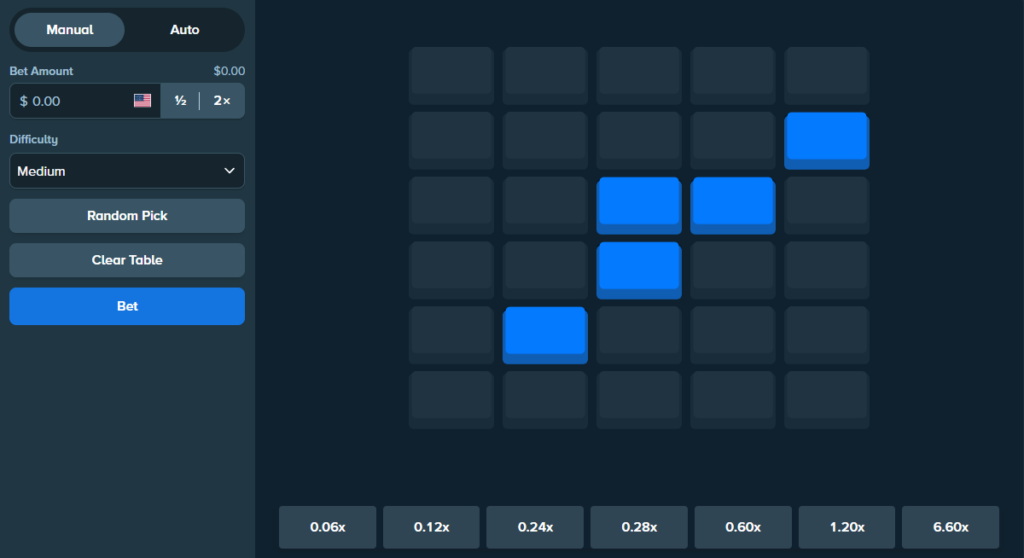
The player sets a stake, picks a difficulty level, and selects between one and five bars from the 5×6 grid — either by clicking individual bars manually or by hitting Random Pick to let the client choose. The selected bars change colour by difficulty: light blue on Easy, darker blue on Medium, green on Hard, gold on Expert. Clicking Bet flips every bar on the grid simultaneously, revealing the multiplier behind each. The payout is the sum of the multipliers under the player’s chosen bars, multiplied by the stake. Bars stay locked in place between rounds until the player either changes the selection or clicks Clear Table — meaning a session of repeated bets on the same selection requires only the Bet click each time.
Crucially, there is no in-round decision. The seed determines every multiplier on the grid before the bet is placed; the player’s only inputs are stake size, difficulty, and selection. This puts Bars closer to a slot spin than to Mines, where the player makes a sequence of cashout decisions during the round.
Stake provides four difficulty levels which adjust the volatility profile while keeping the 98% RTP constant. Lower difficulties produce a tighter band of mostly small multipliers; higher difficulties produce a wider band with longer dry runs and rarer large hits. On Easy with one bar, reported multiplier ranges run from 0.04x to 9x; on Easy with five bars, the range narrows to 0.08x to 1.8x, since the total expected payout is spread across more selections. On Expert with one bar selected, the multiplier ceiling reaches the headline 3,000x figure — the only configuration in which the maximum can be hit.
Selecting more bars does not reduce the stake per bar — the wager is fixed for the round. What it does is dilute the multiplier ceiling and concentrate the payout structure around smaller, more frequent values. A five-bar Easy round will more often produce a small positive return; a one-bar Expert round will more often produce zero. This is functionally identical to the volatility slider on Plinko or the mines-count selection on Mines — different routes through the same RTP.
Auto mode runs a configured number of rounds with stake, difficulty, bar count and stop-on-loss / stop-on-profit limits pre-set. Combined with Random Pick, this allows the player to run hundreds of rounds with no further input. The auto-mode parameters do allow stake adjustments after wins or losses (a built-in framework for Martingale or anti-Martingale loops), but these increase variance without affecting RTP. Importantly, the absence of any in-round skill decision means that auto mode is functionally equivalent to manual play in expected value — unlike on Mines, where auto mode replaces the cashout decision and meaningfully changes results.
Bars has none. There are no free rounds, no progressive multipliers, no scatter mechanics, no level-up systems and no metagame progression. The session is what the player makes of the four levers: stake, difficulty, bar count, manual or auto. This is consistent with the rest of Stake’s Originals minimalism, but it is worth stating because it sets Bars apart from third-party “crash” titles like Aviator, which include in-round leaderboards, free-bet promotions and rain bonuses to retain players socially.
The most striking fact about Bars in player communities is how little dedicated discussion exists. On Reddit, Bitcointalk and Stake’s own community forum, Mines, Crash and Plinko dominate Originals threads — Bars is mentioned in passing as a newer, simpler game but rarely as a primary subject of strategy posts or session reports. This is itself a data point: Bars launched in July 2025 and has not built the dedicated community footprint of Stake’s older minigames.
Where Bars is discussed, the recurring observations are consistent. Players note that the game is genuinely fast — sessions feel compressed, with auto mode pushing round velocity higher than most other Originals. Several Stake forum posts describe Easy-mode-with-three-bars as the most comfortable middle setting, returning frequent enough small multipliers to sustain bankrolls without producing the dry-run frustration of Expert-mode-one-bar. The Random Pick option is mentioned approvingly as a way to remove the small but real cognitive load of choosing tiles each round, which players who run long auto-mode sessions appreciate.
Recurring complaints fall into two categories. The first is generic high-volatility frustration: players who sit on Expert and wonder why the wins are not coming, which is expected behaviour from a high-variance configuration with 98% RTP and no skill input. The second is more substantive: a number of forum posts question why Bars carries a 2% house edge when it sits inside a catalogue where 1% is the headline standard. There is no clear public answer to this from the developer, and it does represent a meaningful trust signal — the game is mathematically less generous than its sibling Originals without an obvious gameplay reason for the gap.
Streamer reception has been muted. Bars has not generated the headline highlight clips that Mines, Crash and Limbo regularly produce — the 3,000x ceiling is too low to produce the seven-figure payout moments that drive viral clip distribution. Major Stake-affiliated streamers (Trainwreckstv, Adin Ross, Roshtein, Drake, xQc) have streamed it occasionally but have not adopted it as a regular session game in the way they have with Mines or Limbo. This is mostly a business observation: Bars does not produce content that converts on Kick, so it does not get featured.
The broader Stake fairness debate from the Bloomberg Businessweek investigation has bled into community sentiment around all Originals, including Bars. Stake’s Trustpilot footprint runs at roughly 1.3 stars across thousands of reviews, dominated by complaints about withdrawals, customer service responsiveness and accusations of game rigging. Most of these complaints are not specific to Bars — they reflect general crypto-casino complaint patterns that are present at most operators in this segment — but the volume is worth noting because it represents the modal community experience of Stake’s customer service rather than its games.
Mines is the most direct internal comparison. Both are 5×5 or 5×6 pick-style games, both have multiple risk settings, both run on Stake Originals provably fair architecture. Mines has a 99% RTP versus Bars’s 98% — a flat doubling of expected loss on Bars over a long session. Mines’s max multiplier reaches 5,148,297x; Bars caps at 3,000x. The fundamental design difference is that Mines requires an active cashout decision during the round, which means the player’s choices can meaningfully influence the actual win-rate distribution within the RTP envelope. Bars has no such decision — the round outcome is fixed once the bet is placed. A player who likes minigames specifically because of the cashout tension should choose Mines; a player who finds that tension stressful and prefers a clean reveal should choose Bars.
The closest sibling. Diamonds is also a pick-and-reveal minigame with no in-round decision, with an RTP of 98.29% (1.71% house edge — slightly more generous than Bars) and a maximum multiplier of 50x. Both games occupy the same mechanical lane: simple, fast, no skill input, modest ceilings. Bars’s 3,000x ceiling is sixty times higher than Diamonds’s 50x, which makes Bars the better choice for a player who wants the same simplicity but with at least the theoretical chance of a meaningful single-round payout. Players choosing between the two are mostly choosing between aesthetic preferences — tile-flipping versus reel-style reveal.
Aviator is the original of the modern crash genre and the natural reference point for any new minigame. It has a 97% RTP (3% house edge — worse than Bars), a maximum payout of 1,000,000x, and a fundamentally different mechanic: a rising multiplier that the player must cash out before the plane crashes. Aviator is a skill-of-timing game; Bars is a no-decision reveal. Aviator carries social features (in-round chat, rain bonuses, leaderboards) that Bars does not. Players who want the genuine crash-game experience should play Aviator; players who want a Stake-exclusive simplified minigame with a tighter house edge should play Bars. The two are more competitors in the broader “casino minigame” category than direct mechanical equivalents.
Positioning verdict: Bars sits as a niche entry within Stake’s Originals catalogue — neither leading the field nor trailing it. It has no realistic competitive position outside Stake; it is a Stake-exclusive product that competes for time within the Stake lobby against superior games in the same studio. Within the Stake lobby, it loses on RTP to Mines and Crash, on max-win to almost everything, and on metagame depth to all the active-decision games. It wins on speed and simplicity — a real but narrow advantage.
The mathematical concern is the 2% house edge inside a catalogue where 1% is the published norm. Players who migrate to Bars from Mines or Crash without noticing this difference are doubling their long-run expected loss. This is not hidden — Stake publishes the figure on the game page — but it is not signposted in a way that draws attention. A reader who treats Stake Originals as a category with uniform mathematical generosity is making an incorrect assumption.
The provider-level concerns are worth stating plainly. Stake has experienced a sustained run of headline events: a $41 million cryptocurrency theft in September 2023 attributed to North Korea’s Lazarus Group; a UK regulatory caution that led Stake to withdraw from the UK market in early 2025; multiple class-action lawsuits in California and Missouri in 2025 over its sweepstakes operations; the Bloomberg Businessweek statistical investigation in early 2026 alleging disproportionate big-win rates for top streamers on Easygo-owned games; a Curaçao licence operating under a recently overhauled regulatory framework where many longstanding operators are still being reassessed under the new LOK regime. None of these specifically concern Bars’s mathematical fairness, but each materially affects what a player is signing up for at the operator level.
Stake has no published third-party RNG audit specific to its Originals. The provably fair architecture is technically sound and player-verifiable, but no external test house has signed off on the implementation in a form that the public can examine. This is a meaningful gap relative to traditional regulated operators.
Bonus contribution and exclusivity: Bars exists only on Stake.com (real-money) and Stake.us (sweepstakes). It does not contribute to wagering at any other casino because no other casino offers it. Stake does not run a traditional welcome bonus on the global platform; it operates a tiered VIP rakeback model where each game contributes proportionally to the wager total. Bars contributes at the standard rate within that system; players grinding for VIP rakeback should note that Bars contributes the same as any other bet but at a worse house edge than 1% Originals, so VIP returns require a larger absolute wager to break even versus Mines or Crash.
Stake is geo-restricted in many regulated markets including the United States (real-money — Stake.us operates only as a sweepstakes), the United Kingdom (since early 2025), Australia, France, the Netherlands, Spain, and Italy at the consumer level. Players accessing Stake from these jurisdictions via a VPN are violating the platform’s terms of service and may have winnings withheld during KYC. Players should check their local laws before depositing.
If no significant red flags applied, this section would say so. They do apply, and they apply at the operator level rather than to the game itself — Bars’s per-round mechanics are credible; the broader environment in which it operates is not free of legitimate concern.
Play this game if: the player wants the fastest, simplest minigame in the Stake lobby with no in-round decisions and is using small stakes — ideally under $1 per round — for short, low-investment sessions where the appeal is the click rhythm rather than the win ceiling. Bars rewards the player who wants to flip a tile, see a result, and move on within four seconds.
Consider an alternative if: the player wants a better RTP and a meaningful max-win ceiling — Stake Mines (99% RTP, 5,148,297x max) is the direct upgrade path within the same studio, with the trade-off being that Mines requires active cashout decisions during the round. Stake Crash (99% RTP, 1,000,000x max) is the right alternative for a player who specifically wants the cashout-before-crash mechanic that Bars does not offer.
Avoid this game if: the player is bankroll-sensitive and plans to session for sustained periods at higher stakes — the 2% house edge will compound against the player at twice the rate of Mines or Crash. A player wagering $10 per round for two hours nightly will, on expectation, lose roughly $4,200 per month on Bars versus $2,100 on Mines, before any volatility variance.
Play the demo first if: the player has never used a Stake Originals minigame. Stake.us offers free Gold Coin play of Bars without deposit. Use the demo specifically to test how the game feels at each of the four difficulty levels and at different bar-counts — find the variance profile that feels manageable before committing real currency. Pay attention to how often Easy-mode-three-bars produces a small positive result versus how often Expert-mode-one-bar produces a zero round; this is the trade-off the entire game is built around.
Stake Bars is a competently built minigame that plays exactly as advertised — fast, simple, RNG-driven, with adjustable variance via difficulty and bar-count selection. Within its narrow design brief it works. The honest verdict is that it is not the best Stake Original to play, because it carries a 2% house edge inside a catalogue where 1% is the standard, and a 3,000x ceiling inside a catalogue where six- and seven-figure ceilings are the standard. Players who choose Bars over Mines or Crash are paying a premium for simplicity and speed.
The single strongest reason to play it: if a player wants the mechanically simplest, fastest reveal-style minigame in any major crypto casino, Bars genuinely delivers. The single biggest reason to be cautious: the 2% house edge compounds materially over real session lengths, and the broader Stake ecosystem in 2026 is operating under more concentrated public scrutiny — including the Bloomberg Businessweek statistical investigation into Easygo-owned game outcomes for influencers — than at any prior point in its history. Players should accept Bars’s per-round mathematics on the basis of the provably fair mechanism, while reading the operator-level signals with appropriate skepticism.
Bars is right for the casual Stake user running short, low-stake sessions for entertainment rather than as a serious bankroll exercise. Recommended cautiously, with the standing note that better choices exist in the same lobby for almost every type of player.
The most interesting finding from this review: among Stake’s 25-plus Originals, Bars carries a 2% house edge — twice the 1% edge on the games Stake itself headlines (Mines, Crash, Plinko, Limbo, Dice). No competitor review of Bars currently makes this comparison. A player who treats the Stake Originals catalogue as mathematically uniform is making a measurable mistake.
Stake Bars has an RTP of 98.00%, with a 2.00% house edge. This is the figure published on the official Stake.com and Stake.us game pages. The RTP applies across all four difficulty levels and all bar-count configurations.
Yes. Each round generates 30 random floats between 0.0 and 1.0 derived from a server seed (committed in advance), the player’s client seed and a per-round nonce. The floats map to the published payout table. Players can rotate their server seed after a round and verify the result independently. There is no published third-party RNG audit specific to Bars.
The maximum multiplier is 3,000x your stake, available only on Expert difficulty with one bar selected. This is one of the lowest maximum-multiplier ceilings in Stake’s Originals catalogue — Mines reaches 5,148,297x, Limbo and Crash reach 1,000,000x.
Aviator (by Spribe) is a true crash game with a 97% RTP, 3% house edge, 1,000,000x maximum payout and a rising-multiplier-with-cashout mechanic. Stake Bars has a higher RTP (98%), a much lower max win (3,000x) and no cashout decision — the round outcome is determined entirely at bet placement. Aviator is the better game for players who want timing-based decisions; Bars is the better game for players who want a faster no-decision reveal.
Yes — Stake.us offers Bars as a free-play option using Gold Coins, with no deposit required. The free-play version uses the same provably fair mechanics as the real-money version on Stake.com but without redeemable winnings.
The house edge is 2.00%. This is double the 1.00% house edge on Stake’s headline Originals — Mines, Crash, Plinko, Limbo and Dice all run at 1%. Practical effect: the expected loss per dollar wagered on Bars is twice the expected loss per dollar on Mines or Crash, regardless of difficulty selection.
Stake Bars launched on 15 July 2025 as the newest Stake Originals title at the time of its release.