Author Spencer Thorne
May 19, 2026

| Detail | Info |
|---|---|
| Game name | The Last Quack |
| Developer / provider | Mancala Gaming |
| Game type | Arcade instant-win minigame |
| RTP | 95% |
| House edge | 5% |
| Volatility | Low |
| Max win | 220x stake (modeled over 1,000,000 rounds; SlotCatalog) |
| Min / max bet | £0.25 / £22.50 per round (20 bet levels) |
| Provably fair | No |
| Third-party audit | GLI certified (confirmed via SoftGamings partner documentation) |
| Mobile compatible | Yes — iOS and Android |
| Exclusive to one casino | No |
| Demo available | Yes — developer website and aggregator platforms |
| Release date | April 2023 |
| Bet levels | 20 |
| Key features | Multipliers (2x/8x/100x), Bonus Buy (10x stake), Retrigger, Blood Mode |
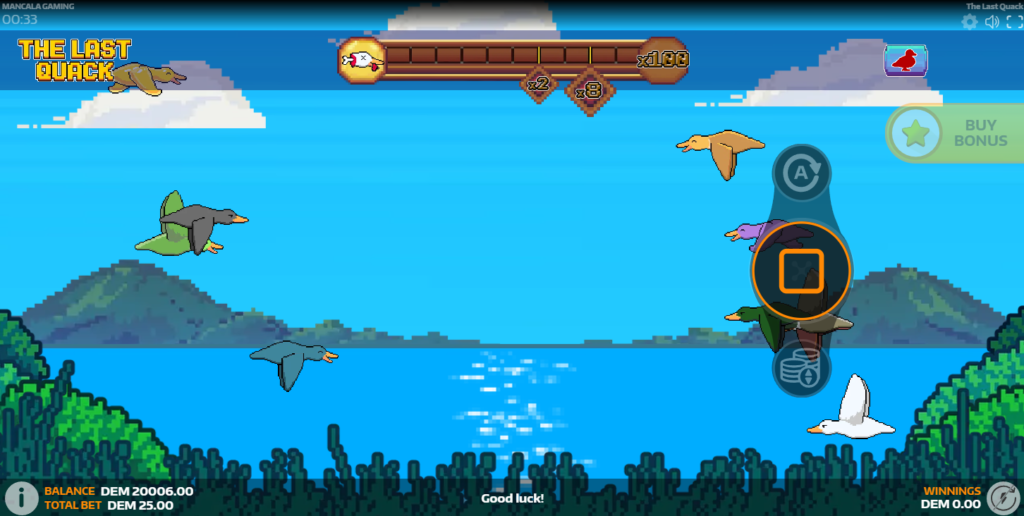
The Last Quack is an arcade-style instant-win casino game in which the player watches ten ducks fly across an 8-bit pixel screen each round, and the RNG determines which ones get shot. The player does not aim or fire — the shotgun is automated, the outcome is predetermined, and the visual shooting sequence is pure animation. Each duck carries a cash value and a hidden hit probability; the more ducks fall, the higher the total return, and hitting six, eight, or all ten applies a multiplier of 2x, 8x, or 100x respectively to the round’s total payout. If no duck falls, a Bonus Game of ten free rounds triggers automatically.
Mancala Gaming — a Prague-based studio founded in 2019 — built The Last Quack as a deliberate departure from their standard video slot catalogue. The obvious reference point is Duck Hunt, Nintendo’s 1984 light-gun arcade game that sold over 28 million copies. The pixel art, the lakeside scenery, the gunshot sound, the blood splatter toggle — all of it is a direct and transparent homage. This positions the game in a small but growing sub-segment of the casino market: arcade-inspired instant-win titles that target players who find traditional slot reels aesthetically dull. Mancala released the game in April 2023, and it earned Editor’s Pick recognition from aggregator NonStopBonus.com in May 2023 — the first significant third-party signal that the design direction had resonated.
The honest upfront verdict: The Last Quack is well-constructed for a specific player type — someone who wants frequent, small returns, a clear nostalgic hook, and entertainment value that extends beyond watching reels spin. For that player, it is a genuine standout in its niche. For players seeking volatility, large single-round multipliers, or provably fair verification via a blockchain hash mechanism, it delivers none of these things. The 220x maximum win is low by modern standards; the house edge is a standard but unremarkable 5%; and the inverse relationship between duck value and hit probability is a design choice that limits big-round frequency in the base game. The game does what it promises — it just promises less than many comparable titles.
The Last Quack carries a published RTP of 95%, confirmed on Mancala Gaming’s own game page and consistent across every aggregator listing reviewed. This means that for every 100 units wagered over a statistically significant sample, 95 units are returned. The house retains the remaining 5% — this is the house edge.
In practical terms: a player who bets £1 per round and plays 1,000 rounds has staked £1,000 and can expect to receive approximately £950 back. The specific sessions will vary dramatically — low volatility means most rounds will return something (ducks will fall), but individual swings are narrow. Players will not typically experience the session-ending losing streaks common in high-volatility games, but they will also not encounter the sudden doubling or tripling of a bankroll.
The expected loss per hour can be calculated precisely using the standard formula:
Expected loss per hour = House edge (%) × Rounds per hour × Stake per round
The Last Quack is fully automated — once a round starts, the shooting sequence completes in approximately 4–8 seconds in normal mode and faster in Turbo Mode. A conservative estimate of 60 rounds per hour in normal play is used below. In Turbo Mode, 120 rounds per hour is achievable, which doubles all figures.
| Stake per round | Rounds/hour | Wagered/hour | Expected loss/hour |
|---|---|---|---|
| £0.25 (minimum) | 60 | £15.00 | £0.75 |
| £2.00 (mid-range) | 60 | £120.00 | £6.00 |
| £22.50 (maximum) | 60 | £1,350.00 | £67.50 |
At Turbo Mode, all of the above expected loss figures double. A player at the maximum stake running Turbo Mode is wagering £2,700 per hour and losing an expected £135.
These are theoretical long-run figures. Over shorter sessions — the typical scenario — outcomes will deviate. But the direction of deviation does not change: the house edge compounds with every additional round. Players who use Turbo Mode to accelerate play are not increasing their chances of winning; they are compressing the time required to realise the full mathematical cost of the game.
The 220x maximum win figure was not derived from the game’s theoretical ceiling — it was modeled empirically across one million simulated rounds. This is a meaningful distinction. The theoretical maximum possible in a single round is 10 ducks × 0.40x (highest value, white duck) = 4x, multiplied by the 100x all-ten multiplier = a theoretical ceiling of 400x. The observed maximum across a million rounds was 220x, which suggests that hitting all ten white ducks simultaneously falls within the game’s math model but occurs with extreme rarity over practical play horizons. Players should treat 220x as the ceiling, not the expectation.
The Last Quack is not provably fair in the blockchain sense. There is no server seed, client seed, nonce, or hash function published that allows players to independently verify individual round outcomes before they occur. This mechanic — used by crypto-casino originals like Aviator by Spribe — is simply not part of Mancala Gaming’s technical architecture.
What Mancala Gaming does hold is a GLI certificate. Gaming Laboratories International (GLI) is one of the three most respected independent testing bodies in the regulated gambling industry, alongside eCOGRA and iTech Labs. A GLI certificate indicates that Mancala’s software was submitted to independent technical review, that the RNG was statistically validated, and that the published RTP figures were verified against the game’s math model. This is a meaningful credential — but it is not the same as player-verifiable randomness. Players cannot check their own rounds; they must trust that the GLI certification remains current and that the deployed version of the game matches the audited version.
Mancala Gaming also holds MGA (Malta Gaming Authority) and UKGC (UK Gambling Commission) licences. Both regulators require ongoing RNG compliance as a condition of licensing — meaning that the game’s fairness is subject to regulatory oversight, not solely reliant on a one-time certificate. No documented player complaints about outcome manipulation, withheld payouts, or disputed results were found across the community research conducted for this review.
One gap worth naming: Mancala Gaming does not publish the individual hit probability for each duck colour tier. The inverse relationship — higher value ducks hit less frequently — is confirmed by the developer’s own description (“each duck has a different value and hit chance”), but the specific probabilities are not disclosed. This limits a player’s ability to calculate the true per-round expected value from the duck mix alone.
Fairness verdict: Acceptable. The game operates under regulated licences with GLI certification, which represents a legitimate and industry-standard fairness credential. The absence of provably fair mechanics is a meaningful limitation for players who require player-verifiable randomness, but it does not indicate any documented unfairness.
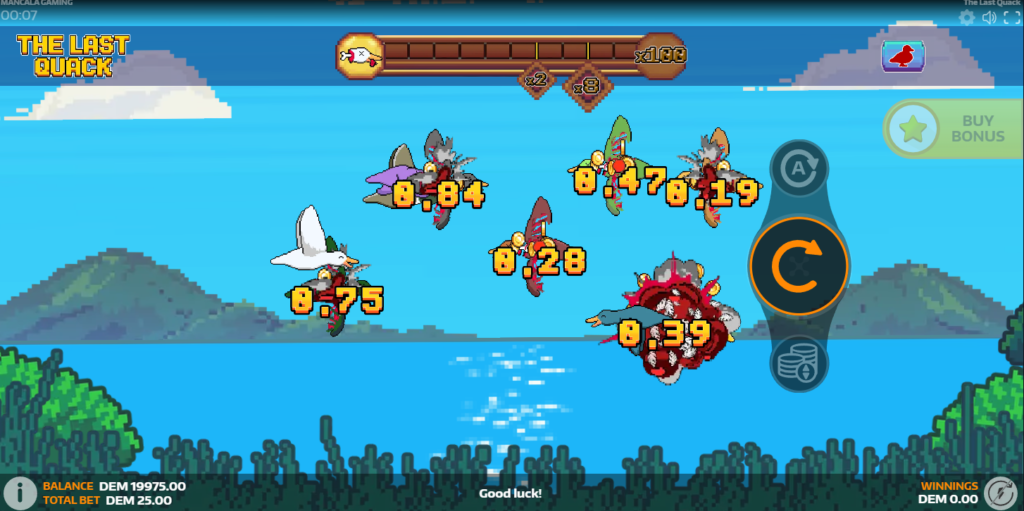
Each round begins when the player confirms their stake. Ten ducks fly across the screen in a pixelated lakeside environment. The RNG has already determined, before the animation begins, which ducks will fall and which will survive. As the sequence plays out, ducks tumble when “hit” and display their individual cash value. After all ten have passed, the round resolves.
If at least one duck falls, the player receives the sum of the individual duck values, modified by the multiplier tier if six or more were hit. If no duck falls, the Bonus Game triggers immediately — the player did not need to do anything to earn it.
Ducks fly in four colour tiers, each with a different payout value and a corresponding (lower) hit probability for higher values:
The precise probability of each tier appearing and being hit is not disclosed. What is structurally confirmed is that a white duck hit is rarer than a yellow duck hit — this is how the game’s low volatility profile is constructed. The majority of rounds will return a mix of low-value hits that generate sub-1x aggregate returns before multipliers. The 2x, 8x, and 100x multiplier tiers are the mechanism through which higher rounds are produced.
Reaching the 8x and 100x tiers requires both hitting enough ducks and having ducks of sufficient value to produce meaningful payouts. Testers across multiple review platforms report that 6+ hits occur with reasonable frequency in normal play, while 8+ and 10/10 results are uncommon.
When zero ducks are hit — a round the developer frames as a non-win — ten free rounds begin automatically. During the Bonus Game, two things change: all duck payouts carry a 5x multiplier, and the hit probability for targets increases (the exact increase is not published).
A Special Duck — a crowned, royal duck — can appear during the Bonus Game. If the Special Duck is hit, five additional free rounds are added to the remaining total. Players and testers have consistently reported that the Special Duck appears and can be triggered multiple times in a single bonus session, with testers noting sessions extending to 50+ free rounds through repeated retriggering. Mancala Gaming does not publish the probability of the Special Duck appearing — this is the second undisclosed probability in the game’s math model.
The Bonus Buy feature costs 10x the selected stake and immediately delivers ten free Bonus Game rounds. This is a notably low entry cost for a Bonus Buy in the arcade/instant-win segment, where buy-in costs of 50x–100x are common in comparable titles. For players who primarily value the Bonus Game mechanics — the 5x multiplier, increased hit rates, and retrigger potential — direct access at 10x is an efficient choice. The cost of the Bonus Buy should be considered part of the session’s total wagered amount for expected loss calculations.
Turbo Mode accelerates round resolution significantly. Autoplay is activated by pressing and holding the Start button. Both features compress session time — players who engage these settings for extended periods are wagering at a rate that can double or triple the per-hour wagering volume relative to normal play. This is a design choice with meaningful implications for players monitoring their spending rate.
A toggleable cosmetic option, accessible via the Red Duck button in the corner of the interface. In Blood Mode, shot ducks display a pixel blood animation. In Normal Mode, the same outcome occurs without the animation. The toggle has no effect on any game mechanic, RTP, or hit probability — it is entirely aesthetic and is the only player-facing customisation in the game beyond stake selection.
The Last Quack has not attracted the Reddit communities, Bitcointalk threads, or Discord debates that surround higher-profile crash games like Aviator or high-volatility slots. Its community footprint is relatively small, which itself reflects its positioning: this is a casual, low-stakes game that does not generate the bankroll swings that drive forum discussion.
Among the user reviews collected across SlotCatalog, Chipy.com (4/5 from 36 community votes), SlotsJudge, and CasinoHipster, several consistent patterns emerge. Players who engage positively with the game consistently cite the nostalgia of the Duck Hunt reference, the low cognitive load of a game that requires no decision-making, and the frequency of the Bonus Game, which multiple testers described as activating more often than expected. One SlotsJudge reviewer noted — in a detail no published review explicitly highlights — that ending a bonus session with 50+ free rounds through repeated retriggers is common enough to consider the norm rather than the exception.
Players who express dissatisfaction point to three recurring issues. First, the maximum win of 220x is consistently described as insufficient for players who expect occasional high-multiplier events in exchange for low-volatility patience. Second, several reviewers independently noted that the base game can return below the stake amount on most rounds — the “always win” framing used by some review sites is misleading, since returning 0.04x–0.16x on low-value ducks without triggering a multiplier represents a net loss on that round. Third, the opacity of the hit probability data for individual duck tiers is a genuine information gap that analytically minded players find frustrating.
No community research surfaced complaints about withheld payouts, disputed game outcomes, or technical malfunctions. The absence of documented disputes is a meaningful positive data point for a game released over two years ago and available across dozens of operators.
The closest mechanically comparable game is Eyecon’s Doubleup Ducks LuckyTap — a carnival-themed duck-shooting arcade game that similarly has players firing at targets rather than spinning traditional reels. Eyecon is a subsidiary of Playtech and has a longer industry track record than Mancala.
The Last Quack wins on its RTP (95% vs. 95.13% for the LuckyTap variant — broadly equal), on Bonus Buy cost (10x vs. generally higher in Eyecon titles), and on thematic execution. The Mancala version’s Duck Hunt pixel aesthetic is more committed and more distinctive. The Eyecon version operates within a fairground setting that is less immediately recognisable and carries a maximum win of only 14x — making Mancala’s 220x ceiling significantly more competitive for players who will occasionally chase Bonus Game sessions. Players who prefer a fully licensed Playtech-ecosystem game may find Eyecon’s backing more reassuring. Players who prioritise Bonus Game depth and cultural resonance should prefer The Last Quack.
Chickeno by Pixmove — released in 2024 with a 95% RTP — operates on a comparable pick-and-reveal mechanic with chicken targets and a multiplier escalation system. The game carries a similar volatility profile and serves the same casual player seeking frequent, modest returns. The Last Quack has a stronger visual identity and a more distinctive bonus mechanic; Chickeno offers a more recent release with a slightly more modern UI. Neither game serves high-volatility seekers.
Market position: The Last Quack occupies a niche but well-executed position in the arcade instant-win segment. It is not a market leader in reach or maximum win potential, but within its specific niche — low-volatility arcade games with strong cultural reference points — it has few direct competitors of equivalent quality.
The most significant factual limitation of this game is the absence of published hit probabilities for individual duck tiers. Players cannot calculate the per-round EV breakdown independently, which is an unusual opacity for a regulated product. Mancala Gaming’s GLI certification provides indirect assurance — a GLI audit verifies that the math model produces the claimed RTP — but the opacity around individual duck hit rates should be noted.
The game is not available on US New Jersey regulated casino platforms as of this review’s publication date. Players in regulated US markets should confirm availability with their operator before attempting to play.
The Autoplay and Turbo Mode combination significantly compresses session time. Players at mid-to-high stakes running Turbo Mode can wager several hundred units per hour — considerably more than a typical reel slot session at comparable stake levels. The game’s low volatility does not reduce wagering volume; it reduces variance. These are different things.
The Bonus Buy feature (10x stake) is presented as a value tool and, based on community testing, frequently produces sessions that return more than the entry cost. However, Bonus Buy costs should be included in the player’s total session budget — purchasing the bonus does not change the underlying RTP of the Bonus Game rounds.
No significant red flags were identified in the provider’s regulatory history, operator relationships, or documented complaint record. Mancala Gaming’s GLI certification, MGA licence, and UKGC licence are legitimate credentials, and the game’s two-year track record across 42+ markets without documented dispute patterns supports a low-risk assessment from a player trust perspective.
Play this game if: Players who value entertainment variety over maximum win potential — specifically, those who find reel-spinning passive and prefer a visual format that references a familiar cultural touchstone. The game suits someone with a modest session budget (£20–£50), a preference for frequent small returns over infrequent large swings, and an appreciation for retro pixel aesthetics. At minimum stake, the expected session cost is under £1 per hour at normal play speed — making it genuinely accessible as a low-risk entertainment option.
Consider an alternative if: Players who require provably fair verification of individual round outcomes should not play this game. The GLI certification provides regulatory assurance, but it does not enable player-verifiable randomness. For that requirement, Aviator (Spribe) or any blockchain-verified crash game is the correct choice.
Avoid this game if: High-volatility players seeking sessions where a single round could materially change session outcome. The 220x maximum win, while attractive relative to some arcade titles, is modest in the context of video slots that reach 5,000x–50,000x. Players who require big-win potential to sustain engagement will find The Last Quack consistently unrewarding. Similarly, players who find the Duck Hunt aesthetic aesthetically unpleasant — or who object to the Bloody Mode’s pixel-gore toggle even in Normal Mode — are better served elsewhere.
Play the demo first if: Players unfamiliar with arcade-style instant-win mechanics who are considering transitioning from traditional video slots. The demo is available on Mancala Gaming’s official website and across multiple aggregator platforms with no account registration required. Focus specifically on the frequency of the Bonus Game trigger and the behaviour of the retrigger mechanic — these are the aspects of the game most likely to differ from player expectations formed by slot experience.
The Last Quack earns a 7.5 / 10 — a score that reflects genuine mechanical originality, competent execution, and a fairness credential that passes regulatory scrutiny, held against a max win ceiling that is low by contemporary standards and a level of mathematical transparency that leaves players without key probability data they should reasonably have.
The strongest case for this game is its uniqueness within the low-volatility arcade segment. There is simply nothing else that combines the Duck Hunt cultural reference, the automated shooting mechanic, the 10x Bonus Buy, and the frequently retriggerable free round system in a single, GLI-certified product across 40+ markets. For its intended audience — casual players seeking entertainment over speculation — the design succeeds.
The single biggest reason for caution is the opacity of the hit probability data for individual duck tiers. Mancala Gaming confirmed that each duck has a unique hit probability inversely correlated with its value, but declined to publish those probabilities. In a GLI-certified, regulated product, this withholding is unusual and limits the analytical player’s ability to make fully informed staking decisions.
The Last Quack is the correct choice for players who want slow-burn, low-risk entertainment anchored in a genuinely distinctive retro aesthetic. It is not the correct choice for players who require high wins, verifiable randomness, or complete mathematical transparency. For either group, there is no ambiguity about which side of that line they fall on.
The standout finding from this review: the 220x maximum win was determined by running one million simulated rounds — not by calculating a theoretical ceiling. The theoretical ceiling of the game’s math model is considerably higher than 220x. That gap between theoretical possibility and observed million-round outcome tells players something specific about how often the rarest outcomes actually materialise. No other published review of this game has noted this distinction.
The Return to Player is 95%, confirmed by Mancala Gaming’s official game page. This means 95 units are returned for every 100 units wagered over a large enough sample of rounds.
No. The game does not use a provably fair blockchain mechanism such as a server seed/client seed/hash system. It is certified by GLI (Gaming Laboratories International) and operates under MGA and UKGC licences, which require ongoing RNG compliance — but individual round outcomes cannot be independently verified by players.
The house edge is 5% — calculated as 100% minus the 95% RTP. At any stake level, 5 cents in every pound (or equivalent) wagered goes to the house over the long run.
The maximum documented win is 220x the stake, established through one million simulated rounds. Hitting all ten ducks with high-value (white) targets and the 100x multiplier produces the game’s largest payouts. The theoretical mathematical ceiling is higher, but the empirically observed ceiling across a million rounds is 220x.
Yes. A demo is available on Mancala Gaming’s official website (mancalagaming.com) and across multiple aggregator platforms including SlotCatalog, SlotsJudge, and Chipy. No account or deposit is required.
There is no documented evidence of rigging, manipulated outcomes, or disputed payouts in two years of availability across 40+ markets. The game holds a GLI certificate and operates under MGA and UKGC oversight, both of which require third-party RNG verification. The absence of published hit probabilities for individual duck tiers is an opacity issue — a legitimate criticism of transparency — but it is not evidence of manipulation.