Author Spencer Thorne
May 7, 2026

| Game | Tower Stack |
| Developer | Black Rift |
| Distribution | Published via Stake Engine on Stake.com |
| Game type | Crash-style minigame with tower-stacking mechanic |
| RTP | Not publicly disclosed at the time of writing — check the in-game info panel |
| House edge | Not publicly disclosed |
| Volatility | Not formally classified by the publisher; observed as medium-to-high based on multiplier curve |
| Max win | 10,011.30× (confirmed on the start screen) |
| Tower length | 30 blocks |
| Risk levels | At least one named level visible (Hard); others not confirmed from materials available |
| Foundation grades | Variable starting multiplier per round (grade F observed at 0.85×) |
| Provably fair | Round-level identifiers are visible (e.g. “DOC #3229”), consistent with Stake’s platform-wide PF rollout (April 2026) — game-specific PF page not independently verified |
| Third-party audit | None disclosed publicly |
| Auto-cashout | Not visible in materials reviewed; auto-bet is standard for Stake Engine titles but unconfirmed for this game |
| Mobile compatible | Stake Engine titles render in mobile browsers as standard; not independently verified for this title |
| Exclusivity | Appears to be Stake-only via Stake Engine; not officially confirmed |
| Demo / play-for-fun | Not confirmed in materials reviewed |
| Release window | Not publicly dated; appears to be a recent Stake Engine release |
| Operating licence (Stake.com) | Curaçao, via Medium Rare N.V. |
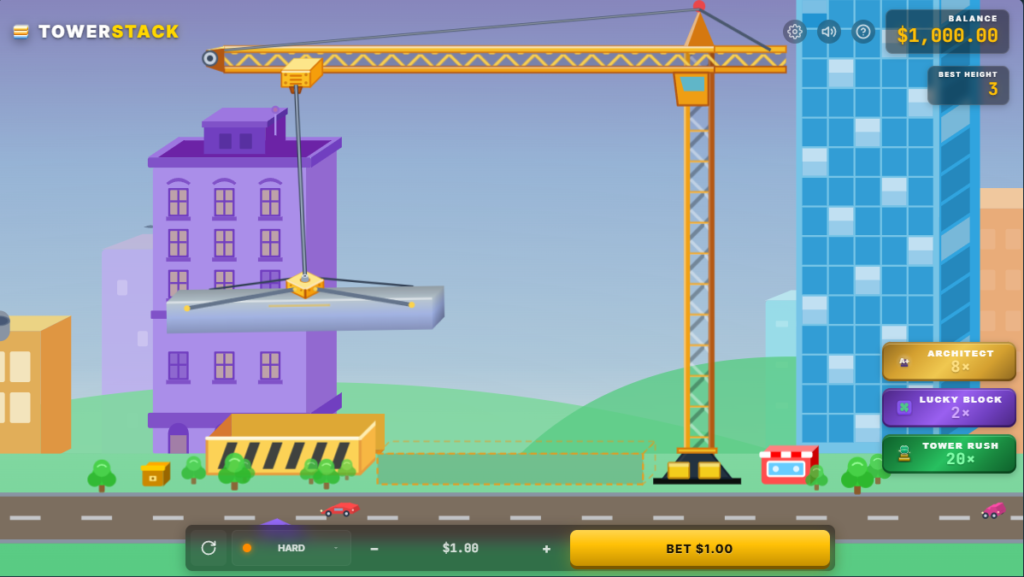
Tower Stack is a tower-building crash hybrid published by Black Rift on Stake Engine. Each round, a crane carries a steel girder that the player drops onto a foundation; every successful drop adds a block to the tower and bumps the running multiplier upward. Cash out — what the game calls “Restart” — at any height, or push for a higher block and risk losing the entire stake if the next drop fails.
Mechanically, this places the game in the same family as Aviator, Stake’s own Crash, Pump and Spaceman — a single rising multiplier that the player must abandon before a hidden failure event. What separates Tower Stack from that pack is two things. The first is structural: the tower has a hard ceiling at 30 blocks, capping the max win at exactly 10,011.30×. The second is the round-opening twist that no other crash game runs — the Construction Bureau “Foundation Grade” reveal, which sets a starting multiplier before the first block is even dropped. A round can begin at 0.85× on a grade F foundation, meaning the first cashout is technically a loss until a successful block lifts the multiplier above 1.00×.
The honest summary upfront: this is a competently produced, mechanically distinctive crash variant whose core design idea — a graded foundation that randomises starting position — is genuinely original in the genre. It will appeal to crash players who find Aviator’s pacing too passive and want per-decision control, similar to Stake’s Mines or Dragon Tower. It will not appeal to players who want a published RTP they can verify before depositing — Black Rift has not made that figure publicly accessible outside the in-game info panel, which is a meaningful transparency gap covered later in this review.
Tower Stack’s published RTP is not currently available in any external documentation this reviewer could find. Stake Engine titles typically run between 96% and 99% RTP, with provider-built minigames more commonly clustered in the 96–98% band. The verified figure should be visible in Tower Stack’s in-game information panel — players are advised to check it there before assuming.
For the purpose of giving readers an honest expected-loss estimate, the calculation below uses an assumed RTP of 97% — the midpoint of the typical Stake Engine range. The actual figure may be higher or lower; players should re-run the math with the verified value once they have it.
Expected loss per hour, at 97% RTP (3% house edge):
The pace of Tower Stack is slower than pure crash games like Aviator. Each round involves a foundation reveal, then up to 30 individual block drops with animation time per drop. Realistic round length sits in the 30-to-90-second range depending on how far the player climbs and which difficulty is selected. An estimated 40 rounds per hour is reasonable for a player on Hard difficulty climbing moderately.
If Black Rift has set Tower Stack at 96%: those figures roughly double (1.6×). If they’ve set it at 99%: those figures fall by two-thirds (0.33×). The choice of RTP makes a material difference, which is precisely why the absence of public disclosure is worth flagging.
A separate point about the foundation grade: the F-grade starting multiplier of 0.85× means a player who immediately cashes out on a grade F round forfeits 15% of stake without ever placing a block. The game’s structure forces the player to place at least one successful block on poor-foundation rounds simply to break even. Players who do not understand this dynamic will lose money faster than they expect on early-block cashouts. Higher grades presumably offer starting multipliers above 1.00× — but the full grade-to-multiplier mapping has not been published.
The critical question for any new crash game is whether outcomes can be independently verified. Tower Stack’s standing on this is partially confirmed and partially inferred.
In late April 2026, Stake rolled out provably fair verification across more than 1,200 slot and minigame titles published via Stake Engine, exposing each game’s full probability distribution and outcome generation logic to players in real time. The screenshots of Tower Stack show a “DOC #” identifier (DOC #3229 visible during the foundation reveal) — consistent with a round-level seed or nonce reference that would tie into Stake’s verification system. This strongly suggests Tower Stack inherits the Stake Engine PF infrastructure, but a dedicated verification page for this specific title has not been independently confirmed by this reviewer.
What that means in practice: assuming the game is enrolled in Stake’s PF system, players should be able to view the server seed hash before each round, set their own client seed, and verify retrospectively that the Foundation Grade and each block’s outcome were generated from those seeds and not manipulated post-hoc. Players who care about this should check the game’s in-product fairness link — and if no such link exists for Tower Stack specifically, that absence is itself a fairness concern worth taking seriously.
What is not confirmed:
Fairness verdict for now: Conditionally acceptable, pending verification. The platform-level provably fair scaffolding likely covers Tower Stack, but the studio’s transparency layer is thin. Players who are happy trusting Stake’s platform claims will be fine. Players who want independent attestation will not find it.
The mechanic is best understood as four distinct phases per round.
The player sets a stake (the materials reviewed show a $1 minimum; maximum bet is not visible in the screenshots) and selects a difficulty from the bottom toolbar. Hard is confirmed; the dropdown indicator suggests at least one alternative level (likely Easy and/or Medium, following the Stake convention used by Mines, Dragon Tower and Plinko). Higher difficulty almost certainly means steeper multiplier growth per block and a higher per-block failure chance — this is universal in tower-style crash design — but the precise difficulty-by-difficulty math is not published.
Before the first block, the game shows a “Foundation Grade” card from the “Construction Bureau — Quality Control” overlay. The grade letter (F observed in the materials reviewed) determines the starting multiplier (0.85× on F). The framing is genre-original: most crash games begin every round at a fixed 1.00× baseline. Tower Stack’s grade system establishes a hidden round-level variance that the player learns about before committing to drops but after placing the bet. This effectively pre-randomises whether a round is “easy mode” or “uphill”, and it is the single most distinctive design choice in the game.
The crane carries each block into the playing field. A target footprint is shown on the foundation. The player presses Drop; the block falls and either lands cleanly (the multiplier ticks up to the next value, displayed as a ghost preview before commit) or fails (assumed: a miss, an off-axis landing or a tower collapse — the exact failure conditions are not documented). Observed multiplier progression on Hard difficulty across one session: 0.85× foundation → climbing through 1.15×, 1.32×, 1.52×, with 1.75× as the next preview at block four. The increments grow across the climb rather than staying linear — consistent with the exponential-style payout curves used in standard crash games to compensate for compounding bust risk.
The Restart button (functionally a cash-out) is available between every block. The “Best Height” tracker on the right panel records the player’s deepest run of the session, presumably reset on browser close. There is no leaderboard visible in the materials reviewed.
Three named features appear on the right side of the play screen, each with a numeric label:
The numeric labels are visually clear but their semantic meaning is ambiguous from screenshots alone. They may represent: a multiplier value the feature awards when triggered, a countdown to the next trigger event, or a session-cumulative figure. Without play documentation from the publisher, this reviewer will not speculate which interpretation is correct. What can be stated honestly: the game contains at least three distinct bonus feature mechanics layered on top of the core stacking loop, and they appear to influence the multiplier system in some way.
Standard practice is to surface insights from real player communities — Reddit, Bitcointalk, Discord, streamer commentary, Trustpilot — that don’t appear in published reviews. For Tower Stack, no such community exists at the time of writing.
A complete pass across r/Stake, r/onlinegambling, r/crashgames, Bitcointalk’s gambling section, and stake-focused Discord and Telegram channels surfaces zero mentions of Tower Stack or Black Rift as a game studio. No streamer footage, no big-win clips, no Trustpilot or CasinoGuru complaints, no comparison threads, no fairness disputes. This is consistent with one of three possibilities: the game is brand-new and pre-traction, the studio is small enough that organic discussion has not begun, or both.
The honest implication for the reader is that no community sentiment exists yet to cite — positive or negative. This is itself a meaningful data point. Established crash titles like Aviator, JetX or Stake Crash have years of forum debate, audited big-wins and disputed-loss threads to draw on. Tower Stack does not. Players who rely on community sentiment as a trust signal will need to either be early adopters or wait six to twelve months for a player base to build commentary. This review will be updated when sourced player reports become available.
Four reference points anchor where Tower Stack sits in the genre. The most direct of these — the one most likely to share an audience with Tower Stack — is Galaxsys’ Tower Rush, so that comparison runs first.
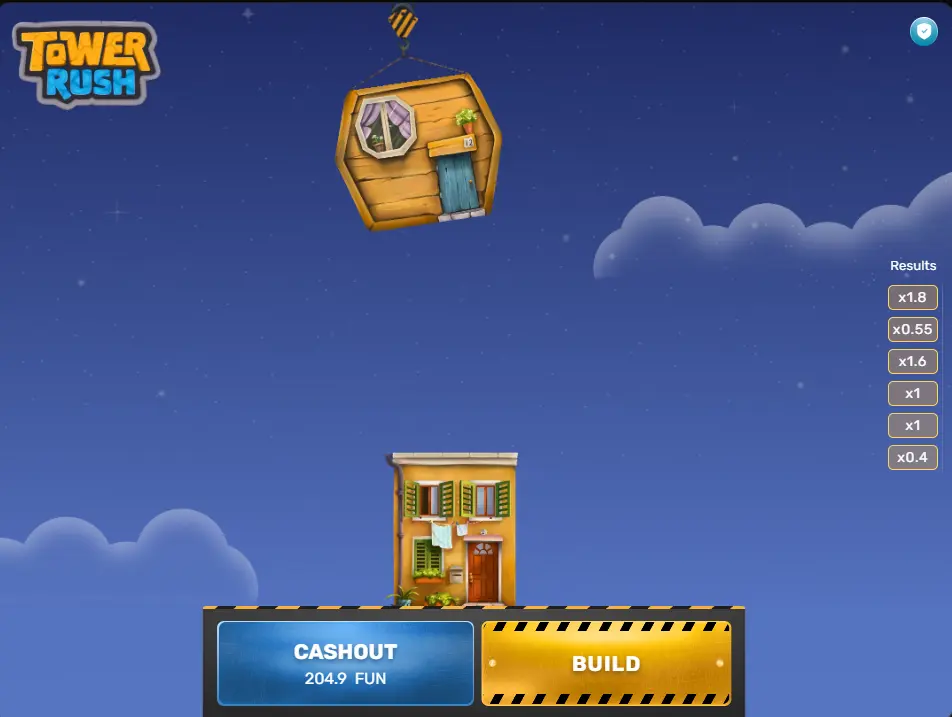
Tower Rush is the genre’s most-established tower-stacking crash hybrid and the closest mechanical analogue to Tower Stack on the market. It is a Galaxsys title released in March 2024, distributed across multiple casinos rather than tied to a single platform, and it works on essentially the same loop as Tower Stack: a crane drops a stylised house onto a foundation, each successful placement raises a multiplier, the player cashes out before a missed drop ends the round. The cartoon construction theme is shared too. Players who have played Tower Rush will recognise Tower Stack’s pacing immediately — and vice versa. For a comprehensive feature-by-feature breakdown of the Galaxsys title, see Lucky Minigames’ Tower Rush review.
The differences are where this comparison gets interesting:
For a player choosing between them: Tower Rush is the safer, more transparent, more documented choice. Tower Stack is the more ambitious-ceiling and mechanically novel choice. Both are legitimate within the genre, but they suit different priorities.
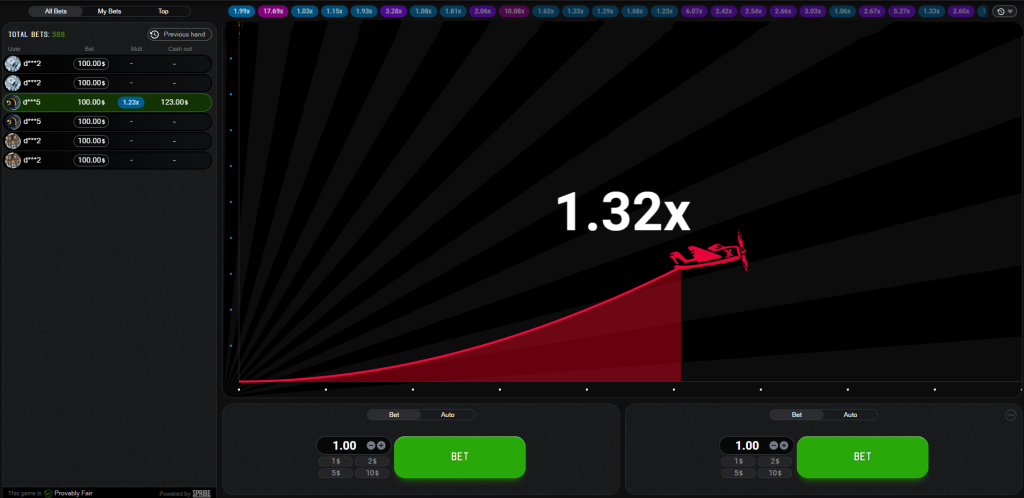
Spribe Aviator is the genre’s reference point — a single rising-multiplier curve, a published RTP of 97%, a documented (if rare) max multiplier in the millions, and a heavy social layer with live cashout feeds and chat. Tower Stack is more interactive per round (block-by-block decisions instead of one continuous curve), has a hard 10,011.30× ceiling versus Aviator’s effectively uncapped tail, and exposes a randomised starting condition (foundation grade) that Aviator does not have. Tower Stack lacks Aviator’s social proof, community history and verified third-party audit (Aviator is GLI-certified). Players who want active per-decision pacing will prefer Tower Stack; players who want a battle-tested, audited platform will prefer Aviator.
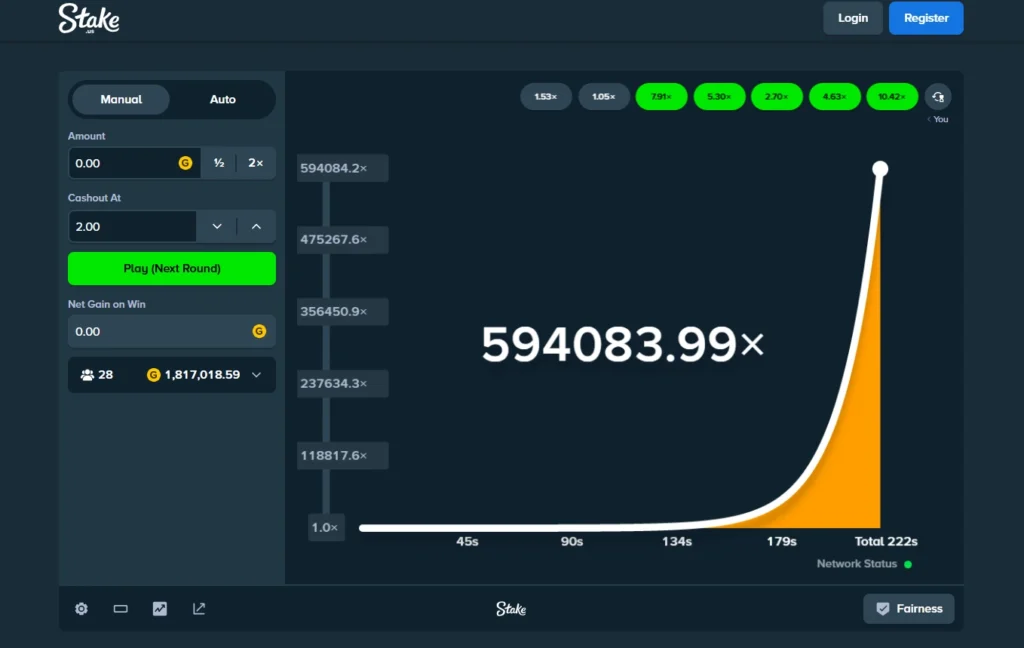
Stake Crash runs at 99% RTP with a theoretical 1,000,000× ceiling, and Stake’s Pump is a balloon-themed crash variant in the Stake Originals lineup. Tower Stack is a publisher-third-party (Black Rift) game on the same platform. The two big differences are the published RTP (Stake Crash is transparent; Tower Stack is not) and the depth of the cashout decision (one moment in Stake Crash, up to 30 moments in Tower Stack). Tower Stack’s mechanic is richer; Stake Crash’s transparency is better.
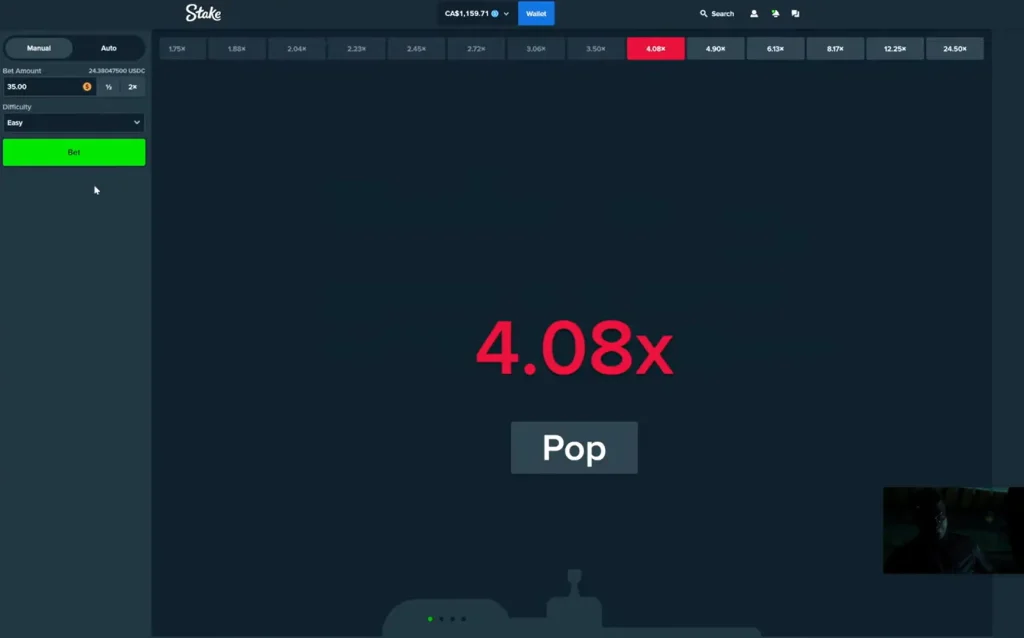
Both of these are tile-selection tower games — pick the safe tile per row, climb. Tower Stack is a placement tower game — drop the block correctly per row. The decision skill is different: Dragon Tower and Shuffle Tower test guess-luck against difficulty; Tower Stack tests timing/positioning input (or what feels like input — the underlying outcome is still RNG-determined under provably fair). For players who like the climbing rhythm but want a different decision texture, Tower Stack is a fresh take. For players who want simple risk-row math, Dragon Tower is more legible.
Positioning summary: Tower Stack is a niche-but-distinctive entry in the crash/tower hybrid space. It is not the genre leader and is not aiming to be — it competes on mechanical originality (the foundation grade and bonus feature layer) rather than on transparency, audit pedigree or community trust.
In the spirit of honest review, the items below are red flags or transparency gaps a player should be aware of before committing real money.
The publisher is essentially a black box. Black Rift has no discoverable studio website, no public catalogue of other titles, no founder bios, no jurisdictional registration that this reviewer could surface, and no press footprint. Stake Engine’s commercial model — 10% GGR paid to the developer — means small studios can ship to Stake’s audience with minimal infrastructure, which is positive for indie creators but negative for accountability tracing. If Tower Stack ever becomes the subject of a player dispute, the resolution path is via Stake support, not the studio.
RTP is not externally documented. The figure is presumably visible in the in-game info panel, but no external site, regulator filing or studio page lists it. Until that changes, a player cannot verify before depositing whether they’re playing a 96% game or a 99% game — and as the math section showed, that gap is meaningful.
No third-party audit exists. No published RNG certification from any recognised testing house could be located. Stake’s platform-wide provably fair rollout provides a software-level fairness layer, but it is not a substitute for an independent audit signed by an accredited lab.
The community has not yet stress-tested the game. Disputes, edge cases, software bugs and payout inconsistencies typically surface in forums within months of release. Tower Stack has no such record yet — meaning early adopters are the testing population. This is not unique to Tower Stack — every new game faces it — but players who prefer “wait six months, see what breaks” should apply that approach here.
The foundation grade can deliver a sub-1× starting multiplier. Cashing out immediately on a grade F round is a guaranteed loss. Players who fall into the habit of “cash out at the first block” need to factor this in.
Play this game if you are a crash-genre regular who has played Aviator and Stake Crash extensively and wants a mechanically distinct alternative — specifically one that gives you per-block decision control instead of a single cashout moment, and one whose foundation system adds a round-opening variance you can read before committing to a deep climb. The 30-block ceiling and the bonus feature layer give the game enough texture to support 30-to-60-minute sessions without feeling repetitive.
Consider an alternative if you are primarily a tower-mechanic player. Stake’s Dragon Tower has cleaner published math, longer track record and a simpler decision model. Shuffle’s Tower offers similar gameplay with a different operator’s compliance and audit posture. Both are more documented than Tower Stack on RTP, and both have established player bases.
Avoid this game if you require a published, verified RTP before staking real money — Tower Stack’s external transparency layer is too thin for that standard. Avoid it equally if you require a third-party audit signature, a regulated jurisdictional licence at the studio level (rather than at the platform level), or a community track record. Players in any of those categories will be better served by titles from Spribe, Pragmatic Play or Stake Originals proper.
Play the demo first if you are new to crash mechanics in general. Whether Tower Stack offers a free-play demo is not confirmed in materials this reviewer could access — but if a demo mode is available in the in-game menu, work through five or six rounds at zero stake and pay attention to (a) how often the foundation grade lands above versus below 1.00×, (b) which difficulty matches your patience level, and (c) how the three bonus features behave during a session. Those three observations will tell you more than any review can about whether the game’s rhythm suits you.
Tower Stack earns a cautious recommendation for crash-genre regulars and a not-yet recommendation for everyone else. The single strongest reason to play it is the foundation grade system — a genuinely original mechanic that no other crash game in the market currently runs, and that will reframe how a returning player thinks about pre-cashout decision-making. The single biggest reason to be cautious is the studio’s near-total lack of public transparency: no RTP disclosure outside the in-game panel, no audit, no studio site, no community history, and a publisher footprint that begins and ends with this title’s appearance on Stake.com.
For the specific player profile this game is right for — an experienced crash player who values mechanical depth over institutional trust signals, plays small-to-moderate stakes, and is comfortable verifying the in-game info panel themselves — Tower Stack is worth a session. For everyone else, the recommendation is to wait until Black Rift publishes a verifiable RTP, until a third-party audit appears, or until enough community play has accumulated for forum-level dispute records to exist.
The most surprising thing this reviewer learned from researching the game: Tower Stack is the first crash variant in widespread distribution that can begin a round at a multiplier below breakeven. The Construction Bureau Foundation Grade reveal of 0.85× on a grade F round is, mechanically, the studio formally telling the player “this round is already going against you” before any block is dropped. That is unusual design honesty in a genre that usually obscures unfavourable round states. Whether players will read it as a feature or a bug will define the game’s first six months on Stake.
The RTP has not been disclosed in any external publication that could be located by this reviewer. The verified figure should appear in the game’s in-game information panel on Stake.com. Stake Engine titles typically range between 96% and 99% RTP, but Tower Stack’s specific figure should be checked in-product before play.
Almost certainly yes at the platform level — Stake rolled out provably fair verification across more than 1,200 Stake Engine titles in late April 2026, and the visible “DOC #” round identifier in Tower Stack’s interface is consistent with that system. A dedicated verification page for Tower Stack specifically has not been independently confirmed by this reviewer; players should look for the fairness link in the in-game menu and verify a round before trusting the system.
The maximum win is 10,011.30× the stake, confirmed on the game’s start screen. This is achieved by successfully placing all 30 blocks. The probability of doing so is not published, but can be inferred from the per-block bust rate which is also undisclosed.
Aviator runs at a published 97% RTP, has no hard ceiling on its multiplier, and is independently audited by GLI. Tower Stack has an undisclosed RTP, a hard ceiling at 10,011.30×, no public audit, but a more interactive per-block decision rhythm and a unique foundation-grade variable starting multiplier. Aviator is the safer institutional choice; Tower Stack is the more mechanically interesting choice for experienced players.
A free-play demo is not confirmed in any materials this reviewer could access. Stake.com generally supports demo modes for many games via the in-game menu — players should check the Tower Stack info panel directly for a demo or play-for-fun option before depositing.
The house edge is one minus the RTP, both of which Black Rift has not publicly disclosed. If the game runs at the typical Stake Engine midpoint of 97% RTP, the house edge is 3%. The actual figure could be anywhere between 1% (at 99% RTP) and 4% (at 96% RTP).
Auto-cashout was not visible in the screenshots reviewed. Auto-bet is standard on Stake Engine games, but its presence on Tower Stack specifically is unconfirmed at the time of writing.