Author Spencer Thorne
August 20, 2026

The number Turbo Games leads with is a maximum multiplier of x1,000,000. At MSport, one of the few operators publishing its Chicken Goal limits in writing, the maximum payout is 8,000,000 units of local currency against a minimum stake of 20 units. Divide the first by the second and the highest multiplier the game can actually pay at that operator is 400,000x. The advertised million is not reachable at the maximum stake, nor at the minimum stake, nor at any stake between them. That arithmetic is public, and no review of this game currently indexed appears to have done it.
| Detail | Information |
|---|---|
| Developer / provider | Turbo Games (released June 2026) |
| Game type | Instant win step multiplier minigame, frequently misfiled as a crash game |
| RTP | 96% on all four difficulty levels (source: Turbo Games game page; confirmed per level in the MSport operator guide) |
| House edge | 4% |
| Max multiplier | x1,000,000 advertised, subject to an operator max win cap |
| Min stake | Operator configurable. One documented deployment sets 20 local currency units |
| Max stake | Operator configurable. The same deployment sets 8,000 local currency units |
| Risk level settings | Yes. Easy 24 steps, Medium 22, Hard 20, Mad 18 |
| Provably fair | Commit and reveal scheme claimed provider wide. Hash function, client seed and conversion formula not published |
| Auto-cashout | Not documented in developer or operator materials |
| Demo available | Yes, free demo on the developer site |
| Mobile compatible | Yes, browser based on Android and iOS |
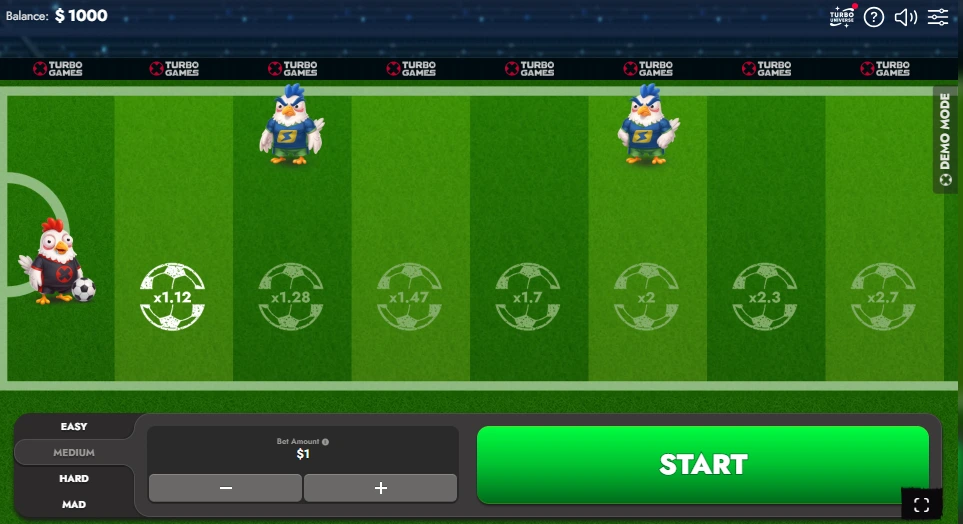
Chicken Goal is an instant win minigame released by Turbo Games in June 2026, timed for the football tournament summer. The player stakes, selects one of four difficulty levels, then moves a chicken carrying a ball across a pitch one step at a time by pressing GO. Each successful step raises the win multiplier. At any point after a successful step the player can press CASH OUT and take the stake multiplied by the coefficient reached. If a defender appears the round ends immediately and the stake is lost, and covering the whole pitch pays a Grand Prize automatically.
Turbo Games has shipped instant and crash titles since 2020, but Chicken Goal is not a new mechanic within that catalogue. The developer’s own games index describes Chicken Route as a four mode ladder running from Easy to Mad across 18 to 24 steps with a Grand Prize at the finish, then describes Chicken Goal as the same run moved to a football pitch. The step counts, mode names and finish bonus are identical, so anyone already playing Chicken Route is not getting a new game.
A round begins when the player sets a stake, picks a difficulty and presses START. From then on it is entirely manual. Each press of GO resolves one binary event: the chicken advances and the multiplier rises, or a defender takes the ball and ends the round with the stake lost. There is no rising real time curve, no shared round and no countdown, which is why the game does not belong in the crash genre despite being sold into it. Nothing moves until the player taps.
Difficulty changes the length of the pitch and the shape of the risk: Easy runs 24 steps, Medium 22, Hard 20 and Mad 18. Fewer steps means a higher per step defender probability and a steeper multiplier ladder, so the shorter field is the more dangerous one. The lowest winning coefficient documented is x1.03, what a first step on the safest setting returns. Turbo Games publishes neither the step multiplier tables nor the per level Grand Prize values, so a player choosing between Hard and Mad cannot see the trade before committing.
Cash out is manual and instant, available after any successful step. Neither the developer’s feature list nor the MSport operator guide documents an auto-cashout or autoplay function, a meaningful difference from genuine crash titles where a preset cash out multiplier is standard. Discipline here has to be self imposed rather than configured.
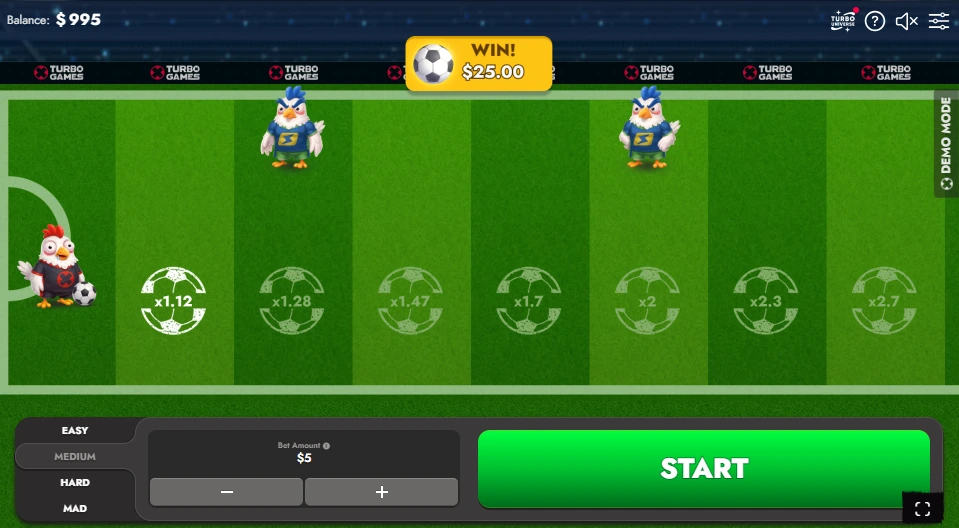
The RTP is 96%, published by Turbo Games and confirmed level by level in MSport’s operator guide, which lists 96% for Easy, Medium, Hard and Mad alike. The house edge is therefore 4%. Over a large number of rounds the game retains about $4 of every $100 staked.
For one RTP to hold whichever mode a player picks and whenever they cash out, the house edge has to be priced into every individual step rather than accumulating with depth. On that assumption the probability of surviving a step and the multiplier attached to it are locked together: probability multiplied by multiplier equals 0.96. Working backwards from the documented x1.03 minimum coefficient gives a first step survival probability of about 93.2% on Easy, a 6.8% chance of losing the stake on the very first tap of the safest setting. Working forwards from the top, the x1,000,000 outcome carries an implied probability of roughly one in 1,041,667.
That relationship exposes something the marketing does not. If the defender probability on Easy stayed flat at 6.8% across all 24 steps, roughly 18% of rounds would reach the end of the pitch and the Grand Prize would be worth only about x5.2. Either the Easy finish is that modest or the risk climbs sharply as the chicken nears the goal, and without a published step table a player cannot tell which.
Expected loss per hour equals house edge multiplied by rounds per hour multiplied by average stake. Because rounds are manual and short, a deliberate pace of 60 rounds per hour is a reasonable assumption, and a fast tapper on Mad will double it. At 60 rounds per hour and a $1 average stake, turnover is $60 and expected loss is 0.04 x 60 x $1, or $2.40 per hour. At a $5 average stake the same pace turns over $300 for an expected loss of $12.00 per hour, and at 120 rounds per hour that reaches $24.00. A three hour session at $5 a round has an expected cost of $36.
The result will almost never be the expectation. Volatility on the lower difficulties is mild, so short sessions cluster near a small loss, while on Mad the ladder is steep and sessions scatter violently. Being up several hundred dollars after an hour is entirely normal and says nothing about the underlying mathematics, because the 4% edge is extracted from turnover rather than from sessions. Every additional round narrows the gap between what happened and what was always going to happen.
Turbo Games states that every title in its catalogue, Chicken Goal included, runs a commit and reveal scheme: the server generates the round seed, publishes its hash before betting opens, and reveals the seed afterwards so the player can hash it and confirm the match. That page was last updated in July 2026 and describes the scheme catalogue wide rather than game by game.
What that gets a player is real but narrow. Confirming the revealed seed hashes to the published commit proves the seed existed before the bet and was not swapped afterwards. It does not prove that the seed produced the defender positions that appeared on screen. To check that, a player needs the algorithm converting seed into step outcomes, and Turbo Games does not publish it. The documentation names no hash function, no client seed and no nonce, all three standard in fully specified implementations and all three necessary to reconstruct a result outside the operator’s own interface.
Chicken Goal therefore sits in the middle: not a black box, but not a fully verifiable implementation either. A player can confirm a commitment was honoured but cannot reproduce their own result, and without a client seed there is no player supplied entropy in the outcome at all. Anyone who calls this game provably fair and stops there is handing readers a badge instead of a mechanism. Turbo Games also cites RNG certification by accredited laboratories, and that certification, not the commit and reveal, is what underwrites the 96% figure.
The flat 96% across all four difficulties is the strongest thing here. In many step multiplier games the effective return degrades with depth, so the interesting part is also the expensive part. Chicken Goal, on the published numbers, charges the same 4% whether a player takes x1.03 and leaves or walks the whole pitch. Choosing Mad over Easy buys variance, not a worse price.
Pacing is genuinely in the player’s hands, rare in this category. Nothing resolves until GO is pressed, so there is no clock pressure and no round that runs away while a player hesitates. A free demo runs on the developer site with no account at the same 96% RTP. The operator guide also confirms bets stay active through a dropped connection and are refunded if the server fails, better documented than most instant titles bother with.
The disclosure is thin where it matters most. A single RTP figure is published, but the per step defender probabilities, the multiplier ladders and the Grand Prize values for each level are not, so the risk decision the whole game is built around has to be made blind. The x1,000,000 headline is worse than undisclosed, it is misleading, because operator max win caps make it unpayable: at the one operator publishing its limits the true ceiling is 400,000x, and at a deployment reported with a $10,000 max win it is lower still.
The provably fair claim is asserted at catalogue level rather than documented at game level, so verification is partial. And mechanically the game adds nothing: it is Chicken Route with a football skin and the same 18 to 24 step structure, released to catch tournament season traffic.
There is also no independent player record. Searches for forum and community discussion turn up no substantive threads about this title, and every review currently ranking is affiliate published, most reproducing the developer’s description verbatim, including the unreachable million. A game two months old with no independent feedback loop is one nobody outside the supply chain has audited in the wild.
The player best served here wants a short, self paced gamble with a transparent price and no reflex component. If a session means twenty minutes at a dollar a round on Easy or Medium, treating the roughly $2.40 an hour as the cost of entertainment, the game delivers that cleanly. A flat stake, a fixed round count decided in advance and a cash out target chosen before pressing START suit it well.
The player who should look elsewhere wants to automate a strategy. Without auto-cashout or autoplay, any plan requiring consistent exits at a set multiplier gets executed by hand under pressure. Established crash titles with configurable auto cash out serve that player better, as do studios publishing full verification documentation.
The player who should avoid Chicken Goal entirely is the one drawn to Mad by the million. That mode compresses the ladder into 18 steps, the steepest per step risk in the game, and it is where near misses bite hardest. Combined with a top prize no operator cap will pay, it is a structure that rewards chasing. If pressing GO once more after a loss feels automatic, this format is the wrong one.
Chicken Goal is built for speed and a round can be lost in a single tap. Manual pacing keeps the clock pressure off, but a player can still run through more rounds per hour than a slot allows, and losses accumulate at that rate. Cashing out at a fixed multiplier is a sound discipline, but it does not change the 4% house edge, charged on turnover whichever exit point is chosen. Set a loss limit before the first round rather than after a losing streak. Support is available from GambleAware at begambleaware.org, GamCare at gamcare.org.uk, the National Council on Problem Gambling at ncpgambling.org or 1-800-522-4700, and Gambling Therapy at gamblingtherapy.org. 18+ only.
Chicken Goal is a competently built and honestly priced instant win game wrapped in a dishonest headline. The strongest reason to play it is the flat 96% across all four difficulty levels, which means depth costs variance rather than value, a design many competitors do not match. The most important reason for caution is that almost everything a player needs to judge the risk, the step probabilities, the ladders and the real per level top prize, is unpublished, while the number published loudest cannot be paid. It is worth playing with caveats: demo first, stay on Easy or Medium, decide the exit before the round starts, and ignore the million. The fact worth taking away is one no other review seems to mention: Turbo Games’ own catalogue page describes Chicken Route as a four mode, 18 to 24 step ladder with a Grand Prize at the finish, and Chicken Goal as that same run relocated to a pitch. This is a seasonal reskin, not a new release.
The RTP is 96%, published by Turbo Games on its official game page and confirmed level by level in MSport’s operator guide, which lists 96% for Easy, Medium, Hard and Mad. The figure does not change with difficulty.
Partially. Turbo Games documents a commit and reveal scheme across its catalogue, where the round seed is hashed before betting opens and revealed afterwards. The provider does not publish the hash function, a player supplied client seed or the formula converting the seed into step outcomes, so a player can confirm the commitment was honoured but cannot independently reproduce their own result.
The advertised maximum multiplier is x1,000,000, but the payable maximum is set by each operator’s win cap, not by the developer. At MSport the cap is 8,000,000 local currency units against a minimum stake of 20, which puts the real ceiling at 400,000x, so the advertised figure cannot be paid at any stake there.
The player stakes, chooses one of four difficulty levels, and presses GO to move a chicken one step at a time across a football pitch. Each successful step raises the multiplier, cash out is available after any step, and if a defender appears the round ends and the stake is lost. Reaching the end of the pitch pays a Grand Prize.
The house edge is 4%, derived from the published 96% RTP. At 60 rounds per hour and a $1 average stake that is an expected loss of about $2.40 per hour, rising to about $12.00 per hour at $5 a round.
There is no evidence of manipulation, and Turbo Games holds RNG certification from accredited testing laboratories alongside a seed commitment scheme. The game is not a fair coin either: it carries a documented 4% mathematical advantage for the house on every stake, which is disclosed rather than hidden.
Not according to any documentation found. Neither the developer’s feature list nor the MSport operator guide describes an auto cash out or autoplay function, so every step and every exit is a manual decision.
None of them returns more than the others, since the RTP is 96% on all four. Easy runs 24 steps with the lowest per step risk and the smallest multipliers, Mad runs 18 with the highest risk and steepest ladder, so the choice is purely about how much variance a player wants for the same price.