Author Spencer Thorne
August 13, 2026

The most consequential button in Royal Drop costs a hundred times the stake, and no published return figure exists to tell a player whether pressing it is reasonable. On a $0.20 bet the Royal Bonus purchase is priced at $20. The pricing is not unusual for a bonus buy. What is unusual is that InOut Games has disclosed no return to player percentage for this title anywhere, so the number that would make the purchase assessable does not exist in public.
| Detail | Information |
|---|---|
| Developer / provider | InOut Games, operated by IOGr B.V., Cyprus based, licensed by Anjouan under ALSI-202506032-FI2 |
| Game type | Instant win with a purchasable feature layer; not a crash game |
| RTP | Not publicly disclosed |
| House edge | Not publicly disclosed |
| Max multiplier | Not publicly documented; the Royal Bonus panel previews chest values of x50, x100 and x50 |
| Min stake | Not published; demo build observed at $0.20 with an incremental stepper |
| Max stake | Not publicly documented |
| Risk level settings | No risk selector observed; two purchasable feature tiers offered instead |
| Provably fair | Not documented for this title |
| Auto-cashout | Not publicly documented |
| Demo available | Yes |
| Mobile compatible | Yes |
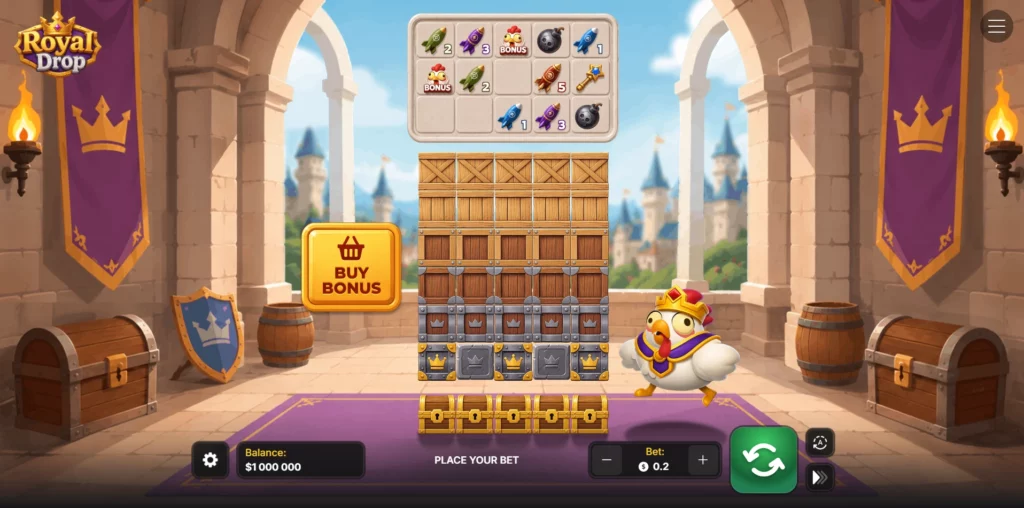
Royal Drop is an instant win title from InOut Games, the Cyprus based studio behind Chicken Road and a portfolio of roughly forty fast round arcade and crash formats. It carries the studio’s cartoon chicken characters into a medieval castle setting of crown banners, stone arches and treasure chests. The commercial entity is IOGr B.V. of Willemstad, operating under a stated Anjouan licence.
Mechanically it sits in the instant win category rather than the crash category, which matters because InOut is best known for crash formats and coverage tends to file everything it releases under that heading. There is no rising multiplier line and no descent in the sense the name suggests. What the client presents prominently is a purchasable feature panel of two tiers, the structural centre of the game.
The base round begins with stake selection through a stepper, observed in the demo at $0.20. InOut has published no stake range, so it depends on operator configuration rather than anything the studio has committed to.
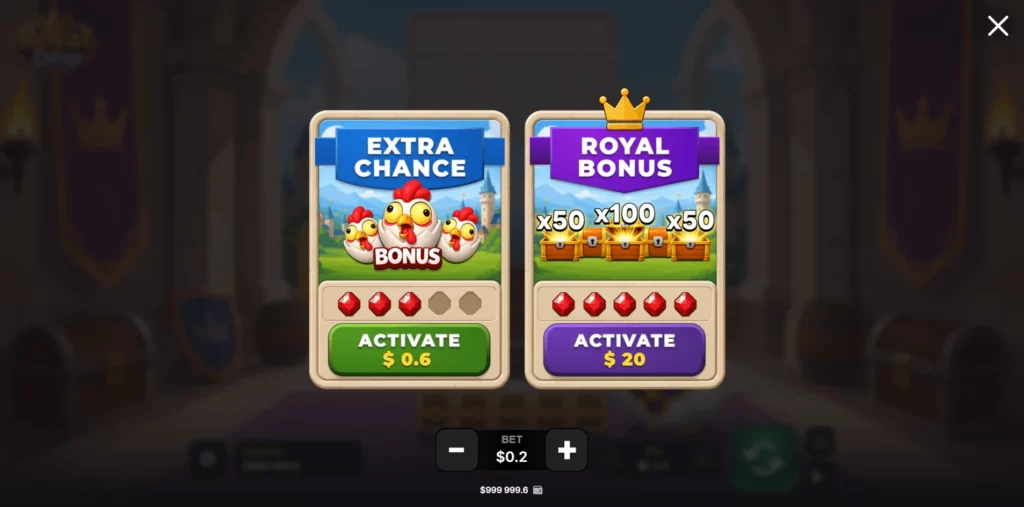
The feature panel offers two purchases. Extra Chance costs three times the stake, shown as $0.60 against a $0.20 bet. Royal Bonus costs one hundred times the stake, shown as $20, and its preview displays three treasure chests carrying values of x50, x100 and x50. Each tier carries a row of five gem slots, three filled for Extra Chance and five for Royal Bonus. That row is probably a tier or volatility indicator, a common convention in buy interfaces, but InOut has published no key explaining it, so the reading is inference rather than fact.
Several things are undocumented and should not be assumed. The chest values previewed on the Royal Bonus card show what the feature can award, not what it does award, and no paytable states the weighting behind them. Whether the two tiers draw from the same prize pool is unstated, as is whether the features run at the same return percentage as base play. That last omission is not trivial, because buy features across the sector are frequently configured to a lower return than base play. Without a paytable, a player cannot answer any of this before committing money.
InOut Games has not publicly disclosed the RTP for Royal Drop. That statement stands in place of a figure, because the alternative is borrowing one. The studio’s other titles are published at rates from 90% on Crash to 99% on Hilo Joker. None of that tells a player anything reliable about this game, and treating a portfolio average as a specification is the most common error in coverage of this studio.
The consequence is precise rather than vague. Without a published return figure a player cannot calculate the expected cost of a session, cannot compare Royal Drop against a competing title on the dimension that determines long run cost, and cannot judge whether the Royal Bonus is fairly priced.
One calculation survives the missing figure, and it is the important one. Expected loss per hour equals house edge multiplied by rounds per hour multiplied by average stake. The edge is unknown but the other terms are not, and stake is what the feature panel changes. Assume 60 rounds per hour, conservative for a format resolving in seconds. At $0.20 a player turns over $12 an hour. Buying Extra Chance at $0.60 a round takes that to $36. Buying Royal Bonus at $20 a round takes it to $1,200.
Because expected loss scales linearly with turnover, whatever the edge turns out to be, the Royal Bonus multiplies the hourly cost of playing by one hundred. At a 3% edge that is roughly $0.36 against $36 an hour; at 8% it is roughly $0.96 against $96. Those percentages illustrate the mechanism rather than describing this game, since no figure for this game exists. The mechanism holds at any edge: a feature buy compresses a hundred rounds of exposure into one click and delivers the cost at a hundred times the rate.
Volatility explains why it will not feel that way. A purchase awarding chest values around x50 or x100 produces a long tailed distribution, so most purchases return less than their price and rare ones several multiples. A player who buys ten and hits one large chest finishes ahead and reasonably concludes the purchase is worth making. Over a few hundred purchases that impression corrects against them. Variance masks the cost of the feature over short samples; it never reduces it.
No provably fair implementation is documented for Royal Drop. InOut markets provable fairness as a portfolio level characteristic in its business facing material, but a studio level marketing claim is not a title level verification scheme. No first party material for this game describes a server seed, a client seed the player can set, a nonce, a named hash function or a verification panel.
The distinction matters because the term is used loosely enough in this sector to have lost most of its meaning. A working implementation runs as follows. Before the round the server generates a secret seed and shows the player a hash of it, typically SHA-256, committing the operator to that value without revealing it. The player supplies or accepts a client seed and a nonce increments each round. The three inputs pass through a keyed hash function, usually HMAC-SHA256, and the output is converted into a result by a published formula. After the seed rotates the server reveals it, the player hashes it to confirm it matches the commitment, then reruns the formula and reproduces their own result. No step requires trusting the operator.
None of that is available here. A Royal Drop player relies on the studio’s RNG certification and the operator’s integrity, the ordinary position a slot player occupies, but that is not verification. One limitation would remain even if InOut published a scheme later: seed verification proves a round came from inputs committed in advance, and says nothing about the return percentage it was drawn from or whether the Royal Bonus is priced correctly against what it pays.
The feature pricing is displayed in currency rather than stake multiples, a better choice than the sector norm. A player sees $20, not 100x, and $20 is the number that registers as money. Studios that show buy costs only as multiples make the figure easier to underweight.
The two tier structure is also more transparent than a single opaque buy. A low cost entry at three times stake lets a player sample the feature layer without committing a hundred times their bet, and the visual differentiation signals that the tiers are not the same product, even if the specifics go unexplained.
Presentation is the third strength: clean art, characters legible at a glance, and a castle setting properly executed rather than assembled from stock parts. A free demo exists, which given the thin documentation is the only reliable way to examine the game before committing money.
The missing RTP disclosure is the central failure. InOut publishes a return figure on its own site for every title in its public catalogue. Royal Drop does not appear in that catalogue, and no figure has been published anywhere. A studio that discloses as a matter of routine and then ships a title without disclosure has produced an outlier, and the outlier is the one carrying a hundred times stake purchase.
The gap extends past the return figure. There is no published paytable, no maximum win, no stated stake range, no explanation of the gem row, no weighting for the chest values, and no confirmation of whether the features run at the same return as base play. A player evaluating the Royal Bonus has the price and the artwork and nothing else.
Third, the absence of a title level provably fair scheme sits awkwardly against the studio’s portfolio level claims about verifiability. A smaller inconsistency: the studio’s site displays Curacao, Malta and Kahnawake marks in its footer while stating an Anjouan licence in the text beside them, without explaining the relationship. That is a documentation problem rather than evidence of anything improper, but not an ambiguity a provider trading on transparency should leave standing.
The player who will get the most from Royal Drop plays the base game at small fixed stakes, treats it as entertainment spending against a budget set in advance, and ignores the feature panel entirely. That player is not making a decision that requires the missing RTP figure, because they are not paying a hundred times stake for an unspecified product. The art is good, the rounds short, and base play at $0.20 costs very little per hour whatever the edge is.
The player who should consider an alternative actively wants a bonus buy format. Buy features are worth playing only when the studio publishes both the base return and the feature return, so the price can be judged against what it pays. Plenty of titles publish both, and choosing one of those removes the central problem with this game.
The player who should avoid Royal Drop entirely is the one inclined to reach for the expensive tier during a losing run. The Royal Bonus is a hundred times stake, so three purchases spend more than three hundred base rounds would and can be triggered in under a minute. A large sum, a single click, and no published information about what the sum buys is the structure most likely to convert a bad session into a much worse one. Anyone who has chased losses in fast round formats should treat that panel as the risk rather than the reward.
Instant win formats are built for pace. Rounds are short, the next is always immediately available, and losses accumulate far faster than in slower formats even at modest stakes. Purchasable features accelerate that by design, since a hundred times stake purchase delivers a hundred rounds of exposure in one click while feeling like a single decision. Automated exits such as auto cashout, where offered, can impose useful discipline but change nothing about the house edge, and no staking system alters the mathematics of a negative expectation game. Set a loss limit before the first round rather than after a losing run, and a time limit alongside it, because time spent converts a small edge into a large cost. Support is available internationally from GambleAware at begambleaware.org, from GamCare in the United Kingdom at gamcare.org.uk, from the National Council on Problem Gambling in the United States at ncpgambling.org or on 1-800-522-4700, and from Gambling Therapy at gamblingtherapy.org. 18+ only.
Royal Drop is a well presented instant win game that cannot be properly assessed, because the studio has not published the figure that would make assessment possible. The strongest reason to play is the base game, which is cheap per round, visually accomplished and undemanding. The strongest reason for caution is the Royal Bonus, a hundred times stake purchase sold with no published return, no paytable and no weighting for the values it previews, which is an unreasonable thing to ask anyone to buy on trust. It is worth playing only with the feature panel left alone until InOut publishes the numbers, and not worth playing at all for anyone who came for the buy feature. The detail almost no coverage of this studio gets right is that InOut’s published rates span nine percentage points, from 90% to 99%, so the portfolio average reviewers routinely quote as though it were a specification tells a Royal Drop player nothing about the game in front of them.
InOut Games has not publicly disclosed the RTP for Royal Drop. The title does not appear in the studio’s public game catalogue, where every listed game carries a published figure, and no aggregator or launch material states one. Do not assume it matches the studio’s other releases, which range from 90% to 99% depending on the title.
Not documented. InOut Games describes provable fairness as a portfolio level characteristic in its business facing material, but no server seed, client seed, nonce, hash function or verification panel is documented for this specific title. Players rely on the studio’s random number generator certification and the operator’s integrity rather than on verification they can perform themselves.
Not publicly documented. The Royal Bonus purchase panel previews treasure chest values of x50, x100 and x50, but those are displayed feature awards rather than a stated maximum win for the game, and no paytable has been published that would confirm a ceiling.
A player sets a stake using a stepper control and plays base rounds, with an optional feature panel offering two purchases. Extra Chance costs three times the stake and Royal Bonus costs one hundred times the stake. Each tier shows a row of five gem indicators, three filled for Extra Chance and five for Royal Bonus, though the studio has published no key explaining what that row represents.
Not publicly disclosed, because the return to player figure it derives from has not been published. What can be calculated without it is the effect of the feature buys on turnover: at 60 rounds per hour and a $0.20 stake, base play turns over $12 an hour, Extra Chance turns over $36 an hour, and Royal Bonus turns over $1,200 an hour. Whatever the edge is, the expensive tier multiplies the hourly cost by one hundred.
There is no evidence that it is, and no player complaints of that nature have surfaced. The more useful point is that no player can currently verify it either way, because no provably fair scheme is documented for this title and no return figure has been published against which results could be sanity checked over time.
No. It is an instant win title with a purchasable feature layer, not a crash format, and there is no rising multiplier to cash out from. InOut Games is best known for crash and near crash formats, which is why the studio’s releases are frequently misfiled under that heading regardless of what they actually do.
There is no way to answer that from published information, which is the honest verdict on it. Judging a buy feature requires knowing the return percentage of the feature and of the base game, so the price can be compared against what it pays back. Neither figure has been published for Royal Drop, so a $20 purchase on a $0.20 stake is being made blind.