Author Spencer Thorne
September 8, 2026

Witchy Rush charges you for every move you make. Most casino games take one bet per round; this one deducts your full stake each time you swipe a symbol, and everything you win sits in a pot that a single random event can wipe to zero. That structure, a bank-or-bust loop hiding inside a match-3 puzzle, is the entire game, and understanding it matters far more than the forest frogs and glowing mushrooms on the screen.
| Detail | Information |
|---|---|
| Developer / provider | The Hood |
| Game type | Instant Win |
| RTP | 97.50% (source: official in-game information panel, v1.0.3) |
| House edge | 2.50% (derived from the published RTP) |
| Max multiplier | Not publicly documented |
| Min stake | $0.10 per swipe |
| Max stake | $100.00 per swipe |
| Risk level settings | No |
| Provably fair | Not documented |
| Auto-cashout | No (manual Collect only) |
| Demo available | Yes |
| Mobile compatible | Yes (touch-first portrait design) |
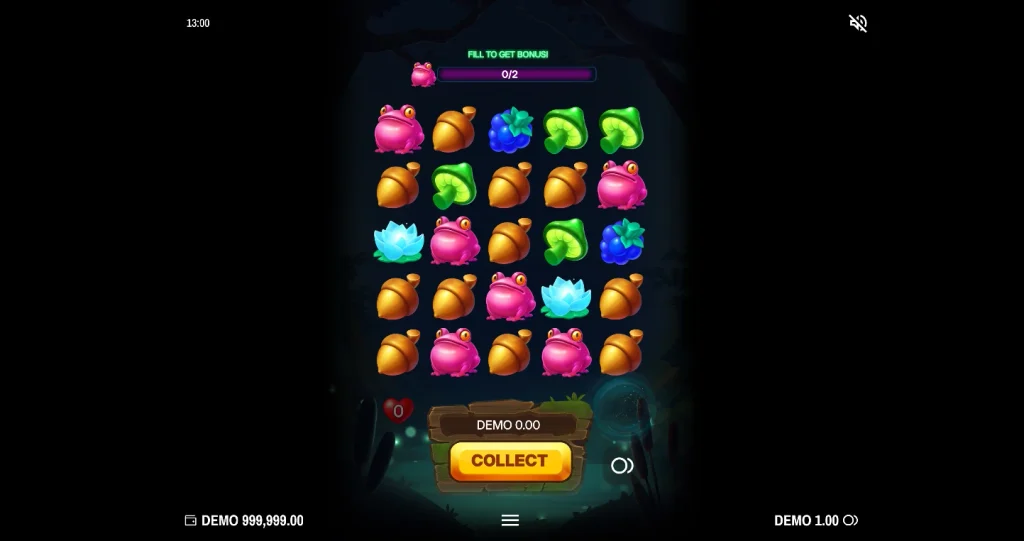
Witchy Rush, full title Witchy Rush: Match3, is a real-money game from a studio called The Hood, currently at version 1.0.3. The official rules describe it as a Match-3 slot with a 5×5 playing field and Swipe to Win mechanics. You drag one symbol onto an adjacent position to line up three, four, or five identical symbols in a row, the way you would in any mobile puzzle game. The difference is that each swipe costs your full bet amount, and each winning line pays according to a paytable rather than points.
The important structural fact is what happens to those wins. They are not paid to your balance. They accumulate in a Cash Pot displayed on a Collect button, and they only become yours when you press Collect. At any moment, a swipe can trigger a random event the game calls Cash Lost, which resets the entire pot to zero and refreshes the board. The Hood has published no release date or company background that can be independently verified, and at the time of writing no major aggregator or review database lists the title, so the in-game documentation is the only primary source available.
A session is a continuous loop rather than a sequence of discrete rounds. You set a bet between $0.10 and $100.00, then swipe a symbol onto a neighbouring cell. The bet is deducted for that swipe regardless of outcome. If the swipe completes a line of three, four, or five identical symbols, the line pays, the winning symbols disappear, and new symbols drop in through a cascade. Cascades can chain: each new winning combination formed by falling symbols clears and refills again until no more lines exist, and no additional bets are charged during a cascade sequence. The bet amount is locked while cascades resolve.
The random number generator determines two separate things on every swipe: which symbols fall into the refreshed positions, and whether that swipe triggers Cash Lost. The rules state plainly that any symbol swipe may result in a random Cash Lost, at which point all winnings accumulated on the Collect counter are reset and the playing field is replaced. The game does not publish the probability of this event, does not signal it in advance, and does not scale it visibly with the size of your pot. You are told it can happen; you are not told how often.
Several persistent systems sit on top of this loop. A Progressive Multiplier counter accumulates multiplier symbols that land randomly after cascades, and the accumulated total is applied to each winning round until you press Collect or a Cash Lost occurs, either of which resets it. A task bar above the field asks you to collect a set number of combinations with a required symbol, paying a randomly chosen bonus of free swipes, a multiplier, a bonus symbol, or a life symbol on completion; that progress also resets on Cash Lost. Special symbols arrive through cascades: a Spinning Top converts random symbols into whatever you swipe it onto, a Rocket clears a full row or column, a Bomb destroys the eight cells around itself, and a Life symbol banks into a counter under the field and absorbs one Cash Lost, preserving your pot and decreasing by one. There are no risk level settings and, notably, no automatic collect function. The decision to bank the pot is always manual.
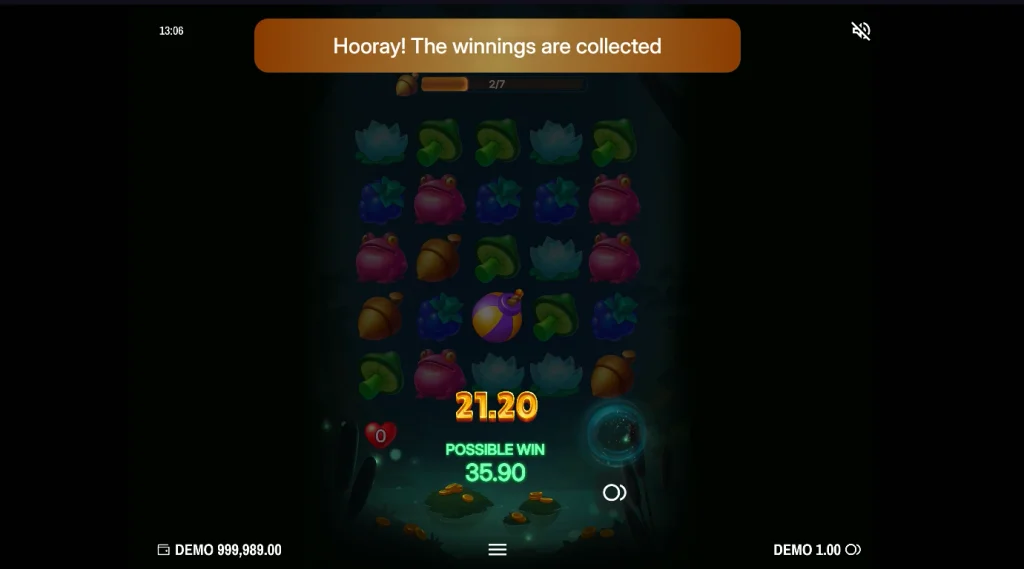
The in-game information panel publishes an RTP of 97.50% with volatility labelled Low. That is the only first-party figure available, and it is a comparatively generous one: it means the house retains approximately $2.50 of every $100 wagered over a large number of swipes. Most video slots sit between 94% and 96.5%, so on paper Witchy Rush is cheaper to play than the average slot. Whether operators can configure lower RTP versions is not documented, and since no aggregator lists the game, there is no independent confirmation of the published figure.
The per-swipe charging model makes wagering velocity the number that matters. Expected loss per hour equals the house edge multiplied by swipes per hour multiplied by the average stake per swipe. Assume a moderate pace of 240 swipes per hour, one swipe roughly every fifteen seconds once cascade animations are included. At a $0.50 stake, the expected loss is 2.5% x 240 x $0.50, which is $3.00 per hour. At $5.00 per swipe, the same arithmetic gives $30.00 per hour. A fast player doubling that pace doubles the cost. Because every move is a full bet, an hour of casual-looking puzzle play can turn over far more money than an hour of a conventional slot at the same nominal stake.
The Low volatility label deserves scepticism in practice. Individual line hits may be small and frequent, which is what the label technically describes, but the Cash Lost mechanic concentrates outcomes into lumps: you do not lose swipes so much as you lose pots. A player can run up a pot worth dozens of bets, feel well ahead of the game, and surrender all of it on one unlucky swipe. Short-term results will therefore swing harder than the volatility label suggests, while the 2.5% edge grinds on underneath regardless of when you collect. Pressing Collect early or late does not change the expected value of the game; it only changes how much of your result rides on any single Cash Lost roll.
No. The official rules contain no provably fair mechanism, no server seed or client seed system, no published hash of upcoming outcomes, and no verification tool. Nothing in the documentation indicates certified RNG testing by a named laboratory either, and no test-house certificate for the title could be located. This is worth being precise about, because the two mechanics a player would most want to verify, the symbol distribution and the Cash Lost probability, are exactly the ones that remain invisible.
In a genuine provably fair implementation, the operator commits to a hashed server seed before play, combines it with a client seed the player can set, and reveals the seed afterwards so each outcome can be recomputed independently. Witchy Rush offers none of that chain. In practical terms, a player is relying entirely on the honesty of the developer and whichever operator hosts the game. The published 97.50% RTP cannot be audited from the outside, and the frequency of Cash Lost events cannot be distinguished from bad luck by any means available to the player. That does not mean the game is dishonest; it means honesty is an assumption you are asked to make, not a property you can check.
The mechanical design is genuinely more engaging than the button-holding that defines most instant-win formats. Swipes are real decisions: board reading, setting up cascades, choosing where to deploy a Spinning Top or a Rocket, and timing the Collect press give the player continuous agency, even though none of it changes the underlying edge. The special symbols interact sensibly, and the Life symbol is a well-designed pressure valve that creates real strategic texture around when to keep swiping.
The published RTP, taken at face value, is another strength. At 97.50%, the theoretical cost of play is materially lower than typical slot territory, and the $0.10 minimum swipe keeps the entry price low. The rules document itself is also clearer than average for a small studio: bet handling during cascades, multiplier reset conditions, and the Cash Lost effect on task progress are all stated explicitly rather than left vague.
The disclosure gaps are serious. There is no documented maximum win or maximum multiplier, so a player cannot know the ceiling of the game they are funding. The Cash Lost probability, the single most important risk parameter in the entire design, is undisclosed. There is no provably fair system and no named testing certificate. The developer has essentially no public footprint, no aggregator coverage, and no visible player community, which means no independent scrutiny of any published figure.
The design also leans on retention mechanics that deserve naming. Task progress that resets on Cash Lost manufactures sunk-cost pressure to keep swiping when a bar sits at thirteen of fifteen. The absence of any auto-collect option forces continuous active engagement with the banking decision, and an accumulated multiplier counter that dies on Collect actively discourages banking. These are engagement tools borrowed from free-to-play puzzle games, applied to an environment where every swipe costs money.
The player best served here is a low-stakes, decision-oriented player who enjoys match-3 puzzles, wants some agency between bets, and treats the session as paid entertainment. Swiping at $0.10 to $0.50 with a firm rule about collecting at a fixed pot size, and a bankroll sized to the per-hour cost calculated above, gets the most from the format at a theoretical cost of a few dollars per hour.
A player who values transparency above all else should look elsewhere. Anyone who chooses games on verifiable fairness, published maximum wins, and independent audit trails will find none of that here and should prefer titles with a full seed-commitment provably fair chain or a named test-lab certificate.
The player who should avoid Witchy Rush entirely is anyone prone to tilt, loss-chasing, or difficulty stopping. The combination of per-swipe charging, resetting task bars, a multiplier that punishes banking, and instant pot wipes is close to a worst-case design for impulsive play, and the speed of the loop means losses compound faster than they appear to.
Witchy Rush is built for fast, continuous play: every swipe is a full bet, there are no natural pauses between rounds, and losses can accumulate more quickly than in slower casino formats. The game offers no auto-collect, so discipline has to come from the player, and banking the pot early does not change the house edge in any case. Set a loss limit and a time limit before you start, not after a losing streak, and treat the expected hourly cost as the price of the session. If gambling stops feeling like entertainment, help is free and confidential: GambleAware (international) at begambleaware.org, GamCare (UK) at gamcare.org.uk, the National Council on Problem Gambling (US) at ncpgambling.org or 1-800-522-4700, and Gambling Therapy (international) at gamblingtherapy.org. 18+ only.
Witchy Rush is a cleverly built collect-or-bust game wearing a puzzle costume, with an attractive published RTP and an unusually engaging core loop for the genre. The strongest reason to play it is the combination of a 97.50% theoretical return and genuine moment-to-moment decisions at stakes starting from $0.10. The most important reason for caution is that nothing about it can be verified: no provably fair chain, no test certificate, no disclosed Cash Lost probability, no documented maximum win, and no independent coverage of the developer. It is a reasonable pick for a disciplined, low-stakes puzzle enthusiast who accepts the trust assumption, and the wrong game for anyone who needs transparency or struggles to walk away, which makes it worth playing only with those specific caveats. The fact most reviews would never tell you, because at the time of writing no other reviews of this game appear to exist, is that Witchy Rush is not a crash game at all but a match-3 slot whose entire risk profile hangs on one undisclosed number: the probability of Cash Lost.
The RTP of Witchy Rush is 97.50%, as published in the game’s own information panel at version 1.0.3. No independent aggregator currently lists the game, so this figure has not been externally confirmed, and possible operator-level RTP configurations are not documented.
No. The official rules describe no provably fair mechanism, no server or client seed system, and no verification tool, and no independent RNG certificate for the title could be located. Players are relying on the developer’s and operator’s honesty rather than on anything they can check.
The maximum win is not publicly documented. Neither the in-game rules nor any external source states a win cap or maximum multiplier, which is a meaningful disclosure gap for a real-money game.
Witchy Rush is a match-3 game on a 5×5 grid where every symbol swipe deducts your full bet, and wins from lines of three, four, or five identical symbols accumulate in a pot rather than paying out directly. You keep the pot only by pressing Collect before a random Cash Lost event wipes it, with cascades, an accumulating multiplier, task bonuses, and special symbols layered on top.
The house edge is 2.50%, derived from the published 97.50% RTP. At 240 swipes per hour, that translates to an expected loss of about $3.00 per hour at a $0.50 stake and about $30.00 per hour at a $5.00 stake.
There is no evidence the game is rigged, but there is also no way for a player to verify that it is not. With no provably fair system, no published test certificate, and an undisclosed Cash Lost probability, fairness rests entirely on the developer and operator, so players should weigh that trust assumption before depositing