Author Spencer Thorne
September 22, 2026

The game is called KO Million, and the most important number in its rules panel is 20,000: the hard cap, in dollars, on any single win. Nothing in this game pays a million, and at the maximum bet the cap turns the whole top end of the ladder into decoration. KO Million also carries a published 95.5% RTP from the same studio whose flagship Chicken Road runs at 98%. It launched on 8 September 2026, so there is no independent player track record yet.
| Detail | Information |
|---|---|
| Developer / provider | InOut Games |
| Game type | Step multiplier instant game (boxing theme), sold alongside crash titles |
| RTP | 95.5% (source: InOut Games official game page) |
| House edge | 4.5% (derived from the published RTP) |
| Max multiplier | Not published; every payout is capped at $20,000 (in-game rules) |
| Min stake | $0.12 |
| Max stake | $200 |
| Risk level settings | Yes, four: Easy, Medium, Hard, Hardcore |
| Provably fair | Not documented for this title |
| Auto-cashout | No (manual cashout; optional Space key shortcut to advance) |
| Demo available | Yes (on the developer’s site) |
| Mobile compatible | Yes (HTML5) |
KO Million is a boxing themed instant game from InOut Games, the studio behind Chicken Road. Despite being grouped under the crash label, it is not technically a crash game. In a crash game, a shared multiplier rises on a timer and the round ends whenever the algorithm decides, with or without you. In KO Million, nothing happens until you act: the in-game rules describe the loop as picking a difficulty, placing a bet, then throwing punches, with each punch raising the multiplier and a cash out available at any time.
That makes it a step multiplier game, the same structural family as Chicken Road and the Mines variants, dressed as a boxing match. You advance one decision at a time, and after every successful punch you choose between banking the current multiplier and risking the whole position on the next one.
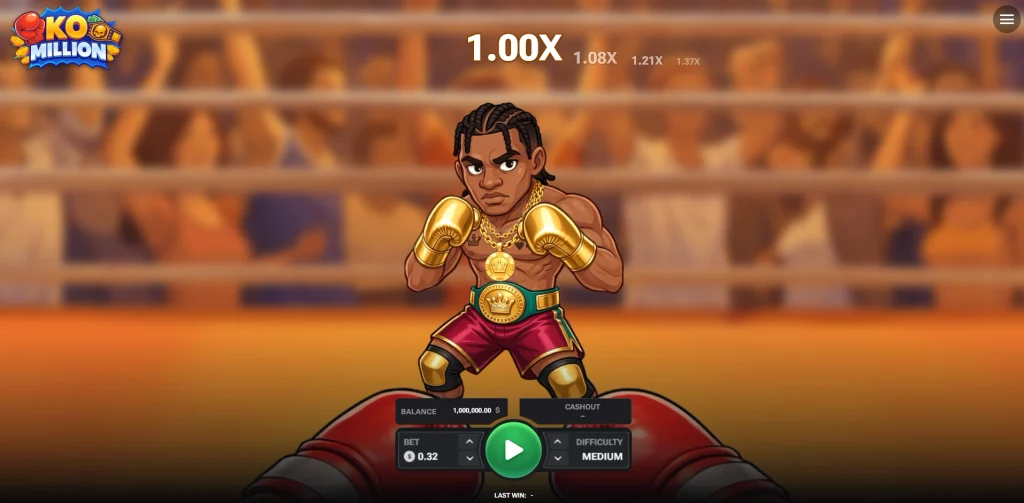
A round begins when you set a stake between $0.12 and $200, pick one of four difficulty levels and start the fight. Each punch that lands moves you up a multiplier ladder, and the client shows the next rungs ahead: at Medium, a new fight opens at 1.00x with 1.08x, 1.21x and 1.37x visible as the next steps, so the early ladder climbs by roughly 8% to 13% per punch. What ends a round is stated plainly in the rules: each fight has a hidden K.O. step, and when you reach it, the bet is lost. The bust point is a property of the fight, expressed in punches rather than seconds, and the RNG’s job is to determine where it sits; the only information you act on is how far you have already climbed.
The four difficulties trade multiplier growth against how soon the knockout can arrive. Easy sets a weaker opponent with slower multiplier growth. Medium grows faster with the K.O. arriving sooner. Hard ramps the ladder fastest, and the rules state outright that the knockout can land on the very first punch. Hardcore goes beyond that, with the steepest ramp of all, and the developer’s rules describe it as only for high rollers. Cashing out is a manual button press between punches; there is no auto-cashout at a preset multiplier, and the only automation adjacent feature is an optional Space key shortcut that throws the next punch. Two further rules matter: any cash out exceeding the maximum win pays only the $20,000 cap, and a malfunction voids all pays and plays.
InOut publishes a 95.5% RTP for KO Million on its official game page. That corresponds to a 4.5% house edge, which means the game retains approximately $4.50 of every $100 wagered over a large number of rounds.
Put into hourly terms, the formula is straightforward: expected loss per hour equals house edge multiplied by rounds per hour multiplied by average stake. Step games are player paced, but a steady session of short fights lands around 60 rounds per hour, and that is the assumption used here. At a $1 stake, the expected cost is 4.5% of $60 wagered, or about $2.70 per hour. At a $5 stake, the same session wagers $300 and carries an expected cost of about $13.50 per hour. For comparison, the same hour on the studio’s own Chicken Road at its published 98% RTP costs about $1.20 at a $1 stake. The boxing theme is, in expectation, more than twice as expensive as the chicken.
The win cap deserves its own arithmetic, because it changes what each difficulty is worth. With a $20,000 maximum win, the effective ceiling is 20,000 divided by your stake: about 166,666x at the $0.12 minimum and just 100x at the $200 maximum. A max stake player on Hardcore is therefore paying the steepest knockout risk in the game for a ladder that stops paying after 100x. The rational pairing runs the other way: extreme difficulties only deliver their tail at small stakes, while large stakes belong on the gentler ladders if anywhere.
Volatility hides the 4.5% edge in any single session: it is an average over an enormous number of rounds, and short sessions scatter widely around it. A player stringing together deep runs at Hard can be up many multiples of their stake in minutes, entirely consistently with a 4.5% long run take. The difficulty settings shift where the variance sits rather than what the game costs: Easy pays small multipliers often and produces long, unremarkable sessions, while Hard and Hardcore fail early most of the time and concentrate the returns into rare large hits. What is still missing is the per step knockout probability at each level, so the trade-off is certain in direction but not verifiable in detail.
This is where KO Million falls short of what a careful player should want. InOut Games markets its catalogue on provable fairness and operates under a Curacao licence, but neither the official KO Million page nor the in-game rules document any verification mechanism: no hash function is named, no server seed and client seed procedure is described, and no method is published by which a player could independently confirm that a fight’s hidden K.O. step was committed before they bet. The only integrity language in the rules panel is the malfunction clause, which protects the operator, not the player.
A genuine implementation hashes a secret server seed and shows you that hash before the round, combines it with a client seed you can set yourself plus a nonce that counts your bets, derives the outcome from that combination, and reveals the server seed afterwards so you can recompute both the hash and the result. If all of that is available, the operator mathematically cannot have altered the outcome after seeing your bet. Anything less, a fairness badge, a licence logo, a post round hash with no committed seed chain, is a trust claim rather than a proof.
As things stand, a KO Million player is relying on InOut’s certification and the integrity of the operator hosting the game, not on anything they can check themselves. That is normal for most certified casino content and not an accusation of wrongdoing, but a hidden bust point is precisely the kind of mechanic verification exists for, and in a genre distributed heavily through crypto casinos its absence is a real gap.
The core design decision is a good one: risk entirely in the player’s hands, with no timer and no shared round, is the most player friendly structure in this category, and the interface supports it well by displaying the next rungs of the ladder ahead of your position, so every punch is a decision made against a visible price. With short rounds and a single button cash out, you always know exactly what you are risking and what you stand to bank.
The disclosure that does exist is also genuinely useful. A published 95.5% RTP, clearly stated bet limits from $0.12 to $200, a stated win cap and plainly worded difficulty descriptions put KO Million ahead of the many titles in this genre that publish nothing at all. A free demo on the developer’s site lets all of it be explored before any money is involved.
The knockout is a black box. The rules confirm each fight has a hidden K.O. step, but nothing tells you the probability of surviving any given punch at any difficulty, and the studio’s own Chicken Road shows this is a choice rather than a necessity: that game displays its odds and full ladder up front, while KO Million shows you only the next few rungs and asks you to trust the rest. For a game whose entire appeal is choosing your own risk level, hiding the risk numbers is the design’s central contradiction.
The value case is also weak. At 95.5%, KO Million sits 2.5 points below the studio’s best known title and below the roughly 97% to 99% range leading step games have normalised, with no visible feature that justifies paying double Chicken Road’s long run cost for a similar decision loop. The name overpromises too: a title built around the word million pays at most $20,000, and at max stake the cap arrives at just 100x. Finally, the game is too new to have a community record: there is no meaningful independent player discussion on Reddit, Bitcointalk or the usual forums yet.
The player who gets the most from KO Million is a small stakes step format fan who values controlling every decision and is drawn enough to the boxing presentation to knowingly pay for it. At low stakes the win cap is irrelevant and the harder ladders keep their full tail, so a few dollars per hour in expected cost buys a well presented version of the format; short sessions, early cash outs and a preset loss limit suit this player best.
The player who should consider an alternative is anyone choosing primarily on value or on transparency. The same studio and the wider genre offer structurally similar games with published RTPs around 97% to 98% and visible per step odds, at roughly half the hourly cost. They should pick one of those and treat KO Million as an occasional change of scenery at most.
The player who should avoid KO Million entirely is the high roller it appears to court, along with anyone for whom fast, repeatable risk decisions are a known problem. At the $200 maximum, everything above 100x is clipped to the cap, which makes Hardcore’s risk profile mathematically pointless at exactly the stakes its description invites. And because rounds are short and the next punch is always one tap away, the format itself works against anyone prone to chasing losses.
KO Million is built for speed: rounds last seconds, the next fight is immediate, and losses can accumulate far faster than in slower casino formats. The player controlled cash out helps with discipline inside a round but changes nothing about the 4.5% the game keeps on average. Set a loss limit and a time limit before the first round, not after a losing streak, and treat the expected hourly cost above as the realistic price of playing. If gambling is causing you problems, free confidential help is available internationally from GambleAware at begambleaware.org and Gambling Therapy at gamblingtherapy.org, in the UK from GamCare at gamcare.org.uk, and in the US from the National Council on Problem Gambling at ncpgambling.org or on 1-800-522-4700. This game is for adults aged 18 and over only.
KO Million is polished and honestly documented on the surface and a black box at its centre, with a theme doing more selling than the numbers can support. The strongest reason to play it is the structure: fully player paced risk with visible upcoming rungs, clearly published limits, and a free demo to learn it without cost. The most important reasons for caution are the hidden knockout odds with no way to verify them and a 95.5% RTP that prices the game well above genre standard. It is the right game for small stakes step fans who want the boxing fantasy and accept its cost, and the wrong game for value focused players, verification minded players and, counterintuitively, the high rollers its hardest mode advertises to. Worth playing only with those caveats accepted, and here is the fact most coverage of this game will not tell you: the million in the title does not exist anywhere in the rules, which cap every win at $20,000 and, at the maximum bet, at a multiplier of just 100x.
The published RTP of KO Million is 95.5%, stated on InOut Games’ official game page. That equates to a 4.5% house edge, which is higher than the roughly 97% to 98% figures common among leading step and crash titles, including InOut’s own Chicken Road.
There is no publicly documented provably fair implementation for KO Million. InOut Games promotes provable fairness across its catalogue, but neither the official page nor the in-game rules describe a seed commitment scheme, hash function or verification procedure, so players currently rely on the studio’s certification and the operator rather than independent verification.
The maximum win on KO Million is $20,000, stated in the in-game rules, and any cash out above that amount pays only the cap. No maximum multiplier is published, but the cap sets an effective ceiling of about 166,666x at the $0.12 minimum stake and just 100x at the $200 maximum stake.
KO Million is a step multiplier game in which you stake between $0.12 and $200, pick one of four difficulty levels and throw punches, with each successful punch raising your multiplier along a visible ladder. Each fight has a hidden K.O. step that ends the round and loses the stake, and you can cash out manually after any successful punch.
The house edge on KO Million is 4.5%, derived from the published 95.5% RTP. Over a large number of rounds the game retains about $4.50 of every $100 wagered, which at 60 rounds per hour works out to an expected cost of roughly $2.70 per hour at a $1 stake.
There is no evidence that KO Million is rigged, and it comes from a licensed studio whose games run at certified operators. However, each fight’s knockout point is hidden, no verification mechanism is published, and the game only released in September 2026, so players cannot currently prove fairness themselves and there is no community track record either way; its fairness is asserted rather than demonstrable.