Author Spencer Thorne
May 21, 2026

Hamster Run is a tap-based crash game developed by InOut Gaming, released on March 24, 2025. Players launch an animated hamster on a wheel, watching a multiplier climb in real-time until either cashing out manually or triggering a crash that zeros the bet. The core mechanic: tap or hold to build energy, charge a meter, and unlock bonus features including a Lucky Wheel (multipliers from 1x to 1,000x) and a Free Spins mini-slot with enhanced RTP. Each round lasts seconds, ending either in a successful cashout or a wipeout.
This game sits at the intersection of crash and slot mechanics, borrowing the fast-paced multiplier tension from Aviator-style games while layering slot-inspired bonus triggers on top. InOut Games explicitly took inspiration from Hamster Kombat, the viral Telegram tap-to-earn game that captivated millions of users with its simple tap mechanic. Taking cues from Hamster Kombat’s success, InOut Games introduced real stakes, adrenaline-fueled mechanics, and casino-level polish. The connection is deliberate: Hamster Run targets the same psychology (tap a cute hamster for rewards) but adds real-money stakes and casino-grade volatility.
The honest summary: Hamster Run delivers competitive crash game RTP (97%, matching Aviator) with added feature complexity that appeals to players who find pure crash games too minimalist. The Lucky Wheel and Free Spins differentiate it mechanically, and the tap-to-charge energy system creates active engagement rather than passive watching. However, after 14 months in circulation (March 2025 – May 2026), the game shows a concerning absence of organic community discussion across Reddit, Bitcointalk, and gambling forums. InOut Games was founded in 2024, meaning this is a very new studio with limited operational track record. No publicly disclosed third-party audit exists beyond Curacao and Anjouan licensing requirements, and no documented instances of players hitting the theoretical 1,000x cap have surfaced.
This game suits players who want crash game speed with slot-style bonus layers, mobile-first design, and provably fair verification – but those prioritizing established developer reputation or third-party audit certification should note the gaps.
Hamster Run operates at a 97% RTP with medium volatility, positioning it identically to Aviator on the return-to-player metric but with variance characteristics that differentiate session experience. The 3% house edge translates to predictable expected loss over extended play.
Expected Loss Calculation – Three Stake Levels:
Assuming 60 rounds per hour (fast-paced tap gameplay allows approximately 1 round per minute):
These figures represent long-term statistical expectations. Medium volatility means session results will deviate from these averages – sometimes significantly – but over hundreds of rounds, the house edge asserts itself.
How Volatility Affects Session Experience:
Medium volatility in Hamster Run manifests as a balance between frequent small wins and occasional larger multiplier hits. Players won’t experience the slow bleed characteristic of low-volatility games, nor the extreme boom-bust cycles of high-volatility titles. Across a typical 2-hour session at $5 per round, expect approximately $18 in theoretical loss, though actual results may range from substantial profit to losses exceeding $50 depending on how multipliers cluster.
The maximum multiplier of 1,000x carries a hard cap of $1,210,000 regardless of bet size. This means high-stakes players wagering $11,000 per round who achieve the 1,000x multiplier will not receive the mathematically proportional $11 million payout – they cap at $1.21 million. This ceiling significantly alters the risk-reward calculation for high rollers compared to games without such caps.
Statistical Probability Context:
While the 1,000x multiplier is mathematically possible within the game’s provably fair algorithm, no public documentation exists of players achieving this cap in real-money play. The probability of reaching specific thresholds decreases exponentially – hitting 10x multipliers occurs regularly, 50x multipliers appear occasionally, 100x+ multipliers are rare, and the 1,000x ceiling remains functionally theoretical based on available evidence. Players should calibrate expectations accordingly: the median multiplier outcome will cluster in the 1x-5x range, with anything above 20x representing genuine upside rather than baseline expectation.
Hamster Run implements a provably fair mechanism using SHA-256 hash verification. The system combines server seeds, client seeds, and nonce values to generate round outcomes that players can independently verify.
How the Verification Works:
Before each round begins, the server generates a hashed seed value. After the round concludes, the server seed is revealed, allowing players to verify that the hash shown before the round matches the revealed seed after. By inputting the server seed, client seed, and nonce into an external SHA-256 hash calculator, players can confirm the round outcome was predetermined and not manipulated mid-game. This verification process is accessible within Hamster Run’s game settings menu.
Third-Party Audit Status:
InOut Games holds a Curacao e-Gaming license (reference 1668/JAZ) and an Anjouan license (ALSI-202506032-FI2), both requiring RNG certification. However, no publicly disclosed third-party audit from independent testing laboratories (eCOGRA, iTech Labs, GLI, Gaming Associates) has been published for Hamster Run specifically.
For Hamster Run, this means the game passed RNG certification sufficient for Curacao and Anjouan licensing approval, but the specific auditor, audit date, and audit scope are not publicly disclosed. Players can verify individual rounds via the provably fair system, but broader statistical distribution analysis (confirming the RTP holds across millions of rounds) relies on the licensing framework rather than published audit reports.
Fairness Verdict:
The provably fair implementation using SHA-256 provides stronger transparency than standard slot games, which typically offer no player-side verification mechanism. InOut Games’ dual licensing ensures baseline RNG compliance. However, the absence of publicly disclosed third-party audits and the developer’s limited operational history (founded 2024, less than 2 years old) means trust relies on cryptographic verification rather than institutional reputation.
For players: the provably fair system is legitimate and verifiable. The lack of third-party audit publication is standard for smaller Curacao/Anjouan operators but represents a transparency gap compared to UKGC or MGA-licensed games. No documented disputes over outcome fairness have surfaced, though the game’s 14-month existence limits the sample size of player experiences.
Overall fairness verdict: Acceptable for players comfortable with provably fair cryptographic verification. Players who prioritize third-party audit certification should note this game relies on licensing standards rather than published independent audits.
Each Hamster Run round begins when the player places a bet and taps “Play” or holds the screen. The RNG determines two outcomes at round start: (1) the crash point (the multiplier at which the round ends) and (2) whether bonus triggers occur. The hamster character animates along a wheel interface while the multiplier climbs in real-time from 1.00x upward. Players must cash out before the crash point to lock in winnings. If the crash occurs before cashout, the bet is lost.
The RNG operates on a predetermined crash distribution curve weighted toward lower multipliers – the majority of rounds end between 1.00x and 3.00x, with exponentially decreasing probability at higher values. The provably fair system ensures this distribution is verifiable post-round via hash checking.
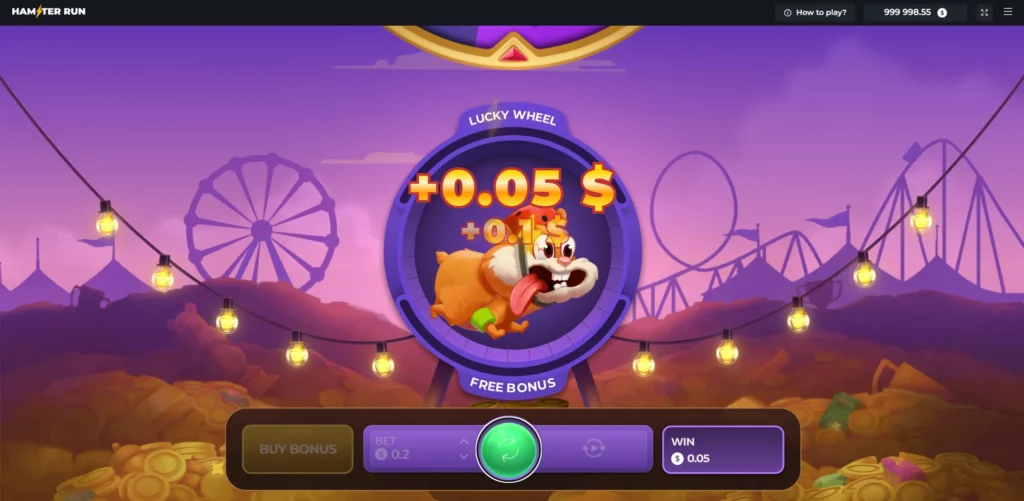
Hamster Run introduces an energy meter mechanic absent from pure crash games. Each tap or hold action charges the meter incrementally. When the meter fills completely, the Lucky Wheel bonus activates automatically at round end (whether the player cashed out successfully or crashed). This creates a parallel progression system – players aren’t just chasing multipliers, they’re also working toward guaranteed bonus spins.
The energy meter requires approximately 15-25 rounds of normal play to fill, varying based on tap frequency and round length. This pacing ensures bonus triggers occur regularly enough to maintain engagement without becoming predictable.
When activated, the Lucky Wheel offers multipliers applied to the player’s bet amount from the triggering round. The wheel uses weighted probability – lower multipliers dominate the distribution, with higher values becoming increasingly rare. The theoretical maximum is 1,000x, though actual probability approaches zero.
The wheel spin is non-interactive (players cannot influence the outcome), and the result applies to the bet size of the round that triggered the wheel, not a separate wager. This means filling the energy meter on a $1 bet yields a wheel spin on that $1 stake, while filling it on a $10 bet multiplies against $10.
The Free Spins feature activates through symbol collection or energy accumulation, launching a mini-slot with enhanced RTP and the chance for sticky Wilds or multiplier boosters. This mode operates as a separate game layer with its own reels and paytable, distinct from the main crash mechanic. Free Spins typically award 3-10 spins depending on the trigger method, with each spin offering the potential for Wild symbol substitution and multiplier application.
The mini-slot RTP is higher than the base game’s 97%, though the exact figure is not publicly disclosed. This creates a dual-RTP structure where bonus-heavy sessions outperform base-game-only sessions over equivalent timeframes.
Auto-cashout allows players to preset a target multiplier (e.g., 2.5x) at which the system automatically cashes out. The feature executes reliably based on available information, with no documented slippage issues (delayed execution causing cashouts at different multipliers than set) publicly reported. Auto-cashout does not interact with the energy meter – tapping is required to charge the meter, so players relying exclusively on auto-cashout will never trigger Lucky Wheel bonuses without manual tap engagement.
The tap-to-charge energy system distinguishes Hamster Run from passive crash games. Unlike Aviator, where players simply watch and click cashout, Hamster Run demands continuous tap engagement to optimize bonus frequency. This design discourages purely automated play and rewards active sessions. The hybrid structure (crash core + slot-style bonuses) also sets it apart – most crash games offer pure multiplier climbing without layered feature triggers.
Extensive searches across Reddit, Bitcointalk, TrustPilot, CasinoGuru, and specialized gambling strategy forums yielded no organic player threads, strategy debates, complaint discussions, or community-generated content specific to this game. Every search result returned promotional content, affiliate sites, or casino marketing materials – but zero authentic player-to-player discussion.
What This Absence Means:
The lack of community formation after more than a year in public circulation is significant. While new games require time to build organic communities, 14 months is sufficient for:
The complete absence of such content suggests either: (1) extremely low player adoption despite marketing presence across multiple casino platforms, or (2) the game hasn’t generated sessions engaging enough to spark discussion. Neither explanation is particularly positive for a game marketed as a “viral hit” and “trending” title.
No Documented x1,000 Multiplier Achievements:
Despite the 1,000x multiplier being prominently marketed as achievable, no public records exist of players hitting this cap in real-money play after 14 months – no streamer clips, no Reddit celebration posts, no casino announcements, no forum victory threads. This raises questions about the practical probability threshold: mathematically possible does not necessarily mean realistically achievable within normal session lengths or bankrolls.
Positive Observations Worth Noting:
Players mentioned in promotional content describe the mobile optimization positively, the visual charm of the hamster character, and the clarity of the interface. However, these observations come from affiliate sites rather than independent forums, limiting their credibility as unbiased player feedback.
The Community Truth:
Until Hamster Run generates organic discussion independent of promotional channels, the “community consensus” remains unavailable. The 14-month void in player-generated content is the most significant finding from community research – not what players say about the game, but that they say virtually nothing at all.
Core Mechanic Difference:
Aviator by Spribe is pure crash – a plane climbs, multiplier rises, players cash out. No bonuses, no energy meters, no mini-slots. Hamster Run layers Lucky Wheel and Free Spins on top of crash mechanics, making it structurally more complex.
RTP Comparison:
Both operate at 97% RTP. Identical long-term payout percentage, though Hamster Run’s bonus features introduce variance in how that 97% manifests across sessions.
Max Multiplier Comparison:
Hamster Run caps at 1,000x ($1.21M ceiling). Aviator caps at 100x in most implementations. Hamster Run offers 10x higher theoretical maximum, though achieving 100x+ in either game remains rare, and no documented instances of Hamster Run’s 1,000x exist after 14 months.
Provably Fair Status:
Both implement provably fair systems. Aviator benefits from Spribe’s longer market presence (launched 2019 vs Hamster Run’s March 2025 launch) and broader operator adoption, which builds institutional trust through sheer exposure.
Which Player Should Choose Which:
Choose Hamster Run if you want bonus features, tap engagement, and thematic design over minimalist abstraction. Choose Aviator if you prioritize developer track record (Spribe’s 7 years vs InOut Games’ 2 years), social multiplayer features, and wider casino availability. The RTP is identical – the choice comes down to mechanical preference and trust weighting.
Same Developer, Different RTP:
Chicken Road by InOut Games, operates at 98% RTP – a full percentage point higher than Hamster Run’s 97%. Both games share the arcade-style animal theme and fast pacing.
The Comparison Reveals:
InOut Games can deliver 98% RTP (proven in Chicken Road), so the 97% figure for Hamster Run represents a deliberate design choice rather than a developer ceiling. Players optimizing strictly for RTP should note Chicken Road offers better math from the same studio.
BGaming Crash operates at 99% RTP, the highest among major crash games, significantly outperforming Hamster Run’s 97%. BGaming’s implementation is minimalist (ascending line graph, no thematic elements) but mathematically superior.
The Trade-Off:
BGaming Crash offers 2 percentage points better RTP but zero bonus features. Hamster Run offers Lucky Wheel, Free Spins, and thematic engagement at the cost of that 2% edge difference. For grinders focused purely on expected value, BGaming Crash wins. For players valuing feature variety, Hamster Run compensates with entertainment layers.
Hamster Run sits in the mid-tier of the crash game market: competitive RTP (97% matches Aviator), differentiated mechanics (bonuses rare in pure crash games), but severely limited track record (new developer, new game, zero organic community adoption). It’s neither a market leader (Aviator holds that position) nor a mathematical standout (BGaming Crash, Chicken Road offer better RTP).
Positioning statement: Hamster Run is a mechanically competent alternative for players who find Aviator too stark and want crash game pacing with slot-style bonus triggers, provided they’re comfortable with a 2-year-old developer, the absence of third-party audit publication, and the complete lack of community validation after 14 months in circulation.
InOut Games operates under Curacao eGaming license (1668/JAZ) and Anjouan license (ALSI-202506032-FI2), both with certified RNG technology, meeting licensing requirements. However, no independent audit from eCOGRA, iTech Labs, GLI, or Gaming Associates has been publicly disclosed. Players can verify individual rounds via the provably fair system, but broader statistical validation relies on trust in the licensing framework rather than published audit reports.
InOut Games was founded in 2024 and currently has approximately 30 titles in its library. The company is less than two years old, meaning extremely limited operational history for assessing dispute resolution practices, payout reliability under stress conditions, or long-term business stability. While newness doesn’t inherently indicate problems, it does mean unknowns exist that established developers (Spribe founded 2019, BGaming founded 2018, Pragmatic Play founded 2015) have already resolved through years of market presence.
The most significant red flag: zero authentic player discussion across Reddit, Bitcointalk, gambling forums, or player communities after 14 months of availability (March 2025 – May 2026). This suggests either critically low player adoption or insufficient engagement to generate the organic content typical of successful casino games. For comparison, Aviator generated extensive Reddit threads, strategy guides, and community discussion within 6 months of launch.
The $1,210,000 maximum win ceiling applies regardless of stake size or multiplier achieved. Players wagering $11,000 per round who hit the 1,000x multiplier will cap at $1.21M rather than the proportional $11M payout. This ceiling is disclosed in terms but not prominently displayed in marketing materials. High-stakes players should factor this cap into risk-reward calculations.
Despite marketing the 1,000x multiplier as achievable, no public records, streamer clips, forum posts, or casino announcements document players hitting this theoretical maximum in real-money play after 14 months of availability. The probability may be so low as to render it functionally unattainable within typical session lengths, making it more of a marketing ceiling than a realistic target.
Hamster Run is not available as a standalone app in app stores and can only be accessed through casino platforms that include InOut Games titles. This distribution model adds an intermediary layer – players interact with casino implementations rather than directly with the developer. Platform-specific issues (payout delays, bonus disputes, account restrictions) fall under casino terms rather than developer control, fragmenting accountability.
Chicken Road by InOut Games operates at 98% RTP vs Hamster Run’s 97%, raising the question: why does the newer game have lower RTP? Players seeking optimal math from this specific developer should consider Chicken Road instead.
You are a mobile-first player who wants crash game mechanics with slot-style bonus layers (Lucky Wheel, Free Spins) and values active tap engagement over passive watching. You’re comfortable with a 97% RTP matching Aviator but prefer thematic design (animated hamster) to abstract minimalism. You trust provably fair cryptographic systems and dual licensing (Curacao + Anjouan) without requiring third-party audit publication. You have a modest to medium bankroll ($1-$50 per session) and approach this as entertainment rather than investment, understanding the 3% house edge will assert itself over time. You’re willing to be an early adopter despite the complete absence of community validation – the lack of player discussion doesn’t concern you.
You want higher RTP – Chicken Road (98%, same developer) or BGaming Crash (99%) offer better mathematical edges. You prioritize established developer reputation – Spribe’s Aviator has 7 years of market presence versus InOut Games’ 2-year existence. You require third-party audit certification beyond licensing requirements – Malta or UKGC-regulated games publish audit reports. You’re a high-stakes player focused on maximum win potential without caps – the $1.21M ceiling limits upside. You value community-developed strategy and peer validation – no organic player forums exist for this game after 14 months.
You are uncomfortable with newer developers lacking operational track record – if your risk tolerance demands established history and public dispute resolution documentation, InOut Games’ 2024 founding date is disqualifying. You need community validation before trying new games – the 14-month absence of organic player discussion is historically unusual and concerning. You’re seeking purely mathematical optimization – the 97% RTP is competitive but not category-leading. You’re a bonus-heavy player who dislikes tap mechanics – the energy meter requires manual tapping, making purely passive auto-cashout play suboptimal for accessing features.
You have never played crash games with tap mechanics – Hamster Run’s energy meter and bonus triggers operate differently than pure crash games like Aviator. The demo (available without registration) allows risk-free exploration. Focus on three things during testing: (1) How frequently does the energy meter fill and trigger Lucky Wheel bonuses? (2) What multiplier range appears most commonly – does the advertised 1,000x feel achievable or purely theoretical? (3) Does the tap-engagement design feel rewarding or tedious after 50+ rounds? These observations inform whether the game’s mechanical structure suits your play style before committing real money.
Hamster Run earns a 6.5/10 rating based on competitive RTP (97%), legitimate provably fair implementation, and mechanical differentiation through Lucky Wheel and Free Spins features. The rating is constrained by the developer’s minimal track record (founded 2024, less than 2 years operational), absence of publicly disclosed third-party audits beyond dual licensing requirements, and most significantly – the complete absence of organic community validation after 14 months of availability, which is historically unusual for a game marketed as successful.
The single strongest reason to play this game: The hybrid crash/slot structure with tap-to-charge energy mechanics creates active engagement absent from passive crash games, delivered at a competitive 97% RTP with mobile-optimized design and provably fair verification accessible through in-game settings.
The single biggest reason to be cautious: After 14 months in public circulation (March 2025 – May 2026), zero authentic player discussion exists across Reddit, Bitcointalk, gambling forums, or community channels – suggesting either critically low player adoption or insufficient engagement to generate the organic content typical of successful casino games. Combined with InOut Games being less than 2 years old with no published operational track record, trust relies entirely on cryptographic verification and licensing rather than institutional reputation or peer validation.
Who this game is definitively right for: Mobile-first players who want crash game pacing with slot-style bonus triggers, value thematic design over minimalist abstraction, trust provably fair cryptographic systems without requiring third-party audit publication, and are comfortable being early adopters without community validation.
Recommendation: Hamster Run is worth trying in demo mode for players curious about crash/slot hybrids, but approach real-money play with extreme caution given the complete absence of community adoption after 14 months. The provably fair system and competitive RTP provide mathematical legitimacy, but the lack of any organic player discussion is a significant red flag that cannot be ignored. For players prioritizing maximum RTP, Chicken Road (98%, same developer) offers better math. For players prioritizing established developers with community validation, Aviator’s 7-year market presence and extensive player base outweighs Hamster Run’s feature advantages.
The standout insight worth remembering: InOut Games explicitly designed Hamster Run to capitalize on Hamster Kombat’s viral success – the Telegram tap-to-earn game that peaked at over 300 million users in 2024. Taking cues from Hamster Kombat’s cultural momentum, they introduced real stakes and casino-level polish. This positioning is calculated cultural arbitrage rather than organic innovation. However, 14 months after launch, the complete failure to generate any community adoption suggests the cultural arbitrage strategy did not translate into sustained player engagement. The game exists, it functions, it’s mathematically legitimate – but virtually nobody is talking about it, which for a “viral hit” is the definition of failure. Proceed accordingly.
Hamster Run operates at 97% RTP, verified across multiple sources including InOut Games official site and SlotCatalog. This means over extended play, the game returns $97 for every $100 wagered, with the remaining 3% representing the house edge.
Yes. Hamster Run implements provably fair verification using SHA-256 hash algorithms. Players can verify individual round outcomes by accessing the server seed, client seed, and nonce values through the game settings menu and checking them against external hash calculators. However, no publicly disclosed third-party audit beyond Curacao and Anjouan licensing requirements exists.
The maximum multiplier is 1,000x, but winnings are capped at $1,210,000 regardless of bet size. A player wagering $11,000 per round who hits the 1,000x multiplier will receive $1.21M, not the proportional $11M payout. No documented instances of players achieving the 1,000x cap exist in public records after 14 months of availability.
Both games operate at identical 97% RTP and implement provably fair systems. Hamster Run adds Lucky Wheel and Free Spins bonus features absent from Aviator’s pure crash mechanics, and requires tap engagement to charge an energy meter. Aviator offers broader casino availability, established developer reputation (Spribe founded 2019 vs InOut Games founded 2024), and extensive community discussion. The choice depends on whether you prioritize feature complexity (Hamster Run) or institutional trust and community validation (Aviator).
Yes. Hamster Run offers a demo mode accessible without registration or deposit. The demo uses virtual credits and provides access to all features including Lucky Wheel and Free Spins, allowing risk-free exploration of mechanics before committing real money.