Author Spencer Thorne
October 7, 2026

Space XY is a multiplayer crash game from BGaming in which a rocket climbs across an X-Y graph and players cash out before it explodes. It has a published 97% RTP, two bet panels per round and a €250,000 win cap.
The Space XY game is promoted on a 10,000x maximum multiplier, but BGaming’s own game page also lists a maximum win of €250,000, and those two figures only agree when the stake is 25 or less. A player betting $100 on one panel can never collect more than 2,500x, because the win cap is reached long before the multiplier ceiling.
| Detail | Information |
|---|---|
| Developer / provider | BGaming |
| Game type | Crash (multiplayer, shared rounds) |
| RTP | 97% (source: BGaming official game page) |
| House edge | 3% |
| Max multiplier | 10,000x (win capped at €250,000 per BGaming) |
| Min stake | $0.10 (operator-configured) |
| Max stake | $100 per bet panel (operator-configured) |
| Risk level settings | No |
| Provably fair | Not documented for this title |
| Auto-cashout | Yes (preset values from 1.05x to 10x) |
| Demo available | Yes |
| Mobile compatible | Yes |
Space XY is a multiplayer crash game released by BGaming on 13 January 2022. Every player at a casino connected to the same game server joins the same round. Bets are placed during a short countdown, a rocket then launches across a graph, and the multiplier attached to it climbs from 1.00x until the rocket explodes. Anyone who cashed out before the explosion is paid their stake multiplied by the value at the moment they left. Anyone still holding a bet when it explodes loses that stake.
BGaming describes the graph literally: the horizontal X axis measures how long the rocket has been in the air, and the vertical Y axis shows the current multiplier. That is the origin of the name and the main presentational difference from Aviator, JetX and similar titles. Although Space XY is sometimes listed as a slot in casino lobbies, it has no reels or paylines, and BGaming files it under its casual games. It sits alongside the other crash games and casino mini-games covered on this site.
A round opens with a betting window. Each player has two independent bet panels, and either can be used alone or both together with different stakes. Stake sizes are chosen from a preset list rather than typed in freely.
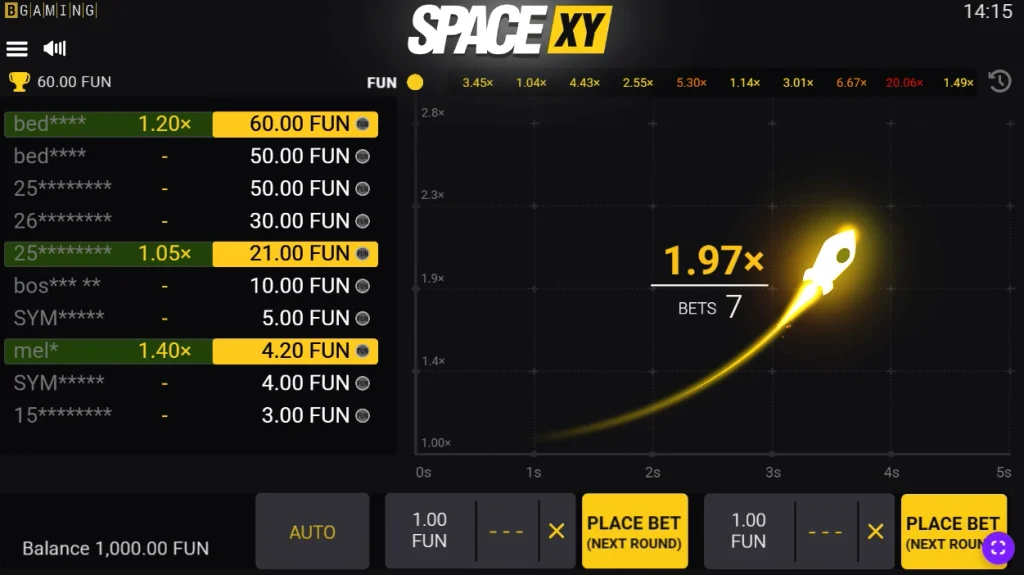
When the window closes, the rocket launches and the multiplier rises in real time. The point at which it will explode is generated by the game server, not by anything the player does. BGaming states that its titles run on certified RNG, but it does not publish documentation explaining at exactly which moment the Space XY crash point is fixed or how it is derived. The round ends when the rocket explodes on screen, at which point the final multiplier is displayed, every uncollected stake is settled as a loss, and the next countdown begins. A round can end almost immediately, which means both panels can be lost before a manual click is physically possible.
Cashing out happens in one of two ways. Manually, the player presses the cashout button on a panel while the rocket is climbing. Automatically, the player attaches a target to the panel before the round starts, and the game cashes out the moment the multiplier reaches it. In Space XY the auto-cashout target is chosen from a fixed list: 1.05x, 1.10x, 1.15x, 1.20x, 1.40x, 1.50x, 2x, 3x, 5x and 10x. Any target above 10x therefore has to be taken by hand, which leaves the player exposed to reaction time and connection latency at exactly the point where the payout is largest. There are no risk levels, difficulty modes or volatility settings; the cashout target is the only variable the player controls.
BGaming publishes an RTP of 97% for Space XY on its official game page. That means the house retains approximately $3 of every $100 wagered over a large number of rounds, a house edge of 3%.
The cost of an hour of play follows from three numbers: expected loss per hour equals the house edge multiplied by the rounds per hour multiplied by the average stake per round. Crash games typically run between 50 and 100 rounds an hour, and this calculation assumes 60 rounds per hour with one panel in use.

At a $1 stake, the expected loss is 0.03 × 60 × $1, which comes to $1.80 per hour on $60 of turnover. At a $10 stake, it is 0.03 × 60 × $10, or $18 per hour on $600 of turnover. Using both panels doubles the turnover, so two $10 bets per round carry an expected cost of $36 per hour. Anyone weighing Space XY as a game for real money should start from these figures rather than from the headline multiplier.
Volatility explains why a session rarely looks like the average. BGaming does not publish the crash-point distribution, so the following figures are illustrative and assume the standard crash design, in which the chance of reaching a target is roughly the RTP divided by the target. On that assumption, a $10 bet with auto-cashout at 2x succeeds about 48.5% of the time. Over 60 rounds, the expected result is an $18 loss, but the standard deviation is about $77, so roughly four hours in ten would still finish in profit. Moving the same bet to a 10x target lowers the success rate to about 9.7% and widens the hourly standard deviation to roughly $229.
That is the real trade-off behind cashout targets, since Space XY has no separate risk settings. A low target produces frequent small wins and a slow, fairly predictable decline. A high target produces long losing runs broken by occasional large payouts. Neither approach removes the 3% edge, and splitting the two panels between a low and a high target simply combines both profiles in one round.
Searches for a Space XY strategy usually come down to choosing cashout targets, and the mathematics above shows the limit of that approach: every target carries the same 3% expected cost, and only the shape of the results changes.
The same logic rules out the Space XY predictor tools, signal channels and bots that are advertised to players. The crash point is generated on BGaming’s server before the rocket moves, and previous rounds carry no information about the next one. A tool that could forecast the result would require access to the server itself, so anything sold as a predictor is at best guesswork presented as analysis and at worst a way to collect payment or account details.
BGaming distributes Space XY through licensed casino operators and does not list a standalone Space XY app or download on its site. The game runs in HTML5 in a mobile or desktop browser, so an APK offered as an official Space XY app download comes from a third party and should be treated with caution.
BGaming has not documented a provably fair mechanism for Space XY. The game’s official page lists auto-cashout, autoplay and multiple bets as features, but not provably fair verification.
BGaming does run a provably fair system on other titles, and its public documentation shows how it works. Before a round, the server calculates the outcome, called the Result, and generates a random string called the Secret. The two are combined and hashed with SHA-256, and that hash is shown to the player before betting. The player can then set a client seed, either their own number or one chosen by the system. After the round, the game reveals the Result and Secret together with the final outcome. To verify, the player pastes the revealed string into any SHA-256 generator, confirms that the output matches the hash shown before the bet, and then applies their client seed to the Result to confirm it produces the outcome they received. BGaming’s worked examples cover roulette, card games and slots. Space XY is not among them.
There is also a structural reason that model does not transfer directly. In a single-player slot, each player’s seed can shape their own outcome. In Space XY, everyone shares one crash point, so an individual client seed cannot alter it. A shared-round crash game needs a different design, usually a published chain of hashed seeds committed in advance, and no such chain is documented for Space XY.
In practice, the check is simple: the game either shows a fairness panel with a hash for the next round before betting, or it does not. Without one, the player is relying on BGaming’s RNG certification and the operator’s integrity. BGaming lists iTech Labs and BMM Testlabs among its certifications and holds a Malta Gaming Authority B2B supply licence, which is meaningful oversight but not a check the player can run on their own round.
The core figures are published by the developer rather than left to operators or aggregators. BGaming’s own page states the 97% RTP, the 10,000x maximum multiplier and the €250,000 cap, which allows a player to calculate costs and ceilings before staking anything.
The two independent bet panels are useful for players who want to separate a cautious bet from a speculative one, and the X-Y graph makes the relationship between flight time and multiplier easier to read than a bare counter. The Space XY demo lets a player watch the speed of rounds and the frequency of early explosions without risking money, and the HTML5 build runs on phones, tablets and desktops.
The fixed auto-cashout list is the main design weakness. Players cannot set targets such as 1.30x or 4x, and nothing above 10x can be automated, so any higher target depends on a manual click. Stake sizes are also preset, which limits fine control over bankroll management.
The fairness position is the second weakness. With no documented provably fair system, players cannot independently confirm any round.
The social side is thin for a multiplayer title. Players can watch other bets and cashouts in the live bets panel, but there is no chat, so the shared round adds atmosphere rather than interaction.
The player who will get the most from Space XY wants a straightforward crash game with a documented RTP, plays low stakes, and is comfortable using the preset auto-cashout targets between 1.05x and 10x. If that player sets a fixed session budget and treats the expected cost of around $1.80 per hour at $1 stakes as the price of entertainment, the game delivers exactly what it describes.
The player who should consider an alternative needs precise control. Anyone who wants custom auto-cashout values, automated targets above 10x, or a player-verifiable fairness record will find Space XY limiting and should look for a crash game that publishes a seed chain and allows free-entry cashout targets.
The player who should avoid this game entirely is the one inclined to chase losses or to aim for the headline multiplier. High-multiplier play cannot be automated here, rounds run continuously, and anyone staking above 25 per bet is pursuing a 10,000x figure that the win cap makes unreachable.
Crash games are designed for fast play. Rounds last seconds, the next one begins almost immediately, and losses can accumulate far more quickly than in slower casino formats. Auto-cashout at a set multiplier can help with discipline, but it does not change the underlying 3% house edge. Set a loss limit before starting, not after a losing streak, and stop when it is reached. Free, confidential support is available internationally from GambleAware at begambleaware.org and Gambling Therapy at gamblingtherapy.org, in the UK from GamCare at gamcare.org.uk, and in the US from the National Council on Problem Gambling at ncpgambling.org or 1-800-522-4700. 18+ only.
Space XY is a competent crash game whose published 97% RTP and clear win cap make it easier to assess than many rivals. Its strongest point is that disclosure, combined with dual bet panels and a free demo. The most important reason for caution is that no provably fair mechanism is documented, so every round rests on certification and trust rather than player verification. It suits low-stakes players who are happy with preset cashout targets and want a simple, fast format, and anyone comparing licensed venues can start from our ranking of the best online casinos. It is worth playing with specific caveats: keep stakes small, use auto-cashout, ignore predictors, and do not chase the headline multiplier. The figure that matters most is the effective ceiling: above a stake of 25, the €250,000 cap makes the advertised 10,000x unreachable, falling to 2,500x at a $100 stake. Other crash and instant titles are covered in our casino mini-game reviews.
The RTP of Space XY is 97%, as published on BGaming’s official game page. BGaming does not publish different RTP figures for individual cashout strategies.
BGaming has not documented a provably fair mechanism for Space XY. The developer’s provably fair documentation covers roulette, card games and slots, and the Space XY game page does not list the feature, so players rely on BGaming’s RNG certification instead.
The maximum win is €250,000, according to BGaming, alongside a maximum multiplier of 10,000x. The full multiplier can only be paid in full at stakes of 25 or less; at a $100 stake the cap is reached at 2,500x.
Players place up to two bets during a countdown, a rocket launches, and its multiplier rises until it explodes at a server-generated crash point. Cashing out before the explosion pays the stake multiplied by the current value, either manually or through a preset auto-cashout between 1.05x and 10x.
The house edge on Space XY is 3%, derived from the published 97% RTP. At 60 rounds per hour, that is an expected cost of $1.80 per hour at $1 stakes and $18 per hour at $10 stakes.
There is no evidence that Space XY is rigged, and BGaming’s RNG is certified by independent testing labs. However, without a documented provably fair system, players cannot verify individual rounds themselves, so fairness rests on the certification and the operator rather than on a check the player can run.
No, Space XY predictors cannot work. The crash point is generated on BGaming’s server and earlier rounds reveal nothing about the next one, so predictor apps, signal groups and bots cannot forecast results.
BGaming does not list a standalone Space XY app or download. The game runs in the browser at casinos that offer BGaming titles, on both mobile and desktop, and a free Space XY demo is available on BGaming’s game page.

High Flyer is a multiplayer plane crash game from Pragmatic Play, released in September 2024, in which players cash out before the aircraft flies away. It publishes a 97% RTP, offers two independent bet spots with auto-cashout and advertises multipliers of up to 1,000,000x.
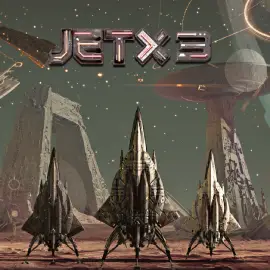
JetX3 is a crash game from SmartSoft Gaming in which three jets take off together, each with its own independent crash point. Players can bet on one, two or all three jets, collect from each separately and reach up to 2,000x per jet.