Author Spencer Thorne
September 3, 2026

The bet limits panel inside Aztec Tower advertises a maximum win of $250,000,000, and that figure is pure decoration. The highest multiplier the game can pay is 9,155x on Hard difficulty, and the maximum stake is $50, which puts the real ceiling at $457,750 per round. The advertised cap sits more than five hundred times above anything the game can mathematically produce, and closing gaps like that is exactly what this review is for.
| Detail | Information |
|---|---|
| Developer / provider | Platipus |
| Game type | Step multiplier instant game (marketed as crash) |
| RTP | 96.14% (source: in-game rules panel) |
| House edge | 3.86% |
| Max multiplier | 9,155x (Hard difficulty, step 10) |
| Min stake | $0.20 |
| Max stake | $50 |
| Risk level settings | Yes (Easy, Medium, Hard) |
| Provably fair | Not documented |
| Auto-cashout | Yes (within Autoplay mode) |
| Demo available | Yes |
| Mobile compatible | Yes |
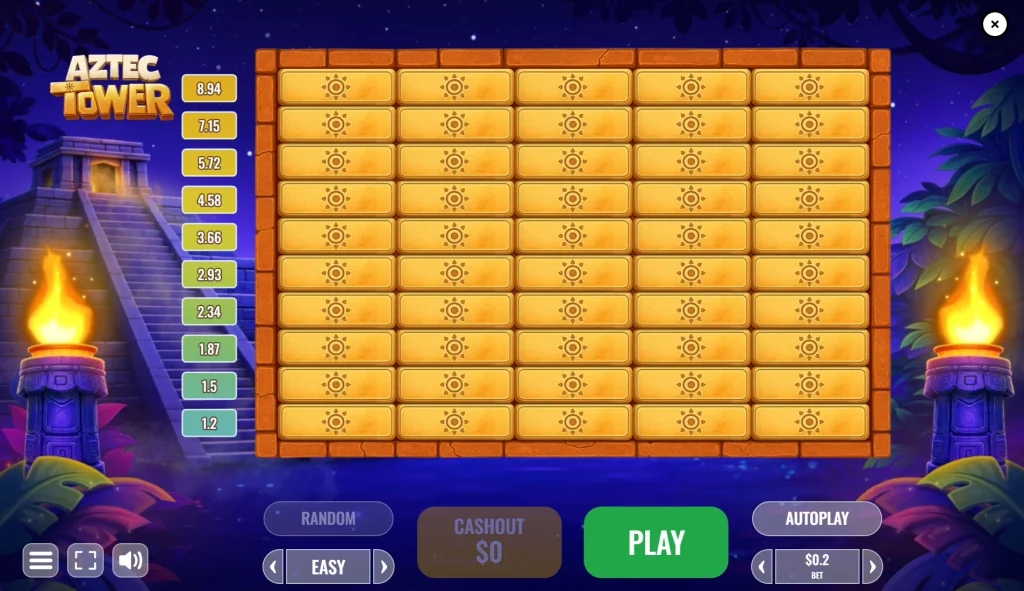
Aztec Tower is an instant game from Platipus, the Isle of Man based studio behind more than 160 casino titles, released in 2026 with its current rules document dated 26 March 2026. Despite being distributed and tagged as a crash game, there is no rising curve and no shared round. Aztec Tower belongs to the step multiplier family alongside Towers and Mines style games. The playing field is a grid of ten rows with five cells in each row.
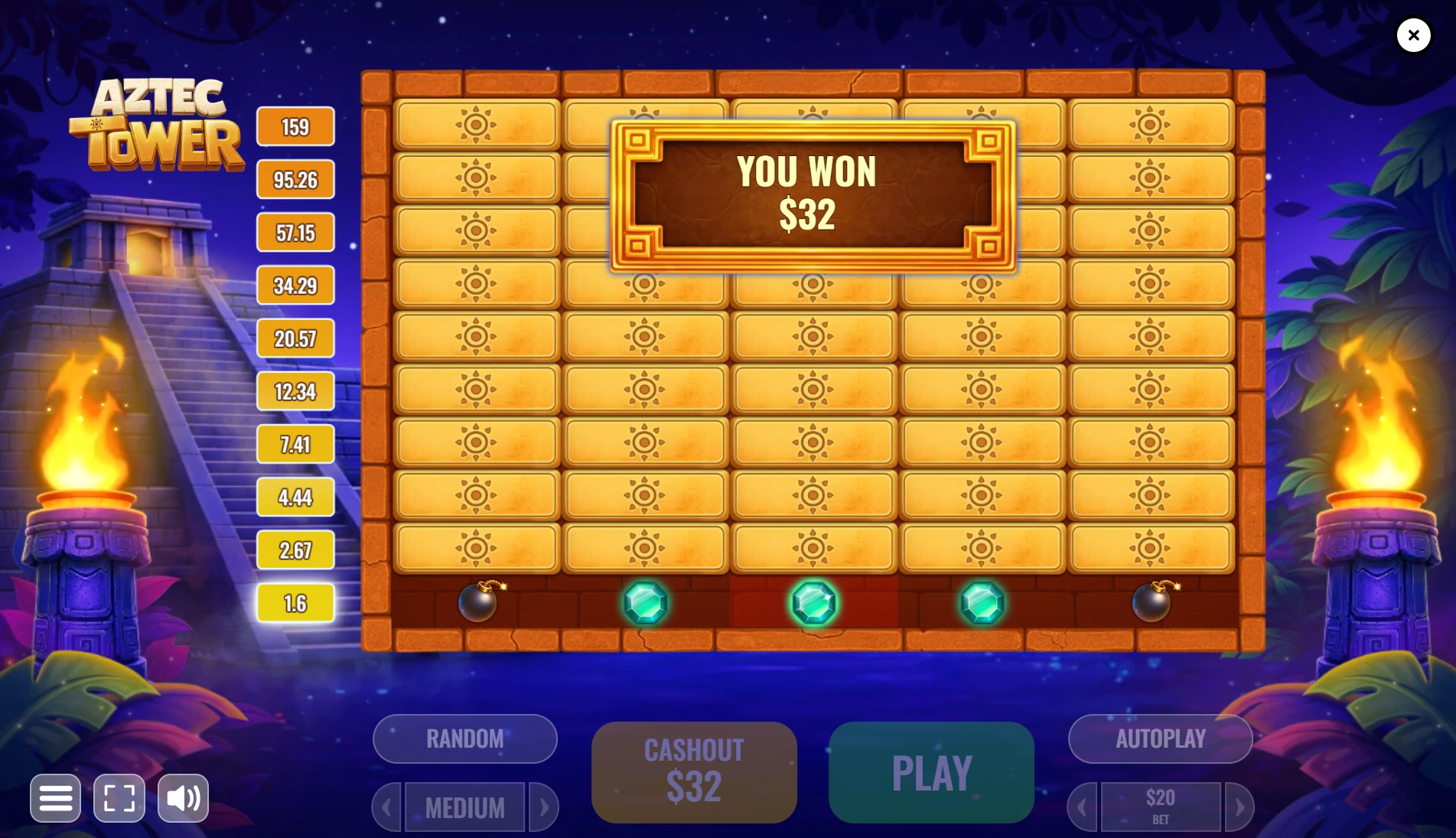
A round starts when the player sets a stake between $0.20 and $50, picks a difficulty, and selects one cell in the bottom row. If the chosen cell hides a crystal, the bet multiplier climbs to the first value on the ladder and the next row unlocks. If it hides a bomb, the round ends and the stake is lost. The player can stop and cash out after any successful step. Clearing all ten rows pays the final ladder multiplier automatically.
Everything that matters happens at the moment of selection. According to the in-game rules, the round continues until the player cashes out, selects a bomb, or reaches the end of the multiplier scale. The server side RNG determines whether each picked cell is safe, and the outcome is communicated instantly: the cell flips, the multiplier ladder on the left of the screen advances one step, and the cashout button updates to show the amount currently secured. There is no timing element at all. Unlike Aviator or JetX, where hesitation costs money because the curve can collapse while you decide, Aztec Tower waits indefinitely between picks. The only decisions are which cell to click and whether to continue.
Difficulty changes the composition of each row rather than the pace. The published multiplier ladders make the underlying structure easy to reconstruct. On Easy, the ladder runs from 1.2x at step one to 8.94x at step ten, and each step multiplies your total by roughly 1.25, which corresponds to four safe cells and one bomb per row. On Medium, the ladder runs from 1.6x to 159x with a step ratio near 1.67, which corresponds to three safe cells and two bombs. On Hard, the ladder runs from 2.4x to 9,155x with a step ratio of 2.5, which corresponds to two safe cells and three bombs in every row of five. The stake and difficulty are locked for the whole round and cannot be changed mid-climb.
A Random button picks cells for you, and Autoplay runs full rounds automatically with a configurable cash-out multiplier, a turbo speed option, and stop conditions for single wins and cumulative losses. The auto cash-out inside Autoplay is a discipline tool, not an edge: it executes the same ladder at the same odds, only without the temptation to deviate. If the connection drops, an unfinished round resumes where it left off or autocompletes with any winnings credited.
Platipus publishes the return figure directly in the game rules: for any bet, the total payout of the game is 96.14%. That means the house retains approximately $3.86 of every $100 wagered over a large number of rounds, on every difficulty. The RTP is stated as a single figure for the whole game, so switching from Easy to Hard changes how the money moves, not how much of it the game keeps.
The cost of playing follows directly. Expected loss per hour equals the house edge multiplied by rounds per hour multiplied by average stake. Assume 60 rounds per hour, a realistic manual pace since rounds end quickly on a bomb or an early cashout. At a $1 stake, the expected loss is 0.0386 × 60 × 1, roughly $2.32 per hour. At a $10 stake it is about $23.16 per hour. Turbo Autoplay can push round counts well past 100 per hour, scaling the expected cost proportionally. These are long run averages, not predictions for any single session.
Volatility is what separates the three modes in practice. The ladder arithmetic implies that a full ten step climb on Easy succeeds about once in nine or ten attempts, while on Hard the survival chance per step is roughly 40%, making a complete climb to 9,155x about a one in 9,500 event. Hard mode sessions therefore consist mostly of first and second row busts punctuated by rare large payouts, while Easy mode produces frequent small wins that grind against the same 3.86% edge. A player can be up substantially after an hour on any setting because short term variance dwarfs the edge, but the mathematics do not bend: the longer and faster you play, the more closely your result converges on losing $3.86 per $100 staked.
One more number deserves attention. The maximum theoretical payout is 9,155 × $50, which is $457,750. The $250,000,000 max win shown in the bet limits table is therefore unreachable by a factor of hundreds, and the accompanying rule that the round automatically cashes out at the max win will never trigger in this configuration. It is boilerplate, not a promise.
Aztec Tower is not provably fair, and nothing in its documentation claims otherwise. A provably fair game commits to its outcomes cryptographically: the server publishes a hash of its secret seed before the round, the player contributes a client seed, and after the round the revealed server seed lets anyone recompute the result and confirm the hash matches, proving the outcome was fixed before any bet was placed. Aztec Tower has none of this apparatus. The in-game rules describe versions, betting, and disconnection handling, but no seeds, no hash function, and no verification page.
What players get instead is the conventional model: a server side RNG operated by Platipus, subject to whatever testing and certification the studio and the licensing regulator of a given operator require. In practice this means you are trusting the developer’s certification chain and the operator’s licence rather than verifying anything yourself. That is the norm for regulated casino content, and it is not evidence of wrongdoing, but it is a genuine difference from titles like Aviator or the original Bustabit lineage, where a motivated player can audit their own round history. Anyone for whom independent verification is the point of playing crash style games should know that this title does not offer it.
The strongest design decision is honest pacing. Because the multiplier only moves when you click, Aztec Tower removes the reaction time pressure that makes continuous crash games punishing, and it turns each round into a sequence of clear, discrete decisions with the secured amount displayed at every step. For a player who likes the risk ladder concept but dislikes racing a curve, that is a real improvement, and the ability to stop and think indefinitely between picks is rare in this genre.
The difficulty system is also more substantive than most risk toggles. Moving from one bomb per row to three transforms the game from a low volatility grind topping out at 8.94x into a lottery shaped hunt for 9,155x, all under the same published 96.14% return. Combined with eight fixed stake values, a functioning demo mode, and Autoplay stop conditions for both wins and losses, the toolkit for controlling exposure is better than the genre average. The published ladders themselves deserve credit: every multiplier for every step is disclosed up front, which is more transparency than many crash titles manage.
The fairness story is the clearest weakness. No provably fair mechanism exists, and Platipus does not publish certification details inside the game beyond the RTP figure, so verification minded players have nothing to work with. The decorative $250,000,000 max win compounds the impression of numbers chosen for effect rather than information.
Discoverability and track record are the other problems. The game is new enough that its rules document dates from March 2026, and there is essentially no independent player feedback to weigh: searches for the title surface an unrelated DreamSpin slot of the same name, an older Platipus slot called Aztec Temple, and even a VR archery game, while forum discussion of this specific title is effectively absent. That is not a fault of the mechanics, but it means anyone playing today is early, without the accumulated community scrutiny that older titles like Aviator have received. Feature depth is also thin: there are no partial cashouts, no dual bets, and no side mechanics, just the ladder.
The player best served here wants a deliberate, turn based gambling session with full control over pacing. They play Easy or Medium at $0.20 to $1, treat the published ladder as a menu, decide before the round which step they will cash out at, and use the demo first. For them the game delivers exactly what it promises: a transparent ladder, no time pressure, and an hourly cost around a couple of dollars at low stakes.
A player who chose this game because it was filed under crash games should consider whether it is actually what they wanted. There is no live curve, no shared multiplayer round, no watching other players bail out. If the social, real time character of Aviator or JetX is the appeal, this is not that, and a genuine crash title will serve them better. Similarly, anyone who prioritises self verification should look at provably fair originals instead.
The player who should avoid Aztec Tower entirely is the one drawn to Hard mode by the 9,155x headline while running a short bankroll. With roughly a 60% chance of losing the stake on every single pick, Hard mode at meaningful stakes will exhaust a small balance with brutal speed, and chasing the ladder after near misses is precisely the behaviour this structure invites. If a one in thousands jackpot hunt strains your budget, this mode is built against you.
Aztec Tower is built for fast repetition: rounds can end in seconds on a first pick bomb, and Turbo Autoplay compresses them further, so losses can accumulate far more quickly than in slower casino formats. Setting a cash-out multiplier in Autoplay can impose discipline on individual rounds, but it does not change the 3.86% house edge, and no picking pattern or difficulty choice can. Decide on a loss limit before the first round, not after a losing streak, and treat the expected hourly cost calculated above as the price of the entertainment rather than a temporary setback. If gambling stops feeling like entertainment, help is free and confidential: GambleAware (begambleaware.org), GamCare in the UK (gamcare.org.uk), the National Council on Problem Gambling in the US (ncpgambling.org, 1-800-522-4700), and Gambling Therapy internationally (gamblingtherapy.org). 18+ only.
Aztec Tower is a competently built, unusually transparent step multiplier game wearing a crash game label it does not really fit. The strongest reason to play it is the combination of a published 96.14% RTP, fully disclosed multiplier ladders, and self paced rounds that let you decide without a clock running. The most important reason for caution is that fairness rests entirely on trust in Platipus and the operator, since no provably fair verification exists, and the game is too new to have any independent community track record. It is right for low stakes players who want a controlled, deliberate ladder game, and wrong for jackpot chasers on thin bankrolls and for anyone who wants real crash dynamics or verifiable outcomes. Worth playing with those caveats, at stakes where a $2 to $3 hourly expected cost is acceptable. And the fact most coverage misses entirely: nearly everything a search engine returns for this game’s name is about a different title, so check the developer credit before you trust anything you read about it, including the reviews.
The RTP is 96.14%, as stated in the in-game rules panel, which specifies that for any bet the total payout of the game is 96.14%. The figure applies across all three difficulty levels.
No, there is no provably fair mechanism documented for Aztec Tower. The game runs on a conventional server side RNG, so players rely on Platipus certification and operator licensing rather than verifying outcomes themselves.
The maximum practical payout is $457,750, which is the 9,155x top multiplier on Hard difficulty applied to the $50 maximum stake. The $250,000,000 max win shown in the bet limits table cannot be reached in this configuration.
You pick one cell out of five in each of ten rows, climbing a published multiplier ladder with every safe pick and losing the stake if you hit a bomb. You can cash out after any successful step, and difficulty sets how many bombs each row contains.
The house edge is 3.86%, derived from the published 96.14% RTP. Over a large number of rounds the game retains approximately $3.86 of every $100 wagered, regardless of difficulty setting.
There is no evidence the game is rigged, and the published RTP and complete multiplier ladders are consistent with each other. However, outcomes cannot be independently verified by players, so fairness ultimately depends on the developer’s RNG certification and the licence of the operator hosting it.
No difficulty offers a better return, since the 96.14% RTP is stated for the whole game. Easy pays small and often, Hard pays enormous and rarely, and the choice is purely about the volatility you can afford.
Yes, a demo version is available and behaves identically to real play. Testing the three difficulty ladders in demo mode before staking money is the cheapest lesson the game offers.

Chicken Halloween is BGaming's October 2026 seasonal reskin of Chicken Shot, a casual instant-win game where every shot at a costumed chicken is a separate wager with a published win chance and a fixed multiplier from x1.1 to x64.

High Flyer is a multiplayer plane crash game from Pragmatic Play, released in September 2024, in which players cash out before the aircraft flies away. It publishes a 97% RTP, offers two independent bet spots with auto-cashout and advertises multipliers of up to 1,000,000x.

Space XY is a multiplayer crash game from BGaming in which a rocket climbs across an X-Y graph and players cash out before it explodes. It has a published 97% RTP, two bet panels per round and a €250,000 win cap.
JetX3 is a crash game from SmartSoft Gaming in which three jets take off together, each with its own independent crash point. Players can bet on one, two or all three jets, collect from each separately and reach up to 2,000x per jet.