Author Spencer Thorne
October 15, 2026

Chicken Halloween is BGaming's October 2026 seasonal reskin of Chicken Shot, a casual instant-win game where every shot at a costumed chicken is a separate wager with a published win chance and a fixed multiplier from x1.1 to x64.
Every click on a chicken in Chicken Halloween is a separate bet at your full stake, and a missed shot costs that stake in full. The game looks like an arcade shooter where you keep firing at a big bird until it finally goes down, and the on-screen click counter encourages exactly that reading, but the published rules describe something much simpler: each shot is an independent fixed-odds wager, the chance printed next to each chicken is the chance for that shot, and nothing in the rules says that earlier misses make the next shot more likely to land. Understanding that one point changes how the whole game should be played and what it costs.
| Detail | Information |
|---|---|
| Developer / provider | BGaming |
| Game type | Fixed-odds instant win (casual shooter), not a crash game |
| RTP | 97% (source: in-game rules, version 1.0 dated 21 September 2026; matches bgaming.com game page) |
| House edge | 3% |
| Max multiplier | x64 |
| Min stake | Not publicly documented (set by the operator) |
| Max stake | Not stated directly; the developer’s listed max win of 256,000 at x64 implies 4,000 |
| Risk level settings | No separate setting; the chosen target sets the risk |
| Provably fair | Not documented for this title |
| Auto-cashout | No (no cashout mechanic); Autoplay with stop conditions instead |
| Demo available | Yes |
| Mobile compatible | Yes |
Chicken Halloween is a casual instant-win game released by BGaming on 14 October 2026 as part of its Halloween promotional set. It is a seasonal version of the studio’s earlier title Chicken Shot, with the farm moved to a purple night scene of pumpkins and tombstones and the chickens dressed as mummies, vampires, scarecrows, witches on broomsticks and a large stitched monster bird that carries the top prize. The game is often filed alongside crash games because it sits in the same casino lobbies, but it has none of the defining crash mechanics. There is no rising multiplier, no shared round, no cashout decision and no bust point.
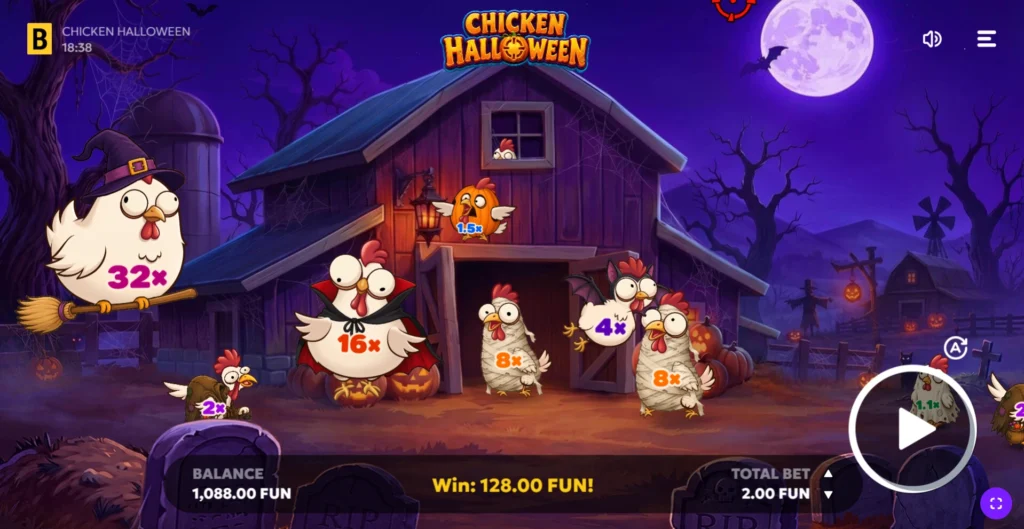
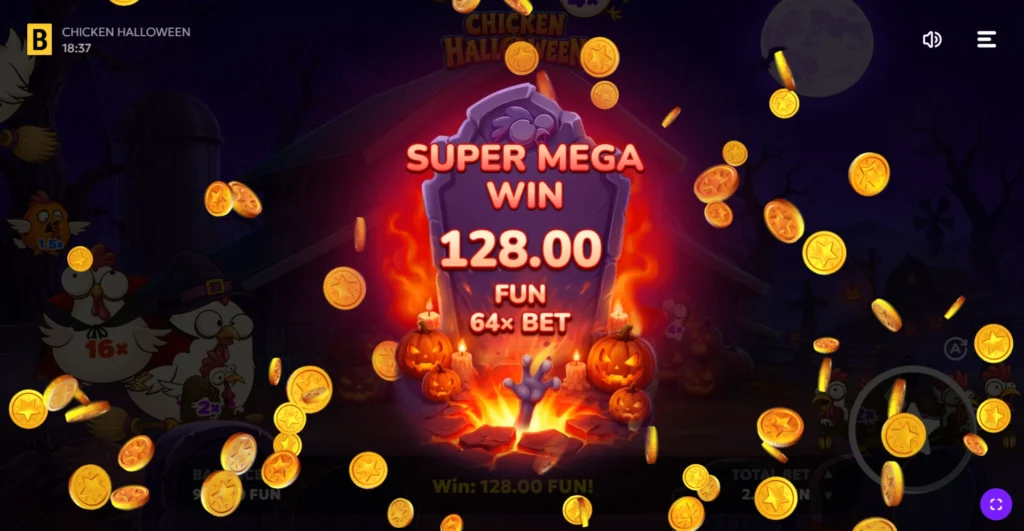
A round consists of a single shot. The player chooses a stake, then either clicks a specific chicken or presses Play to have the game pick one at random. Each chicken displays a fixed multiplier. If the targeted chicken bursts, the stake is multiplied by that figure and paid to the balance; if it does not burst, the stake is lost. That is the entire loop, repeated as quickly as the player clicks. The same per-shot maths applies to many titles in our casino mini-game reviews.
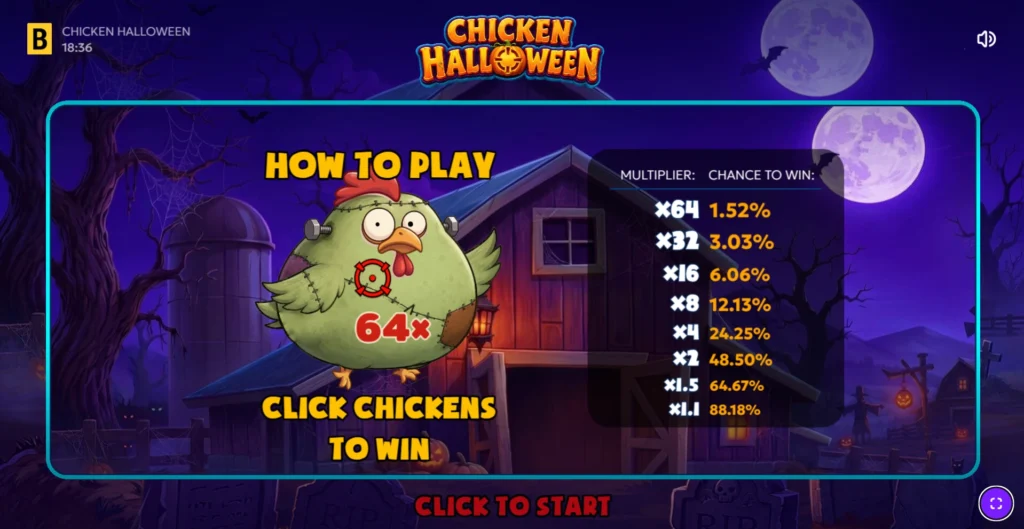
Eight chicken types appear on screen, each tied to one of eight multipliers: x1.1, x1.5, x2, x4, x8, x16, x32 and x64. The rules panel publishes the win chance for each, from 88.18% on the x1.1 ghost chicken down to 1.52% on the x64 giant. Hovering over a bird shows a tooltip with its chance to win and the number of clicks you have made on it. Birds move around the scene, appear in windows and fly across on brooms, so the selection of targets on screen changes as you play.
The random number generator decides the outcome of each shot when it is fired. Because every shot is a new bet, there is nothing equivalent to a crash point being drawn at the start of a round. The developer’s marketing copy says bigger chickens “take more shots” to bring down, which is accurate only in the sense that a 1.52% event needs, on average, around 66 attempts before it happens. Each of those attempts is paid for separately. The rules also state that clicks apply only to the current session and the specific chicken, and that they are lost if the game is refreshed, disconnects or the chicken leaves the screen. The published odds table gives a single chance per multiplier and does not describe any change in odds based on how many times a bird has been clicked, so the safe reading is that the counter is a display feature and every shot carries the same published chance.
There is no auto-cashout because there is nothing to cash out. Instead, Autoplay runs a chosen number of shots with optional stop conditions: on any win, when a single win exceeds a set amount, or when the balance rises or falls by a set amount. An Advanced option restricts Autoplay to one or more chicken types. Holding down on a chicken also triggers rapid autoclicks, which is the feature with the largest effect on spending speed. There are no risk modes as such; picking the x1.1 bird or the x64 bird is the risk setting.
BGaming states a theoretical RTP of 97% in the in-game rules (version 1.0, dated 21 September 2026) and on its official game page. Over a large number of shots, the house retains approximately $3 of every $100 wagered. The odds table is consistent with that figure for every target: 1.1 multiplied by 88.18%, 2 multiplied by 48.50% and 64 multiplied by 1.52% all come to roughly 97% once display rounding is allowed for. That means no chicken offers better value than another. Target choice changes how a session feels, not what it costs.
The formula for hourly cost is expected loss = house edge × shots per hour × average stake. Crash games usually run 50 to 100 rounds an hour, but Chicken Halloween has no round timer and is limited only by how fast the player fires, so we assume 600 shots per hour, which is one shot every six seconds of manual play. At a $0.50 stake that is $300 wagered and an expected loss of $9 per hour. At a $2 stake it is $1,200 wagered and an expected loss of $36 per hour. The rules do not state the speed of the hold-to-autoclick feature, but if it fires even two shots per second, an hour of held clicking at $2 would turn over $14,400 and carry an expected loss of $432. Speed, not the house edge, is the main cost driver here.
Volatility is where the targets differ sharply. On the x1.1 chicken a player wins 88.18% of shots, but each win returns only $0.10 profit on a $1 stake while each miss costs the full $1, so one miss erases ten wins. On the x2 bird outcomes are close to a coin flip. On the x64 bird a player misses 98.48% of shots; the probability of firing 50 shots without a hit is about 46%, and the probability of going 100 shots without one is about 22%. A single x64 hit can put a short session well into profit, which is why a small sample of play can look favourable, but across thousands of shots every target converges on the same 3% loss rate.
No provably fair mechanism is documented for Chicken Halloween. The rules panel says only that the game uses a certified random number generator and refers players to the BGaming website. This matters because BGaming does operate a genuine provably fair system on part of its catalogue, and a player who knows that may assume it covers every BGaming title. It does not appear to cover this one.
On games where BGaming supports it, the system works like this. Before a round, the game pre-calculates the result, adds a random string called the Secret, and shows the player a SHA-256 hash of the Result plus Secret. The player can enter a Client Seed of their own choosing or accept a random one. After the round, the game reveals the Result, the Secret, the Client Seed and the Final Result. The player can then hash the revealed Result plus Secret in any SHA-256 tool, confirm it matches the hash shown before the bet, and check that applying their Client Seed to the Result produces the outcome they saw. That process proves the outcome was fixed before the stake was placed.
Without that widget, a Chicken Halloween player has no way to check an individual shot. The fairness of the game rests on BGaming’s RNG certification and on the operator running the certified build with the published 97% configuration. That is the normal arrangement for most casino software, but it is reliance on third parties rather than something the player can test.
The strongest point is transparency about odds. Many instant-win games publish an RTP and nothing else, while Chicken Halloween prints the exact chance for every multiplier both in the rules and on the start screen, and repeats it in the hover tooltip. A player can see before every shot what they are betting on, and the numbers check out against the stated RTP.
The 97% RTP is also higher than the figure on many casino slots, and the low-multiplier targets give genuinely low-volatility play for anyone who wants a long, slow session at small stakes. The Autoplay stop conditions are more complete than in many casual games, with a loss limit option that lets a player cap a session in advance. The Halloween art is well executed and the game runs on mobile and desktop, according to the developer.
The click counter and the “more shots for bigger chickens” framing work against the player’s understanding of the odds. They suggest that persistence builds toward a payout, when the rules describe independent shots at fixed odds. Combined with hold-to-autoclick, this creates a format in which a player can place hundreds of full-stake bets in a few minutes while feeling they are chipping away at one target.
The absence of a documented provably fair widget is a weakness for a studio that offers one elsewhere, and the x64 ceiling is low. There are no features, bonus rounds or progressive elements, so the game offers the same eight bets for its whole life. Because the game launched on 14 October 2026, we found no player discussion of it on forums or Reddit at the time of writing, so there is no community record yet of how it behaves in live play.
The player who gets the most from Chicken Halloween is someone who enjoys simple fixed-odds betting, likes seeing the exact probability before each bet, and plays small stakes with a session budget set in Autoplay’s loss limit. For that player, the low targets offer a slow, predictable session and the high targets offer occasional larger hits, all at a known 3% cost. Players choosing where to play can compare licensing and game libraries in our online casino reviews.
A player who wants a real crash game, with a rising multiplier and a timing decision, should look elsewhere, as should anyone who wants bonus features or a max win far above x64. The broader range of formats is covered in our guide to crash games, mini-games and slots.
A player who tends to chase losses or play on impulse should avoid this game entirely. Unlimited shot speed, hold-to-autoclick and a counter that rewards persistence are a poor combination for anyone prone to “one more try” thinking, because each try is a fresh bet and the next one is never more likely to land.
Chicken Halloween is built for fast play, and because a round is a single click, losses can accumulate far faster than in slower casino formats. Autoplay stop conditions can help with discipline, but they do not change the underlying 3% house edge, and no choice of chicken does either. Set a loss limit before you start, not after a losing streak, and stop when you reach it. Support is available from GambleAware (international) at begambleaware.org, GamCare (UK) at gamcare.org.uk, the National Council on Problem Gambling (US) at ncpgambling.org or 1-800-522-4700, and Gambling Therapy (international) at gamblingtherapy.org. 18+ only.
Chicken Halloween is a well-made, honestly documented fixed-odds game with a 97% RTP and a full published odds table. The strongest reason to play it is that transparency: every bet has a stated chance and a stated payout. The main reason for caution is speed, since every click is a full-stake wager and autoclick can multiply hourly losses many times over. It suits small-stakes players who set a loss limit in Autoplay and treat each shot as the separate bet it is. It is worth playing with that caveat, and with the understanding that no number of clicks on the x64 chicken makes the next one more likely to hit, because the published rules give it the same 1.52% chance every time.
The RTP of Chicken Halloween is 97%. BGaming states this in the in-game rules (version 1.0, dated 21 September 2026) and on its official game page, and the published odds for each chicken are consistent with it.
No provably fair mechanism is documented for Chicken Halloween. The rules state only that it uses a certified RNG, so players cannot verify individual shots with a seed and hash check as they can on BGaming’s provably fair titles.
The maximum win is x64 the stake, paid when the giant stitched chicken bursts. BGaming lists the maximum win amount as 256,000, which implies a top stake of 4,000 at x64.
You set a stake and shoot a chicken by clicking it, or press Play for a random target. If it bursts you win the stake times its multiplier; if not, you lose the stake. Every shot is a separate bet.
The house edge is 3%, derived from the published 97% RTP. It is the same for every chicken, so target choice affects volatility but not long-term cost.
There is no evidence that Chicken Halloween is rigged, and its odds table matches its stated RTP. However, without provably fair verification, players rely on BGaming’s RNG certification and the operator rather than checking results themselves.
The published rules give one fixed chance per chicken and do not describe any increase with repeated clicks. Treat every shot as independent; clicks are also reset if the game reloads or the chicken leaves the screen.

High Flyer is a multiplayer plane crash game from Pragmatic Play, released in September 2024, in which players cash out before the aircraft flies away. It publishes a 97% RTP, offers two independent bet spots with auto-cashout and advertises multipliers of up to 1,000,000x.

Space XY is a multiplayer crash game from BGaming in which a rocket climbs across an X-Y graph and players cash out before it explodes. It has a published 97% RTP, two bet panels per round and a €250,000 win cap.

JetX3 is a crash game from SmartSoft Gaming in which three jets take off together, each with its own independent crash point. Players can bet on one, two or all three jets, collect from each separately and reach up to 2,000x per jet.