Author Spencer Thorne
September 10, 2026

Buried in the Space Race rules panel is a sentence most players scroll past: the 96% return to player figure “implies that, on average, out of every 100 spaceships, 4 spaceships explode at the start of the round.” It means roughly 1 in every 25 bets you place in this game is dead before the multiplier moves at all, with no window to cash out. Under the standard crash payout model, that instant bust rate is not a side effect of the design: it is precisely where the house collects its edge. That single sentence tells you more about Space Race than any amount of rocket animation.
| Detail | Information |
|---|---|
| Developer / provider | Spinocchio |
| Game type | Crash (three simultaneous racing outcomes) |
| RTP | 96% (source: in-game rules panel) |
| House edge | 4% |
| Max multiplier | Not publicly documented |
| Min stake | $1.00 per bet (game currency units) |
| Max stake | $100.00 per bet (game currency units) |
| Risk level settings | No |
| Provably fair | Claimed in-game; implementation not publicly documented |
| Auto-cashout | Yes |
| Demo available | Yes (free play credits) |
| Mobile compatible | Yes |
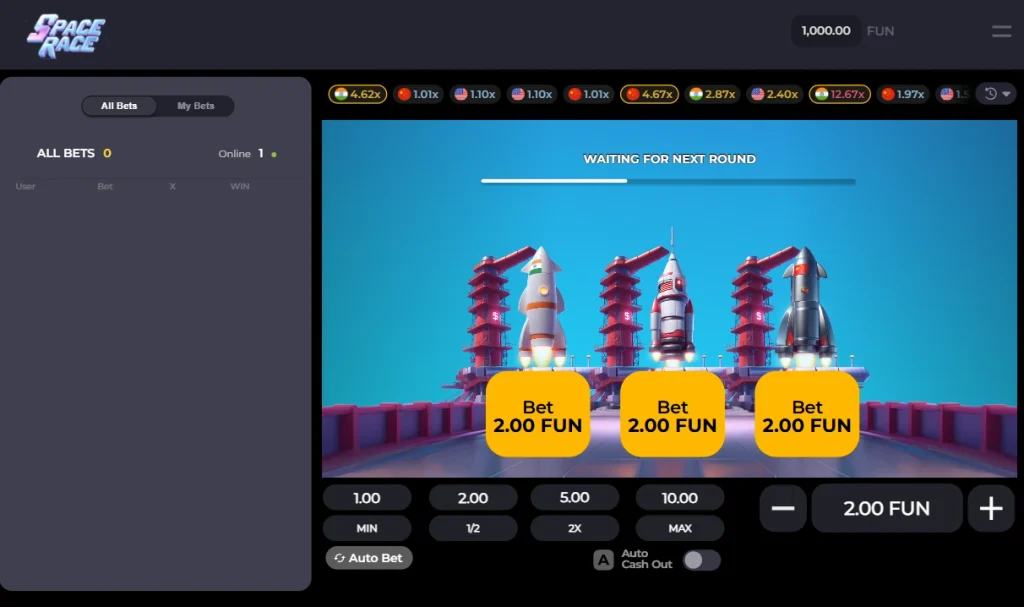
Space Race is a crash game from Spinocchio, a smaller studio whose titles circulate through casino game aggregator networks rather than major operator lobbies. The premise follows the format Aviator popularised: you place a bet, a multiplier climbs from 1.00x, and you must cash out before a random termination point wipes the round. Where Space Race departs from the template is in what you are betting on. Each round stages a race between three cartoon spaceships, each carrying its own independently generated crash multiplier, and you can back any or all of them in the same round.
When a round begins, the three rockets lift off together and a shared multiplier readout starts climbing. One by one, the ships explode at their pre-determined values. Your bet is tied to a specific ship, and your task is to cash that bet out before that ship detonates: time it and you collect your stake multiplied by the value showing at that moment, miss it and the stake is gone.
Before each round starts, the game’s random number generator produces the explosion multipliers for all three spaceships. This matters: the outcomes are fixed at launch, not decided in real time as the animation plays. The rising multiplier you watch is a playback of a decision already made, and nothing you do during the flight, other than cashing out, changes anything.
You place between one and three bets before takeoff, each assigned to a ship, each between $1 and $100 in the game’s currency units. The round multiplier starts at 1x and climbs continuously until the last surviving spaceship explodes, which ends the round. A win on any bet is that bet’s stake multiplied by the value at which you cashed that specific bet out. The three outcomes are settled independently, so a round can hand you one win and two losses from the same launch.
Auto Bet repeats your stake for a chosen number of rounds and supports stop conditions: you can halt it when your balance falls by a set amount, rises by a set amount, or when a single win exceeds a threshold. Auto Cash Out is a toggle on the bet panel that banks your bet the instant the multiplier reaches a value you specify. Its limitation is the obvious one: it executes a plan, it does not improve the odds of the plan. There are no risk level settings, difficulty modes or bonus rounds. Two protective rules are worth knowing: if your connection drops mid-round, the game cashes out your live bets at the current multiplier, and any hardware or software malfunction voids the affected bets and refunds them.
The in-game rules panel states a theoretical RTP of 96%, which puts the house edge at 4%: over a large number of rounds the game is built to keep approximately $4 of every $100 wagered. That is on the expensive side for the genre. Aviator and several other established crash titles publish RTPs around 97%, and some crypto-native implementations run closer to 99%. A full percentage point of extra edge sounds trivial until you multiply it across the round volume a crash game generates.
Expected loss per hour equals house edge times rounds per hour times average stake per round. Crash games typically cycle 50 to 100 rounds per hour, so assume a moderate 60. A player betting $1 on one ship per round faces an expected loss of 4% x 60 x $1, which is $2.40 per hour. At a $5 single-ship stake the figure is $12 per hour. Backing all three ships at $5 each puts $15 into every round, and the expected loss becomes 4% x 60 x $15, which is $36 per hour. Spreading bets across the ships feels like hedging, but each bet carries the same 4% edge, so triple betting simply triples the expected cost. It changes the shape of your variance, not the direction of the maths.
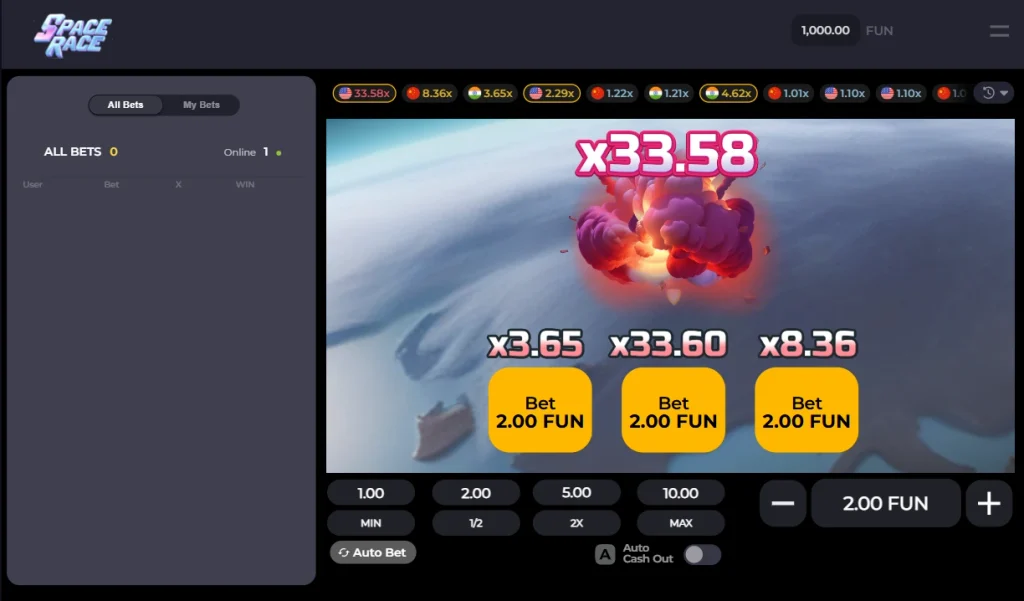
Variance is why sessions rarely feel like a steady $12 per hour drain. Crash payouts follow a heavily skewed distribution: most rounds bust at low values while occasional rounds run to large multipliers, and Space Race’s results bar shows exactly this texture, long strings of values near 1x punctuated by outliers past 10x. A player who catches one of those outliers early can sit ahead of the maths for a whole session. The 96% figure only asserts itself across thousands of rounds, which is how a game with a 4% edge produces plenty of winning evenings while remaining unfavourable long term.
The most important number, though, is the one from the opening of this review. If Space Race follows the standard crash distribution used across the genre, a 96% RTP corresponds exactly to a 4% probability that a ship explodes at launch, before the multiplier leaves 1.00x, and the developer’s own rules text confirms the 4 in 100 instant bust rate. In that model, every surviving flight is effectively a fair game, and the house’s entire take is collected in those launchpad explosions you can do nothing about. No cash out discipline, however sharp, touches them.
The rules panel states that each round’s multipliers are produced by a provably fair algorithm, links to a further explanation, and notes that Provably Fair settings can be adjusted through the game menu. A settings panel implies some player-side interaction, typically the ability to view or change a client seed.
What is missing is the documentation that would let this review call the implementation verified. A genuine provably fair scheme has three published components: a server seed the operator commits to in advance by publishing its hash, a client seed the player controls, and a defined hash function, usually SHA-256 based, that combines them into the round result. After the round, the server seed is revealed and the player can recompute the outcome and confirm it matches the pre-committed hash. Spinocchio’s accessible rules text names none of these components, and no independent public documentation of its algorithm could be located during research for this review. The honest description is therefore that Space Race claims provable fairness and provides a settings interface for it, but the mechanism is not publicly documented. In practice you are trusting the claim, not verifying it, a materially weaker position than Spribe or the open crash implementations offer, where the full verification procedure is published.
The three-ship structure is a genuine mechanical idea rather than a reskin. Running three independent outcomes in one round lets a player split stakes across a conservative target and a speculative one simultaneously, something single-curve crash games only offer through dual bet panels. The presentation keeps each outcome legible at a glance, and the per-ship results history is more informative than the single stream most competitors show.
The disclosure standard is unusually good for a small studio title. The rules panel states the RTP, spells out what it implies in instant bust frequency, documents the disconnection and malfunction policies, and explains every auto bet stop condition. Plenty of far bigger crash games publish less, and a free demo mode means the whole loop can be tested without staking anything.
The 96% RTP is the structural weakness. In a genre where the market leader publishes 97% and several rivals go higher, Space Race asks you to pay roughly a third more edge for the three-ship novelty. The provably fair claim, as discussed, is not backed by published implementation details, and the maximum multiplier and any win cap are not documented anywhere accessible, which leaves the realistic ceiling on a $100 bet unknowable in advance.
There is also a visibility problem. Research for this review found no meaningful player discussion of Space Race on Reddit, Bitcointalk or the usual gambling forums, and almost no independent editorial coverage beyond demo listings on aggregator sites. That absence cuts both ways: there are no documented complaints, but there is also no community track record of payouts and no body of experience to check the developer’s claims against. For a game whose fairness mechanism is undocumented, the missing community footprint matters more than it would for an established title.
The player this game suits best already knows the crash format, treats it as paid entertainment with a fixed budget, and is drawn to the tactical layer the three ships add. That player might run $1 to $2 stakes, keep one bet on a low auto cashout around 1.5x and occasionally let a second bet ride, and accept an expected cost of a few dollars per hour in exchange for more decisions per round.
A player who chooses games primarily on value should look elsewhere, and specifically at crash titles with a published 97% or higher RTP and a fully documented seed verification process. That player gives up the racing gimmick and in return pays a quarter less edge on every dollar wagered, with fairness they can actually recompute.
The player who should avoid Space Race entirely is anyone prone to escalating stakes to chase losses, and anyone tempted by the three-bet panel to triple their exposure by default. The rounds are fast, the instant busts are frequent and uncontrollable, and the structure makes it feel natural to have $15 or $30 in flight every thirty seconds. For a loss-chasing temperament, this game’s tempo and bet architecture are actively dangerous.
Crash games are engineered for speed. Rounds resolve in seconds, there is no natural pause between them, and auto bet removes even the friction of pressing a button, so losses can accumulate far faster than in slower casino formats. Auto cashout at a fixed multiplier is a useful discipline tool because it takes the in-the-moment decision out of your hands, but it does not alter the 4% house edge by a single cent. Decide on a loss limit before your first round, not after a losing streak, and stop when you reach it regardless of how the session feels. If gambling has stopped feeling like entertainment, help is free and confidential: GambleAware at begambleaware.org internationally, GamCare at gamcare.org.uk in the UK, the National Council on Problem Gambling at ncpgambling.org or 1-800-522-4700 in the US, and Gambling Therapy at gamblingtherapy.org worldwide. 18+ only.
Space Race is a mechanically interesting crash variant with above-average in-game disclosure and a below-average price of play. The strongest reason to try it is the three-ship format, which adds real decision texture that single-curve crash games lack and can be explored risk-free in demo mode. The most important reason for caution is the combination of a 96% RTP, a full point worse than the genre’s leaders, with a provably fair system whose workings are claimed but nowhere publicly documented. It is worth playing with specific caveats: small stakes, one ship at a time by default and a firm session budget, for players who value the format over the maths, while value-focused players and anyone who wants verifiable fairness should choose an established alternative. And the fact most reviews never mention is the one the game’s own rules panel admits: at a 96% RTP, 4 in every 100 ships explode at launch, and under the standard crash model those unavoidable launchpad busts are not bad luck at the edges of the game, they are the entire house edge, collected before you ever get the chance to act.
The RTP of Space Race is 96%, as stated in the game’s own rules panel. This means the game is designed to return $96 of every $100 wagered over a very large number of rounds, with the remaining 4% forming the house edge.
Space Race claims to be provably fair, and the game menu includes a Provably Fair settings section, but Spinocchio does not publicly document the implementation. No published server seed commitment, client seed procedure or hash function could be found, so the claim cannot currently be independently verified from public material.
The maximum win on Space Race is not publicly documented. The maximum stake is $100 per bet in game currency units, but neither the rules panel nor any accessible Spinocchio documentation states a multiplier ceiling or win cap, so the realistic upper limit is unknown.
Space Race is a crash game in which three spaceships launch each round, each with its own crash multiplier generated before the round starts. You bet on up to three ships at once, watch the multiplier climb from 1x, and must cash each bet out before its ship explodes to win your stake times the cashout value.
The house edge on Space Race is 4%, derived from the published 96% RTP. At an assumed 60 rounds per hour, that edge produces an expected loss of about $2.40 per hour on $1 single-ship bets, and triple that if you back all three ships every round.
There is no evidence that Space Race is rigged, but there is also no public way to prove it is not. The game states that outcomes are pre-generated by a provably fair algorithm, yet the verification mechanism is undocumented and no independent player community has tested it, so players are relying on the developer’s claim rather than on verifiable cryptographic proof.

Chicken Halloween is BGaming's October 2026 seasonal reskin of Chicken Shot, a casual instant-win game where every shot at a costumed chicken is a separate wager with a published win chance and a fixed multiplier from x1.1 to x64.

High Flyer is a multiplayer plane crash game from Pragmatic Play, released in September 2024, in which players cash out before the aircraft flies away. It publishes a 97% RTP, offers two independent bet spots with auto-cashout and advertises multipliers of up to 1,000,000x.
Space XY is a multiplayer crash game from BGaming in which a rocket climbs across an X-Y graph and players cash out before it explodes. It has a published 97% RTP, two bet panels per round and a €250,000 win cap.
JetX3 is a crash game from SmartSoft Gaming in which three jets take off together, each with its own independent crash point. Players can bet on one, two or all three jets, collect from each separately and reach up to 2,000x per jet.