Author Spencer Thorne
July 2, 2026

The most useful thing to understand about Avia Fly 2 before you place a bet is that you do not actually make a decision during the round. Almost every review describes it as a crash game where you cash out before the plane goes down, and almost every review is wrong on that point. According to the developer, the flight follows a route calculated the instant you place your bet. What you watch afterwards, the plane weaving past rockets and scooping up multipliers, is the animated reveal of a result that already exists. That single fact reshapes how you should read the “strategy” and “timing” advice that fills the rest of the internet about this title.
| Detail | Information |
|---|---|
| Developer / provider | InOut Games (IOG B.V., Curaçao; Anjouan licence ALSI-202506032-FI2) |
| Game type | Instant-win plane game with collected modifiers (marketed as crash-style) |
| RTP | 96.5% (source: InOut Games official game page, inout.games) |
| House edge | 3.5% |
| Max multiplier | Not officially documented (affiliate sources conflict, from x100 to 10,000x) |
| Min stake | $0.10 |
| Max stake | $200 |
| Risk level settings | Speed modes yes; a dedicated risk selector is not officially confirmed |
| Provably fair | Claimed by some operator pages, not independently documented |
| Auto-cashout | Not clearly documented; autoplay exists, manual timed cash-out does not |
| Demo available | Yes |
| Mobile compatible | Yes (HTML5, no download) |
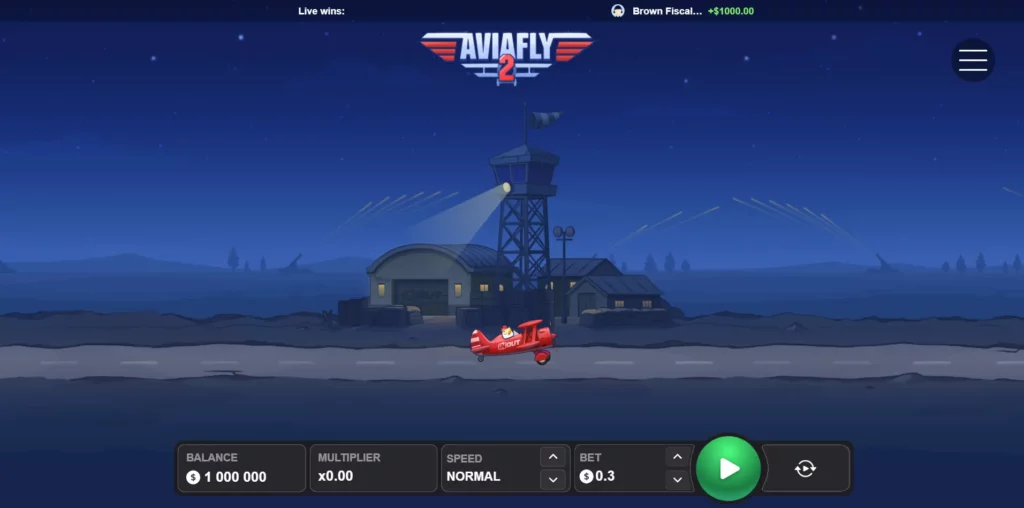
Avia Fly 2 is an instant-win casino game built by the studio InOut Games and released on 27 January 2026 as the sequel to their original aviation title. The theme is deliberately light: a cartoon chicken pilots a small plane down a runway. Beneath that surface is a short, high-volatility round that resolves in seconds. You place a stake, the plane takes off, and it travels a set path picking up mathematical symbols that build or shrink your potential payout. The round ends one of two ways: the plane lands cleanly and pays out the total it accumulated, or it hits a hazard and the round is lost with nothing returned.
It is marketed alongside crash games such as Aviator and shares their pacing, but mechanically it belongs to a newer group, closer to Aviamasters 2, where a plane collects modifiers along a journey rather than a single number climbing until it busts. That distinction matters, because the collection format changes what the player controls, which turns out to be very little.
A round begins when you set a stake, anywhere from $0.10 to $200 depending on the operator, and launch the plane. From that moment the outcome is, by the developer’s own description, following a pre-calculated route. During the flight the plane collects three kinds of elements: additions that stack fixed values onto your running total (commonly plus one, two, five and ten), multipliers in the x2 to x5 range that scale whatever it has gathered, and dividers shown as a rocket that halve the accumulated total. Scattered across the landing area are hazards, described as craters, bombs and wrecked tanks, and touching one ends the run at zero.
What determines the result is not your reflexes but where the plane travels and which symbols and hazards sit on that path, all fixed before the animation plays. In the developer’s version there is no manual cash-out button and no exit to time. There is an autoplay feature that repeats rounds, and several sources reference speed settings (often Slow, Normal, Fast and Ultra) that change how quickly the animation runs. Speed changes the tempo and how many rounds you get through, but not the outcome, which was set at launch.

Avia Fly 2 has a published return to player of 96.5%, stated on InOut Games’ own game page, which means a house edge of 3.5%. Over a very large number of rounds the game returns about $96.50 of every $100 wagered and retains roughly $3.50. That is competitive for the category, but it is still a negative expectation: play long enough and the maths, not the plane, decides the result.
It helps to turn that percentage into an hourly cost, because a 3.5% edge sounds small until you see how often you feed it. Expected loss per hour equals the house edge times rounds per hour times your average stake. Instant games run fast, so assume a moderate 60 rounds per hour. At a $1 average stake that is 0.035 times 60 times $1, about $2.10 an hour; at a $10 stake it is roughly $21 an hour. Push toward 100 rounds an hour and those climb to about $3.50 and $35, because the edge is charged on every round. At the $200 ceiling and 60 rounds an hour, the expected cost is on the order of $420 an hour. None of this predicts a single session; it is the long-run drift underneath every session.
The gap between that steady drift and what you actually feel is volatility, and Avia Fly 2 is described consistently as high-volatility, meaning outcomes cluster into swings rather than settling near the average. You can hit a clean landing stacked with a x5 multiplier and be well ahead, or watch a run of rockets and crashes drain a balance quickly. Neither changes the 96.5% figure. The published RTP appears to be a single number across speed settings, so a faster rhythm does not buy a better edge. It only lets you reach the long run sooner, which for a negative-expectation game is not a point in your favour.
Several operator and affiliate pages state that Avia Fly 2 is provably fair, usually with a boilerplate line about SHA-256 hashing and a server seed combined with a client seed. Taken at face value that would be a genuine feature. In a real provably fair system the operator publishes a hashed server seed before the round as a commitment, your browser contributes a client seed, and after the round the server seed is revealed so you can re-hash the inputs yourself and confirm they match the pre-round commitment and produce the stated result.
The problem is that I could not find that system documented for this specific game. The developer’s own game page markets the RTP and the mechanics but says nothing about provably fair verification. The claims come from third party pages, they are generic, they do not describe how a seed maps to a pre-calculated route with its particular additions, multipliers, dividers and hazard positions, and some cite conflicting licence numbers. A provably fair system for a collection game like this would need to specify exactly how the seeds determine every symbol and every hazard, and no such specification is publicly available that I could locate. In practice a player cannot today follow a documented, game-specific procedure to verify an Avia Fly 2 result; you are relying instead on Curaçao and Anjouan licensing and the operator’s integrity, which is the ordinary certified-RNG situation, not cryptographic verification you perform yourself. If verifiability matters to you, ask the operator to show the seeds, the pre-round hash and the verification steps, and if they cannot, treat the game as unverified.
The collection mechanic is the game’s real strength, and it is more than cosmetic. Watching a total build through additions and then leap on a multiplier, with the constant threat of a divider or a crash on landing, gives each round a small arc rather than the flat single-number climb of a classic crash title. For players who found the original formula repetitive, that texture is a genuine improvement and the most defensible reason to try it.
Presentation and accessibility are handled well too. It runs in HTML5 with no download, works across mobile and desktop, and keeps its interface simple, with stakes from a very low $0.10 that let you learn the rhythm cheaply. A free demo mirrors the real mechanics, a risk-free way to see how the flight and landing behave first. The published 96.5% RTP is a real positive as well, stated openly by the developer and competitive for the format.
The biggest weakness is the gap between how the game is sold and what is documented. The provably fair claim is not backed by a verifiable, game-specific method that I could find, and the maximum multiplier is not published by the developer at all, with affiliate sources contradicting each other from a x100 cap to 10,000x. When a core payout ceiling cannot be pinned down from the maker, that is a real information gap for anyone judging the game on its numbers. The RTP itself is sometimes misreported as 97% in advertising when the developer’s figure is 96.5%, a small but telling sign of how loosely this title is described.
The design also gives the player less agency than the marketing implies. Because the route is pre-calculated, the “decisions” and “timing” that reviews praise are largely absent, and the speed and autoplay settings mostly change pace rather than outcomes. There is also almost no independent community data yet. The title is new, the forum threads that exist are thin and often carry promotional links, and the “player feedback” circulating is largely the developer’s own, which is useful as a sketch but no substitute for independent scrutiny that does not exist yet.
The player who will get the most from Avia Fly 2 wants a few minutes of fast, self-contained entertainment, understands the game is negative expectation, and sets a fixed budget they are content to spend as the price of it. That player treats the demo as the main event, or plays real money in the $0.10 to $1 range, enjoys the collection arc for what it is, and stops at a preset limit rather than chasing a landing.
The player who should look elsewhere is anyone who values being able to verify fairness themselves. If provably fair verification is a genuine requirement, a title with a documented, seed-based system and a public verifier will serve you far better than Avia Fly 2’s unverified claim. The same applies to anyone who wants real in-round control, since the pre-calculated route means the timing skill is not here.
The player who should avoid it entirely is anyone chasing a large win to recover losses or to profit. The combination of a fixed 3.5% edge, high variance and a maximum payout the developer will not even confirm is exactly the wrong environment for that mindset.
Games like Avia Fly 2 are engineered for speed, and speed is the risk. Rounds last seconds, so losses can accumulate far faster than in slower formats like table games or standard slots, and at higher stakes and speeds the hourly cost shown above becomes substantial. Autoplay and set-and-forget features remove friction, making it easier to keep going past the point you intended. Deciding a loss limit before you start, and treating it as fixed rather than something to revisit after a losing streak, is the single most effective habit, and none of the game’s settings changes the underlying 3.5% edge. If gambling is affecting you or someone you know, support is available: GambleAware at begambleaware.org, GamCare at gamcare.org.uk, the National Council on Problem Gambling in the US at ncpgambling.org or 1-800-522-4700, and Gambling Therapy internationally at gamblingtherapy.org. 18+ only.
Avia Fly 2 is a competent, well-presented instant game whose collection mechanic gives it more character than a plain crash title, and its openly published 96.5% RTP is a point in its favour. The strongest reason to try it is that added texture, best met first in the free demo; the most important reason for caution is that it hands you far less control than its marketing suggests, while leaving its provably fair claim unverified and its maximum payout undocumented. It suits a casual player who wants short, cheap entertainment on a firm budget with no illusions about winning, and it is wrong for anyone who wants verifiable fairness, real in-round decisions, or a serious shot at a large payout. On balance it is worth a look in demo, and worth real money only at low stakes with a strict loss limit set in advance. And here is what most reviews leave out entirely: the drama you watch is the replay of a result decided the moment you bet, so there is no skillful moment to seize, only a route already drawn.
The RTP is 96.5%, published on InOut Games’ own game page. That is a long-run theoretical average, not a guarantee for any single session, and it leaves a house edge of 3.5%.
Not in a way that is documented and verifiable. Some operator pages claim a provably fair system with server and client seeds, but the developer publishes no game-specific verification method, so a player currently cannot independently confirm a result and is relying on the operator’s licensing and integrity instead.
It is not officially documented. The developer’s game page does not state a maximum multiplier, and third party sources contradict each other, ranging from a x100 cap to claims of 10,000x, so no reliable figure can be confirmed.
You place a stake and launch a plane that follows a pre-calculated route, collecting additions, multipliers and dividers while risking hazards on landing. If it lands safely you win the accumulated total; if it hits a hazard you lose the round. There is no manual cash-out in the developer’s description of the core game.
The house edge is 3.5%, which is the mathematical complement of the 96.5% RTP. Over many rounds the game is designed to keep about $3.50 of every $100 wagered, regardless of speed or volatility settings.
There is no evidence that it is, and it operates under Curaçao and Anjouan licensing with a stated 96.5% RTP. That said, because a documented provably fair verification method is not available for this specific game, you cannot personally prove any individual result, which is a transparency limitation rather than proof of wrongdoing.

Chicken Halloween is BGaming's October 2026 seasonal reskin of Chicken Shot, a casual instant-win game where every shot at a costumed chicken is a separate wager with a published win chance and a fixed multiplier from x1.1 to x64.

High Flyer is a multiplayer plane crash game from Pragmatic Play, released in September 2024, in which players cash out before the aircraft flies away. It publishes a 97% RTP, offers two independent bet spots with auto-cashout and advertises multipliers of up to 1,000,000x.

Space XY is a multiplayer crash game from BGaming in which a rocket climbs across an X-Y graph and players cash out before it explodes. It has a published 97% RTP, two bet panels per round and a €250,000 win cap.
JetX3 is a crash game from SmartSoft Gaming in which three jets take off together, each with its own independent crash point. Players can bet on one, two or all three jets, collect from each separately and reach up to 2,000x per jet.