Author Spencer Thorne
August 25, 2026

AviaPix is a pixel-art crash game and one of the exclusive in-house titles in the MyStake Originals catalogue. A small green propeller plane takes off across a starfield, a multiplier climbs from 1.00x, and the aim is to cash out before the crash takes the stake with it. Stakes run from $0.10 to $200, two independent bets can ride each round, and every win is capped at $10,000 per bet. The formula is familiar and cleanly executed; what sets this game apart is how little of its mathematics anyone is allowed to see.
| Detail | Information |
|---|---|
| Developer / provider | MyStake Originals |
| Game type | Crash |
| RTP | X% (unfilled placeholder in the in-game rules) |
| Max multiplier | 10,000x (in-game tutorial), capped at $10,000 win per bet |
| Min stake | $0.10 |
| Max stake | $200.00 |
| Risk level settings | No |
| Provably fair | Advertised, but only a post-round integrity hash is documented |
| Auto-cashout | Yes (default 2.00x) |
| Mobile compatible | Yes |
AviaPix is a crash game in the classic single-curve mould, presented in a retro pixel-art style: a small green propeller plane climbs across a starfield, dragging a red trajectory line behind it while a multiplier counter rises in blocky arcade type. It is one of the exclusive titles in the MyStake Originals catalogue, sitting alongside Aviamasters, XCrash, Plinko XY and the operator’s other in-house games, and no developer or studio is credited anywhere in the client or in any public material. Every specification in this review is sourced from the game’s own How to Play tutorial and rules panel, because nothing else documenting it exists.
Mechanically it makes no attempt to reinvent the genre, and that is worth stating plainly. There are no risk levels, no obstacle mechanics, no bonus collectibles and no progression system. What distinguishes AviaPix from the crash titles it imitates is not a mechanic but a disclosure gap: where Aviator publishes a 97 percent RTP and a full seed-based fairness scheme, and even MyStake’s own Aero carries an aggregator-listed 95.9 percent figure, AviaPix ships with its RTP field literally unfilled and a verification section that documents less than it appears to.
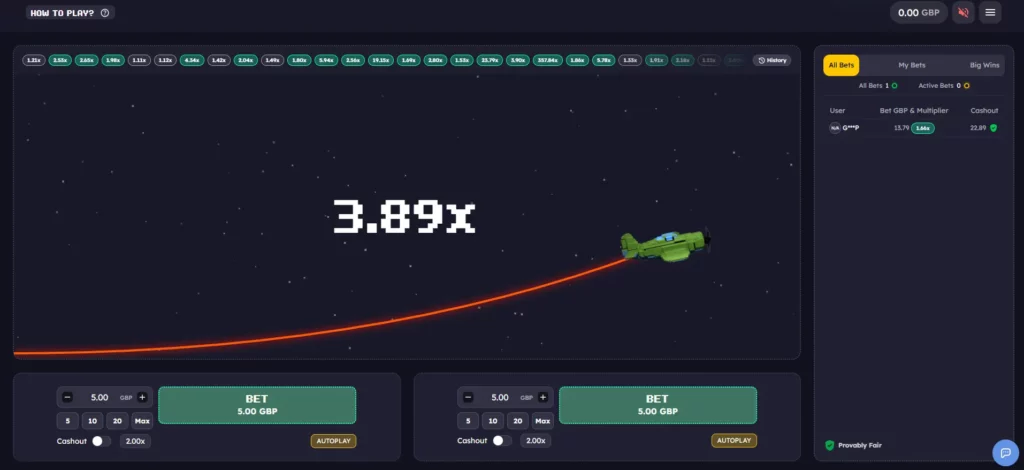
Each round begins with a betting phase. A Place Your Bets banner appears with a countdown bar, and during this window players commit their stake in one or both of two independent bet slots; the rules call these Standard Bet and Double Bet, each with its own stake controls, cashout toggle and autoplay. Stakes run from $0.10 to $200.00 per bet. When the countdown ends, the plane takes off and the multiplier starts climbing from 1.00x. The crash point for the round is determined by the game’s RNG; nothing about the derivation is published, so when and how that value is fixed cannot be verified from outside. The plane flies until the round’s crash value is reached, at which point the round terminates and every stake still active is lost. A history strip shows recent round multipliers, and side panels display all bets in the round, the player’s own bets and recent big wins.
Cashing out works the way the genre standardised. At any moment during the flight a player can hit the cashout button, and the win is calculated as stake multiplied by the multiplier at the instant of cashout. Alternatively, the auto-cashout toggle lets a target multiplier be set in advance, defaulting to 2.00x, and the system collects automatically when the counter reaches it. Autoplay extends this to 5, 10, 20, 50, 100, 500 or unlimited consecutive rounds, with preset auto-cashout targets of 2x, 3x, 5x, 10x or 20x or any custom value, plus optional stop conditions that halt the sequence if the balance rises above or falls below chosen thresholds. Two operational rules deserve attention. If the internet connection drops while a bet is active, the bet is lost unless auto-cashout is enabled, in which case the system collects at the configured target; and in the event of a technical malfunction, affected bets and payouts are voided and funds returned.
The rules panel’s RTP section reads X%, so no return figure and no house edge can be stated for AviaPix, and the placeholder makes the omission harder to excuse than ordinary silence: the template anticipated the number, and it was never entered. Without it, a player cannot price the game at all. Whether it costs like the premium crash market at a 1 to 3 percent edge or like the weak end at 5 percent and beyond is unknowable.
What can be shown is what the unknown is worth, using the standard formula: expected loss per hour equals house edge multiplied by rounds per hour multiplied by average stake. Crash rounds with a betting phase resolve quickly, so assume 60 rounds per hour. If the edge were 1 percent, a $1-per-round player would expect to lose about $0.60 per hour and a $10 player about $6. At 3 percent those figures become $1.80 and $18, and at 5 percent, $3 and $30. These are illustrations of the genre’s plausible range, not AviaPix figures, and that is the point: a single undisclosed number moves the average hourly cost of identical play by a factor of five.
The advertised ceiling also needs the arithmetic most reviews skip. The tutorial promises wins up to 10,000x, but the rules cap the maximum win at $10,000 per bet while allowing stakes up to $200. Those two numbers only coexist at the bottom of the stake range: the full 10,000x is achievable only on stakes of $1 or less, and the effective ceiling shrinks as stakes rise, down to just 50x at the $200 maximum bet. A player staking $200 who rides a round to 300x is paid as if they cashed at 50x. Volatility supplies the final distortion: short sessions are dominated by variance, so a winning evening proves nothing about the configured edge, and session results are the only feedback this game offers.
The interface carries a Provably Fair badge with a green check, and the documented mechanism does not support the label. The Round Verification section explains that each round’s integrity code is a SHA256 hash generated from three parameters: round number, multiplier and serial number, and it directs players to generic online hash calculators to check it.
A genuine provably fair system has a specific structure. Before the round, the server publishes a hash committing to a secret seed; the outcome is derived from that server seed combined with a client seed the player controls; after the round the seed is revealed, and the player can both confirm the commitment matches and rerun the published formula to reproduce the multiplier. The chain is what proves the outcome was fixed before bets were taken. AviaPix documents none of those links. There is no client seed, no published secret-seed commitment or reveal, and no formula deriving the multiplier from anything. Hashing the round number, the already-known multiplier and a serial number produces a checksum of the result, not a proof about how the result was generated. In practice a player can verify that the recorded outcome matches its integrity code, which guards against records being altered after publication, and nothing more. Fairness itself remains entirely a matter of trust in the operator and its Curaçao-licensed RNG oversight. The badge says provably fair; the documentation describes tamper-evidence.
Judged as a piece of interface design, AviaPix is a clean implementation of the format. The pixel aesthetic is coherent rather than cosmetic, the round loop is instantly legible, and the two-slot bet system matches what Aviator popularised, letting a player run a conservative auto-cashout on one slot while taking a longer ride on the other. The stake range is genuinely wide, with a $0.10 floor that suits cautious bankrolls, and the rules panel is unusually candid about operational edge cases, spelling out the connection-loss rule, the malfunction policy and exact limits rather than burying them. The autoplay suite with its optional stop conditions is fuller than many rivals offer.
The disclosure of limits also deserves credit in one narrow respect: the $10,000 win cap is stated plainly in the rules rather than hidden in operator terms, which is more than can be said for many crash titles where the cap surfaces only at payout time, even if the tutorial’s 10,000x headline does not volunteer the arithmetic.
The failures are all failures of disclosure, and they stack. The RTP placeholder is the headline: a live gambling product whose own rules template flags the return figure as missing. The Provably Fair badge overstates the documented mechanism, which as published can demonstrate record integrity but not fair generation, and attaching the genre’s strongest trust label to its weakest verification scheme is a serious gap. No developer is attributed anywhere, so there is no studio reputation or certification trail to consult. The connection-loss rule resolves every dropout against the player unless auto-cashout happens to be set. The unlimited autoplay option, running indefinitely with stop conditions that are optional rather than required, is a genuinely player-hostile default in a fast format. And there is still no aggregator listing, no documented demo and no player community anywhere, so the informal early-warning layer that surrounds better-known games simply does not exist here.
The player this game fits is an experienced crash player on MyStake who wants a different skin on familiar mechanics, stakes small, sets auto-cashout as routine, and treats the session as prepaid entertainment at an accepted, unknowable price. For that player the wide stake floor, the dual slots and the readable interface deliver a perfectly functional session.
The player who should choose an alternative is anyone who selects games on their numbers. Aviator offers the same core loop with a published 97 percent RTP and a fully auditable seed-based fairness chain, and MyStake’s own Aero at least carries a listed return figure. A player who compares edges has nothing to compare here and gives up nothing by playing a documented title instead. Anyone intending to stake large should also look elsewhere or recalculate, because above $1 per bet the advertised 10,000x ceiling is fiction and the real ceiling at $200 stakes is 50x.
The player who should avoid AviaPix entirely is anyone with an unstable connection, anyone drawn to unlimited autoplay, and anyone for whom unverifiable outcomes feed tilt rather than indifference. Fast rounds, an unknown edge and an infinite autoplay switch are a poor combination for anyone prone to chasing losses, because cost accumulates at speed and the missing mathematics make recovery impossible to reason about.
AviaPix rounds resolve in seconds and restart immediately, so losses can accumulate far faster than in slower casino formats, and the undisclosed edge means the rate of that accumulation cannot be estimated in advance. Auto-cashout at a fixed target imposes discipline on individual rounds and protects against the connection-loss rule, but it does not change the underlying house edge, whatever that edge is; the unlimited autoplay mode deserves particular caution and its optional stop-loss should be treated as mandatory. Set a loss limit and a time limit before the first round, not after a losing streak, and treat reaching either as the end of the session. Support is available from GambleAware (international) at begambleaware.org, GamCare (UK) at gamcare.org.uk, the National Council on Problem Gambling (US) at ncpgambling.org or 1-800-522-4700, and Gambling Therapy (international) at gamblingtherapy.org. 18+ only.
AviaPix is a tidy, playable crash game wrapped around the worst disclosure record in its catalogue: an RTP field left as a template placeholder, a fairness badge its documented mechanism cannot support, and a headline multiplier that collapses to 50x at maximum stakes. The strongest reason to play it is the interface, a genuinely clean dual-bet crash implementation with a low stake floor and honest operational rules. The most important reason for caution is that the price and the integrity of the product are both unverifiable, which is a worse position than nearly every alternative, including other games on the same site. It is defensible only for small-stakes entertainment players who accept those unknowns deliberately; for everyone else it is not worth playing while the RTP stays blank, because equally fast games with published mathematics and auditable fairness are a menu click away. The fact no other review will tell you, because no other review of this game exists, is sitting in the rules panel itself: the return to player of AviaPix is officially X percent.
The RTP of AviaPix is not disclosed, and the game’s own rules panel shows the figure as an unfilled X% placeholder. No developer documentation, aggregator listing or testing report publishes a return figure, so the game’s long-run cost cannot be calculated or compared.
AviaPix displays a Provably Fair badge, but the documented mechanism is a post-round SHA256 integrity code built from the round number, the multiplier and a serial number. That lets players confirm a recorded result was not altered afterwards; it does not include seeds, commitments or a derivation formula, so fair generation of outcomes cannot be verified.
The maximum win on AviaPix is $10,000 per bet, and the maximum multiplier shown in the tutorial is 10,000x. Because stakes reach $200, the two limits interact: the full 10,000x is only achievable at stakes of $1 or less, and at the $200 maximum bet the effective ceiling is 50x.
AviaPix is a crash game: players bet during a countdown phase, a pixel-art plane takes off, and a multiplier climbs from 1.00x until the round’s hidden crash point ends the flight. Cashing out before the crash pays stake times the current multiplier; failing to cash out loses the bet. Two independent bets per round, auto-cashout defaulting to 2.00x and autoplay up to unlimited rounds are supported.
The house edge on AviaPix is undisclosed, because no RTP is published. As an illustration of what that uncertainty costs, at 60 rounds per hour a $10-per-round player expects to lose about $6 per hour at a 1 percent edge and about $30 per hour at a 5 percent edge, and nothing published locates this game within that range.
There is no evidence that AviaPix is rigged, and no way for a player to prove it is not. The documented verification only confirms that recorded results match their integrity codes, so outcome generation rests on trust in the operator and its licence-level RNG oversight rather than on anything independently checkable.
No demo mode for AviaPix is documented in the game’s rules or anywhere else. Independent reviews of MyStake note that its instant and mini-game sections often lack demo play, so players should assume real-money stakes are required unless the client itself shows otherwise.
No developer is publicly attributed to AviaPix. It is presented as a MyStake original, and while studios such as UpGaming are credited for other exclusives on the platform, no studio is named for this title in the game client or any public material.