Author Spencer Thorne
June 25, 2026

Your reflexes do not matter. Despite the frantic traffic animation and marketing daring you to be the fastest chicken on the highway, every safe lane and every fatal one in a round is fixed by a pair of cryptographic seeds before you tap the screen a single time. You are not dodging cars. You are uncovering a sequence that was written the moment the round began, and the only choice that touches your balance is deciding when to stop walking. That gap between how the game feels and how it actually resolves is the most important thing to understand before you stake money on it.
| Detail | Information |
|---|---|
| Developer / provider | InOut Games (IOGr B.V.) |
| Game type | Step based instant win game, commonly marketed as crash |
| RTP | 96.5% (source: SlotCatalog) reported figures vary across outlets |
| House edge | Approximately 3.5% (derived from the 96.5% RTP) |
| Max multiplier | x4,218,142.50 on Hardcore (source: SlotCatalog) |
| Min stake | $0.10 |
| Max stake | $200 |
| Risk level settings | Yes (Easy, Medium, Hard, Hardcore) |
| Provably fair | Yes (dual seed, SHA-256, Curacao licence) |
| Auto-cashout | Yes (auto stop at a target step; no autoplay) |
| Demo available | Yes |
| Mobile compatible | Yes (HTML5) |
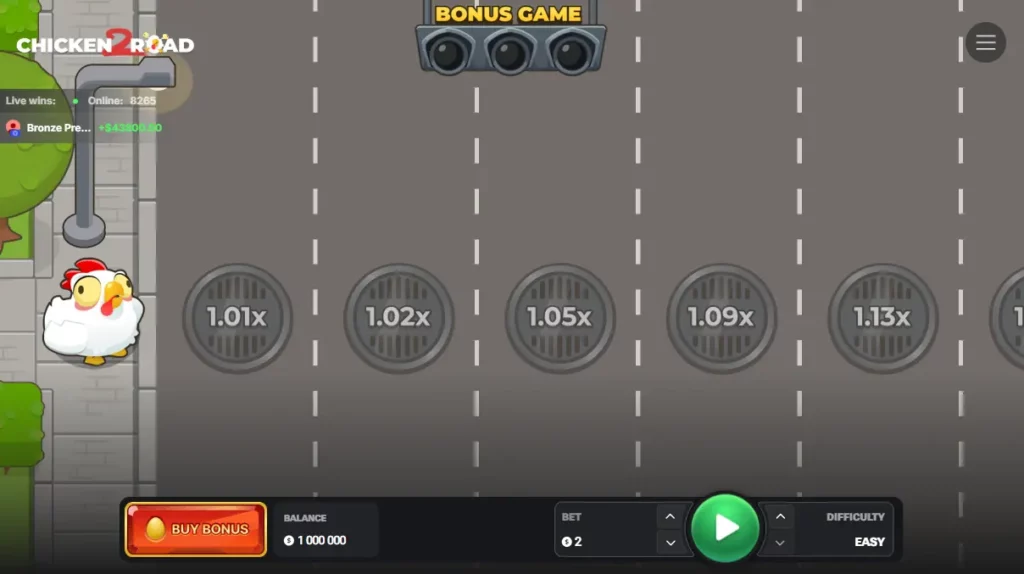
Chicken Road 2 Bonus is a step based instant win game from InOut Games, the studio behind the original Chicken Road. It is widely listed under the crash label, but mechanically it has little in common with a curve climber like Aviator. There is no multiplier rising automatically toward a random bust point. Instead, you guide a chicken across a multi lane road one tap at a time. Each successful step adds a fixed increment to your multiplier, each step carries a chance of ending the round, and you cash out whenever you decide you have gone far enough. It is closer to a game of Mines than to a classic crash graph. The Bonus edition was released in early 2026, with its launch reported as February 2026, and it sits alongside the 2025 sequel rather than replacing it.
What separates this release from the plain sequel is a collectible bonus layer. Light symbols can appear at random on successful steps, and banking three of them by cashing out safely triggers a set of automated free runs in which the chicken advances on its own and stops one step short of danger each time.
A round begins when you choose a difficulty, set your stake, and start. At that instant the outcome of the entire crossing is already determined by the seed pair described later, locking the position of every fatal lane before you move. You then tap to advance the chicken one step forward. Each safe step nudges the multiplier up by a fixed amount and increases your potential payout. If the next lane is one of the fatal ones, the chicken is hit, the round ends immediately, and both the accumulated multiplier and the original stake are lost. If you stop first, you collect your stake multiplied by the coefficient you reached.
The four difficulty settings are not cosmetic. Each changes three linked numbers at once: how many steps make up the full path, the probability that any given step is fatal, and the size of the top multiplier. On the easiest setting the path is long, the per step failure chance is low, and the multiplier grows gently, so you bank frequent small wins. As difficulty rises, the path shortens, the per step failure chance climbs sharply, and the multiplier curve steepens, so wins become rare but far larger. The key thing the difficulty toggle does not change is the long run return: all four settings give back roughly the same percentage over time. You are choosing your volatility, not your edge.
Auto-cashout is available and worth understanding precisely. You can set a target step or multiplier, and the game will exit for you the moment it is reached, which protects you from hesitation and from connection lag on mobile. What it does not do is speed up play, because the game has no autoplay: you still have to click manually for every single step forward. It also does nothing to the house edge.

The published RTP for the Bonus edition is 96.5%, as listed by the aggregator SlotCatalog. If that figure holds at the operator where you play, the house retains roughly $3.50 of every $100 wagered over a large number of rounds. Reported figures for the Chicken Road family are inconsistent across sources: the original Chicken Road is widely cited at 98%, the 2025 sequel at 95.5% to 96.4% depending on the outlet, and this Bonus edition at 96.5%. That spread may reflect operator configurable return tiers, a common practice for studios that distribute through many casinos, or simply careless reporting. Either way, confirm the exact RTP inside the lobby where you play, because that is the only number that governs your money.
Now the cost. Expected loss per hour equals the house edge multiplied by rounds per hour multiplied by your average stake. Because every step is a manual click and players tend to deliberate, this game runs slower than an auto resolving crash title, so assume a realistic sixty rounds per hour. At a $1 stake that is 0.035 times 60 times $1, which works out to about $2.10 lost per hour on average. At a $5 stake the same arithmetic gives roughly $10.50 per hour.
That cost is a long run average, which is different from what you feel in a single sitting. In a short session you can finish well ahead, especially on Hardcore where a single survived run can multiply your stake hundreds of times. Higher difficulty does not improve your expected value; it widens the range of outcomes around the same negative average, trading a steady drip of small results for rare large ones.
This is the section most reviews of this game wave through with a reassuring word and no explanation, so here is what the system actually does. Before a round, the server generates a secret server seed and shows you only the SHA-256 hash of it. Your device contributes a client seed, which you can usually change. The two seeds, combined and processed through SHA-256, determine every step outcome for that round, meaning which lanes are safe and which are fatal. Because the server committed to its hashed seed before you did anything, it cannot swap in a different result after watching your choices.
After the round ends, the server reveals the original unhashed server seed. To verify, you run SHA-256 on that revealed seed yourself, using any online hash tool, and confirm it matches the hash you were shown before the round. If it matches, the server did not switch seeds. You then feed both seeds and the round number into a verifier to regenerate the path and confirm the safe and fatal lanes match what you actually saw. InOut Games distributes the title under a Curacao master licence and exposes these values through the game menu, so this is a genuine, player auditable mechanism rather than a marketing badge. The honest caveat is that provably fair proves a specific round was not tampered with after the fact; it does not certify that the overall RTP matches the operator’s claim, and it cannot protect you on a cloned site that copies the branding without real verification.
The risk control is the standout. Four explicit difficulty tiers give you direct, transparent influence over your session’s volatility, and players consistently single this out as the standout feature. You decide whether you want a long, gentle grind or a short, explosive gamble, and the trade off is visible rather than hidden.
The fairness layer is also better implemented than most. The provably fair system is real and self auditable, the demo mode mirrors the live game so you can confirm there is no bait and switch, and at least one independent investigation that tracked several hundred real rounds found results landing within a fraction of a percent of the advertised return, with no statistical anomalies.
The headline weakness is value relative to its own family. At a reported 96.5% return, the Bonus edition costs noticeably more per bet than the 98% original, and inconsistent franchise figures make it easy to wander into a worse paying variant without realising it. If you specifically want the lowest cost version of this concept, this is not it.
The bonus layer that gives the game its name is underwhelming in practice. Once triggered, the free runs are entirely passive: you watch the chicken auto stop at the safe maximum and tally multipliers while making no decisions, which strips out the one thing that makes the base game interesting. The direct Bonus Buy at one hundred times your stake is poor value by most accounts, with returns that frequently fail to justify the entry price. There is also no autoplay, which makes longer sessions tedious.
Some players report that the chicken seems to hesitate right as a car arrives, which feels like manipulation but is simply the animation rendering a predetermined loss. More seriously, the popularity of the brand has spawned a swarm of fake mirror sites and APK downloads that steal the branding, so the real risk to your money often lies in where you play rather than in the game itself.
The player who will get the most from this is someone who treats it as cheap, self contained entertainment with a clear stop point. If you set a strict loss limit, play Easy or Medium for longer, steadier sessions, and use auto-cashout to enforce your exit, the game delivers what it promises: a quick, transparent, low minimum diversion you can walk away from.
The player who should consider an alternative is the value focused grinder who plays often and cares about cost per bet. If that is you, the 96.5% return is a meaningful tax compared with the franchise’s own 98% original or with higher returning instant games elsewhere, and the missing autoplay makes volume play a chore. You would be better served by a higher RTP title with the same step based mechanic.
The player who should avoid it entirely is anyone drawn to the Hardcore multiplier and the million times jackpot. That mode is engineered so the top prize is, for practical purposes, unreachable, and its appeal works directly against the kind of player most likely to chase it: someone who escalates risk after losses. If a giant headline number is what pulls you in, this game’s most dangerous setting is aimed squarely at you.
Step games like this are built for fast play, and that speed is the real hazard. Rounds are short, the manual rhythm encourages “just one more,” and losses can stack up far quicker than in slower formats even at small stakes. Auto-cashout at a set multiplier can impose discipline, but it does not change the underlying house edge: the math still favours the operator on every round. Decide your loss limit before you start, not in the middle of a losing streak when the decision is hardest, and treat any winnings as luck, not a working strategy. If gambling stops feeling like entertainment, help is available. GambleAware offers international support at begambleaware.org, GamCare in the UK at gamcare.org.uk, the National Council on Problem Gambling in the US at ncpgambling.org or on 1-800-522-4700, and Gambling Therapy internationally at gamblingtherapy.org. 18+ only.
Chicken Road 2 Bonus is a competent, genuinely transparent step game wrapped in a bonus feature that adds less than its name suggests. The single strongest reason to play it is the combination of real, player auditable fairness and direct control over your own volatility. The single most important reason for caution is the cost: at a reported 96.5% return it is meaningfully more expensive per bet than its own 98% predecessor, and the passive bonus mode and one hundred times bonus buy add little for the price. This is a game worth playing only with specific caveats, and only for the disciplined casual player who sets a loss limit, sticks to the lower difficulties, and treats it as paid entertainment rather than a route to the jackpot. The one fact most reviews leave out is the one that should anchor every decision: nothing about your reflexes, timing, or tapping speed affects the result, because each round is fully resolved by its seeds before you take a single step, and your only real choice is how far to push a risk whose price never moves in your favour.
The reported RTP is 96.5%, according to the aggregator SlotCatalog. Figures across the Chicken Road family are inconsistent, so confirm the exact return inside the casino lobby where you actually play, since that is the only figure that governs your money.
Yes. It uses a dual seed SHA-256 system: the server publishes a hashed server seed before the round, your device adds a client seed, and after the round you can verify the revealed seed against that hash and regenerate the path yourself to confirm nothing was altered.
The top multiplier is x4,218,142.50 on the Hardcore setting, per SlotCatalog. In practice this requires surviving a string of high risk steps that is close to impossible, so it should be treated as a theoretical ceiling rather than a realistic target.
You guide a chicken across a road one manual step at a time. Each safe step raises your multiplier by a fixed amount, each step carries a chance of ending the round, and you cash out whenever you choose. The Bonus edition adds collectible Light symbols that trigger automated free runs.
Roughly 3.5%, derived from the reported 96.5% RTP, meaning the operator retains about $3.50 of every $100 wagered over a large number of rounds. At a $1 stake and sixty rounds per hour, that averages out to about $2.10 in expected losses per hour.
On a legitimate operator, no. The provably fair system lets you verify each round independently, and at least one investigation tracking hundreds of real rounds found results matching the advertised math. The real risk is fake mirror sites and APK downloads that copy the branding without the genuine verification.

Chicken Halloween is BGaming's October 2026 seasonal reskin of Chicken Shot, a casual instant-win game where every shot at a costumed chicken is a separate wager with a published win chance and a fixed multiplier from x1.1 to x64.

High Flyer is a multiplayer plane crash game from Pragmatic Play, released in September 2024, in which players cash out before the aircraft flies away. It publishes a 97% RTP, offers two independent bet spots with auto-cashout and advertises multipliers of up to 1,000,000x.

Space XY is a multiplayer crash game from BGaming in which a rocket climbs across an X-Y graph and players cash out before it explodes. It has a published 97% RTP, two bet panels per round and a €250,000 win cap.

JetX3 is a crash game from SmartSoft Gaming in which three jets take off together, each with its own independent crash point. Players can bet on one, two or all three jets, collect from each separately and reach up to 2,000x per jet.