Author Spencer Thorne
June 30, 2026

Almost every review of MegaBlock sells it as a game of skill, a “precision crash game” where timing lets you beat the odds. That claim cannot be true; the proof is built into the game itself. MegaBlock is provably fair, which means the outcome of every round is locked inside a cryptographic hash before the first block ever moves. The point at which your tower collapses is decided the instant you press play, not by how sharp your reflexes are. The swinging block and the satisfying tap are animation sitting on top of a result that was already determined, and that one fact changes how you should read everything else about this game.
| Detail | Information |
|---|---|
| Developer / provider | InOut Games |
| Game type | Crash / instant-win hybrid (tower-building step multiplier) |
| RTP | 95.5% (source: InOut Games official documentation) |
| House edge | 4.5% |
| Max multiplier | 2,941,884x (Hardcore mode), capped by a $20,000 max win |
| Min stake | $0.10 |
| Max stake | $200 (some operators and official pages list $100) |
| Risk level settings | Yes (four difficulty modes) |
| Provably fair | Yes (server seed, client seed, nonce) |
| Auto-cashout | Yes (Auto Game with cashout steps) |
| Demo available | Yes (free, no registration) |
| Mobile compatible | Yes (HTML5, no download) |
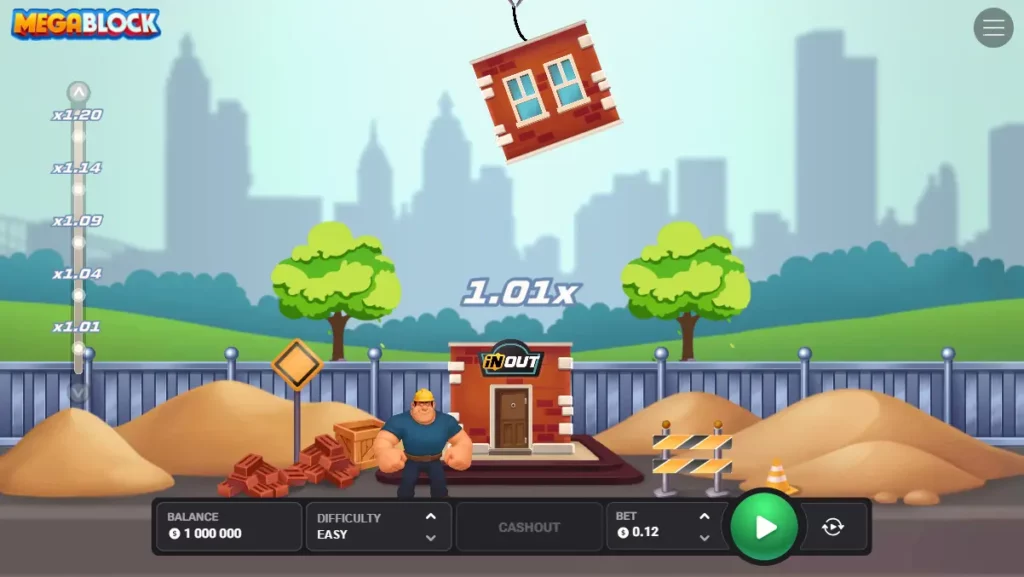
MegaBlock is an instant-win game built around a step multiplier, dressed up as a tower-building arcade challenge. Each round, you place a bet, pick a difficulty, and press a button to drop a block onto a growing stack. Every successful placement adds a floor and nudges a live multiplier upward, while a miss or a tower collapse ends the round and costs your stake. There are no reels, paylines, or bonus symbols; the entire game is that single loop repeated.
It was released by InOut Games on February 10, 2026, as a flagship title. InOut is a Curacao-licensed developer active since around 2024, with more than thirty instant-style games including crash titles, mines, and plinko variants, and is best known for the Chicken Road series. MegaBlock is not an original concept; it belongs to the established tower-building crash subgenre and is openly described by some reviewers as a clone of Galaxsys’ Tower Rush. What InOut added is a four-tier difficulty selector, the one genuine point of differentiation worth examining.
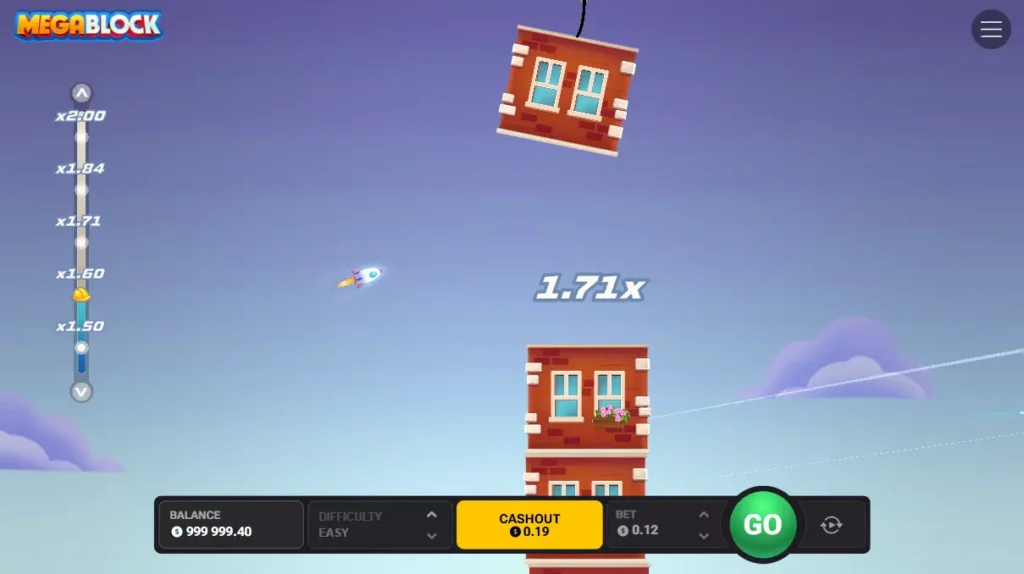
A round begins when you set a stake, choose one of four difficulty modes, and press play. From that moment the result is fixed. The random number generator has already determined how far the tower can go before it fails on that round, and the provably fair hash encoding this is committed before you interact. You then tap to drop blocks: land one and the multiplier ticks up a step; the cashout button activates the moment your first block lands, and the current multiplier is shown above the tower throughout.
The round ends one of two ways: you cash out and bank the current multiplier, or you reach the placement the RNG marked as the failure point, the tower collapses, and the stake is gone. Your timing changes how the drop looks but not that predetermined collapse point. This is what contradicts the marketing: in a genuinely provably fair game, a skilled player cannot outperform the published RTP through reflexes, because the outcome was sealed before the skill was applied.
The four difficulty modes are where the design earns its keep. Each changes the maximum number of blocks and the multiplier range. Easy allows up to 24 blocks with a ceiling around 23.75x; Medium allows 22 blocks up to roughly 2,116x; Hard allows 20 blocks up to about 48,348x; and Hardcore caps you at 15 blocks but stretches the ceiling to a theoretical 2,941,884x. Fewer blocks with a higher ceiling means each placement carries a steeper chance of being the failure point, so Hardcore busts early and often in exchange for its enormous top end. An Auto Game function adds automatic rounds and target cashout points, and session recovery restores an interrupted round if your connection drops.
MegaBlock’s RTP is published by InOut Games at 95.5%, which gives a house edge of 4.5%. In plain terms, if the RTP is 95.5%, the operator retains approximately $4.50 of every $100 wagered over a large number of rounds. That figure is firmer than most crash games manage to publish, but it is slightly worse than the category norm of 96% to 97%, so MegaBlock keeps a little more of your money than its closest competitors do.
The formula for expected loss is house edge multiplied by rounds per hour multiplied by average stake. MegaBlock runs a touch slower than pure crash but still clears high volume. Assuming sixty rounds per hour, a player betting $1 per round faces an expected loss of 0.045 x 60 x $1, about $2.70 an hour. At $5 per round that becomes 0.045 x 60 x $5, roughly $13.50 an hour. At a faster hundred rounds per hour those figures rise to about $4.50 and $22.50. These are statistical averages, not guarantees for any single session.
Here is where the difficulty selector matters mathematically. The RTP stays at 95.5% across all four modes, so changing difficulty does not change the house edge or your long-run expected loss at all. What it changes is variance, the shape of results around that average. Easy produces frequent small wins and a steadier balance; Hardcore produces long losing streaks broken by rare, very large hits. Both bleed money at the same 4.5% rate; they simply distribute the pain differently. This is why a player can be up significantly after twenty minutes and still be playing a negative-expectation game: the longer you play, the more reliably results converge toward losing 4.5% of everything you stake.
One number deserves a footnote: the headline 2,941,884x multiplier is effectively unreachable as a payout, because all wins are capped at $20,000. At the minimum $0.10 stake the most you can ever actually receive is 200,000x, and at a $200 stake the game auto-cashes you at 100x because that already hits the cap. The seven-figure multiplier is a marketing ceiling, not a realistic outcome.
This is the section most crash reviews skip or treat as a trust badge, so here is what it means in practice. The system uses three values: a server seed generated by the provider, a client seed contributed by your browser, and a nonce that increments each round. Before a round, the game shows you a hashed version of the server seed, a fingerprint that cannot be altered afterward, which commits the operator to a result it cannot then change. After the round resolves, the original server seed is revealed. You combine the revealed server seed, your client seed, and the nonce, run them through the hash function, and confirm two things: that the revealed seed matches the fingerprint shown earlier, and that those inputs reproduce the exact result you saw.
In MegaBlock this is accessible through a shield or settings icon in the menu, where you can view both seeds and change your client seed at any time, the feature that stops the operator from being the only party shaping the randomness. You can paste the values into any independent hash verifier and check them yourself. That is a genuine, functional verification path and a real point in the game’s favour. What it proves is narrow, though: provably fair confirms the result was not edited after you bet; it does not make the game safe, generous, or low-edge. And it confirms the central point of this review, because if the result is sealed in a hash before you act, your timing is decorative.
The difficulty system is the strongest thing here, and it is a real design idea rather than a gimmick. Switching volatility between rounds means one title can behave like a low-variance grind on Easy and an extreme lottery on Hardcore, and few crash games hand the player that dial so directly.
The presentation is clean and functional. Players consistently note that the cartoon construction-site interface is readable, the controls are large enough to use under pressure, and the game loads fast in HTML5 with no download. One recurring positive is that the provably fair checker works as described, with verified rounds matching the seed data. The published 95.5% RTP, while not class-leading, is at least disclosed clearly, which is more than many instant games offer.
The biggest problem is the gap between how the game is sold and how it works. The marketing leans heavily on skill, precision, and player agency, yet the provably fair architecture guarantees the outcome is predetermined, which shapes whether a player believes they can influence results when they cannot. Independent feedback is also thin and hard to trust. The game launched in February 2026, genuine forum discussion is sparse, a Trustpilot listing carries only a handful of reviews, and many “player testimonials” sit on affiliate pages with an incentive to sell. The most candid recurring criticisms are that the game is “decent but nothing groundbreaking” and that Hardcore mode is close to unplayable unless you enjoy losing.
The numbers are not in the player’s favour either. The 4.5% house edge is a step worse than the 3% to 3.5% offered by the leading crash titles, the feature set beyond the difficulty dial is thin with no real bonus rounds, and the seven-figure max multiplier is functionally unreachable because of the $20,000 cap.
The player who will get the most from MegaBlock enjoys the tactile, decision-heavy rhythm of a step-multiplier game and treats it strictly as paid entertainment. They want short rounds, a clear cashout choice, and the freedom to dial volatility up or down, and they accept the 95.5% RTP as the price of admission. Small stakes, a firm loss limit, and Easy or Medium mode suit them best.
The player who should consider an alternative is the value-focused crash player who cares about the house edge. If your priority is keeping more of your money in play over a long session, the 4.5% edge is beatable elsewhere, and a title in the 96% to 97% range will cost you noticeably less per hour for a similar experience.
The player who should avoid MegaBlock entirely is anyone drawn in by the skill narrative who believes practice and timing will turn a profit. That belief is the most dangerous thing about this game, because the fairness mechanism proves it false, and chasing the Hardcore ceiling on the assumption that reflexes can deliver it is a fast route to a drained balance.
Crash games like MegaBlock are engineered for speed, and that is exactly what makes them risky. Rounds are short, the next bet is always one tap away, and losses accumulate far faster than in slower casino formats. Auto-cashout at a set multiplier can impose some discipline and stop you riding greed into a collapse, but it does nothing to change the underlying 4.5% house edge. Decide on a loss limit before you start a session, never after a losing streak when judgement is at its worst, and treat any money staked as already spent. If gambling stops feeling like entertainment, support is available: GambleAware (international) at begambleaware.org, GamCare (UK) at gamcare.org.uk, the National Council on Problem Gambling (US) at ncpgambling.org or 1-800-522-4700, and Gambling Therapy (international) at gamblingtherapy.org. 18+ only.
MegaBlock is a competently built, genuinely verifiable instant-win game wrapped in a misleading skill story, and it is worth playing only with clear eyes and a small bankroll. The single strongest reason to play it is the difficulty selector, which gives you real control over variance in a way most crash games do not. The single most important reason for caution is that its 4.5% house edge is worse than the category’s best, and the timing skill it advertises is decorative because outcomes are sealed before you act. It is right for the casual player who accepts the cost, and wrong for anyone hunting value or expecting skill to pay. The one fact most reviews leave out: because the result is committed to a provably fair hash before the round begins, no amount of practice can beat the published RTP, which makes the “precision crash game” label exactly backwards.
The RTP is 95.5%, published in InOut Games’ own documentation, which gives a house edge of 4.5%. It is consistent across all four difficulty modes and sits slightly below the 96% to 97% typical of leading crash games.
Yes. Every round uses a server seed, a client seed, and a nonce, with the server seed hash shown before the round and the seed revealed afterward so you can reproduce and verify the result with any independent hash tool. You can also change your client seed in the game menu.
The theoretical maximum multiplier is 2,941,884x on Hardcore mode, but all wins are capped at $20,000, which makes that multiplier effectively unreachable. At the $0.10 minimum stake the highest payout you can actually receive is 200,000x.
You set a stake, choose one of four difficulty modes, and drop blocks to build a tower. Each successful placement raises a live multiplier, and you cash out before the tower collapses. The collapse point is set by the RNG before the round starts.
The house edge is 4.5%, derived directly from the 95.5% RTP. Over many rounds the game keeps about $4.50 of every $100 wagered, regardless of which difficulty you play.
No evidence suggests it is rigged, and the provably fair system lets you verify each result independently. That said, the game still carries a built-in 4.5% house edge, so it is designed for you to lose money over time even when every round is genuinely fair.

Chicken Halloween is BGaming's October 2026 seasonal reskin of Chicken Shot, a casual instant-win game where every shot at a costumed chicken is a separate wager with a published win chance and a fixed multiplier from x1.1 to x64.

High Flyer is a multiplayer plane crash game from Pragmatic Play, released in September 2024, in which players cash out before the aircraft flies away. It publishes a 97% RTP, offers two independent bet spots with auto-cashout and advertises multipliers of up to 1,000,000x.

Space XY is a multiplayer crash game from BGaming in which a rocket climbs across an X-Y graph and players cash out before it explodes. It has a published 97% RTP, two bet panels per round and a €250,000 win cap.
JetX3 is a crash game from SmartSoft Gaming in which three jets take off together, each with its own independent crash point. Players can bet on one, two or all three jets, collect from each separately and reach up to 2,000x per jet.