Author Spencer Thorne
August 27, 2026

Play Me contains a state in which losing is impossible. When a held tile turns gold, Boost Mode is active, the odds climb faster than normal and the rules guarantee they cannot stop until the boost ends. A crash game with a scripted no-loss window sounds like a contradiction, and it is exactly the kind of feature that tempts reviewers into strategy talk about waiting for gold tiles. The truth is less romantic: the boost triggers at random, cannot be earned or timed, and is already priced into the published 97% return. What it actually reveals is how this game works underneath its Guitar Hero costume.
| Detail | Information |
|---|---|
| Developer / provider | Galaxsys |
| Game type | Hybrid: turbo and crash mechanics, hold-and-release format |
| RTP | 97% (source: Galaxsys official game page and in-game rules) |
| House edge | 3% |
| Max multiplier | Not officially documented; third parties cite 1,000x; win cap applies |
| Min stake | $1 (per the in-game rules panel; operator configurable) |
| Max stake | $100 (per the in-game rules panel; operator configurable) |
| Max win | 10,000 units per the in-game rules panel |
| Risk level settings | No |
| Provably fair | Not documented |
| Auto-cashout | No |
| Demo available | Yes |
| Mobile compatible | Yes |
Play Me is a hold-and-release multiplier game released by Galaxsys on 19 February 2025 and listed in the studio’s Fast Games category. Galaxsys itself describes it as a combination of a turbo game and a crash game, and that hybrid label is more accurate than the plain crash tag most reviews attach to it. There is no shared round, no communal countdown and no betting window. Each player starts their own run whenever they press a tile, which is the turbo element, and each run ends when the multiplier stops, which is the crash element.
Visually, the game borrows from rhythm titles. Tiles scroll down four lanes in time with a backing track, and the player presses and holds any tile, or a dedicated button below the lanes, to start accumulating odds. The presentation suggests a music game where timing and accuracy matter. Mechanically, it is nothing of the sort, and the official rules say so directly. The player is free to press or leave out any tile, and missing tiles has no effect on the outcome.
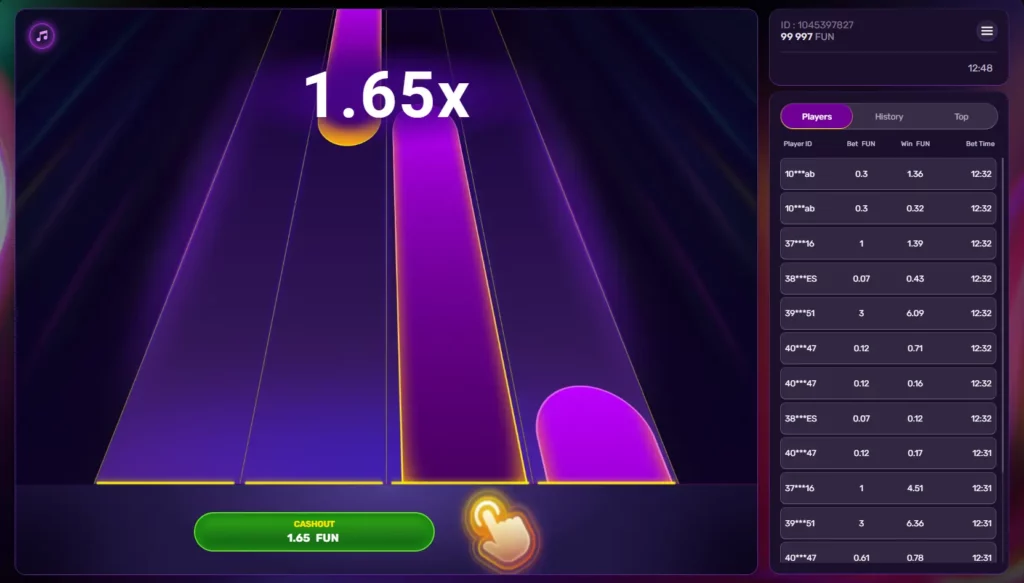
A round begins the moment the player, having set a stake, presses and holds a tile or the dedicated button. The odds counter starts at x1.00 and climbs while the hold continues. The server determines the stopping point at random, and the rules are explicit that the counter can stop at x1.00 itself, meaning a run can bust instantly with no multiplier gained. If the odds stop while the player is still holding, the stake is lost. That is the bust condition, and it is communicated by the counter freezing at its terminal value while the tile run ends.
Releasing the tile before the stop is the survival move. On release, the current odds freeze, and the player then has two options. The first is to press Cashout, which pays the stake multiplied by the frozen odds. The second is to press and hold another tile or the button again, in which case the odds resume climbing from the frozen value rather than resetting to x1.00. This chaining option is the game’s one genuinely distinctive mechanic: a player can build a multiplier across several holds, banking nothing in between, with each new hold risking the entire accumulated value against a fresh random stop.
There are no risk level settings and no auto-cashout. Everything is manual, which matters, because the pacing of losses is set entirely by how quickly the player chooses to re-enter. Boost Mode is the only scripted variation. At a random moment a held tile turns gold, and while the boost lasts the odds climb faster and cannot stop, so the player cannot lose during the boost window. When it ends, the tile reverts and the normal random-stop rule resumes. A disconnection policy backs all of this: if the connection drops after a bet is placed, the server settles the outcome and credits any registered winnings, and an abandoned run with frozen odds is settled automatically after one hour of inactivity.
Galaxsys publishes the RTP directly in the game’s rules panel and on its official game page: 97%. That means the house edge is 3%, so the operator retains approximately $3 of every $100 wagered over a large number of rounds. The figure sits at the generous end for the genre, above the 96% common in slots, though below the 97.3% to 99% that some competing crash titles advertise.
Expected loss per hour equals house edge multiplied by rounds per hour multiplied by average stake. Because Play Me has no waiting period between rounds, it plays faster than communal crash games; assume 60 rounds per hour as a moderate manual pace. At a $1 average stake, that is 0.03 x 60 x 1, or $1.80 per hour. At a $10 average stake, the same arithmetic gives $18 per hour.
Those are long-run averages, and short sessions will not feel like them. A game that can stop at x1.00 on entry but occasionally lets a chained run climb high is a high-variance design: most runs end small or in a bust, and the RTP is carried by infrequent large outcomes. A player can be up several buy-ins after an hour, and the mathematics have not changed. The 3% edge is the slope of the floor, not a description of any single session.
One number deserves particular scrutiny. Third-party catalogues list a maximum win of 1,000x, while the in-game rules panel documents a maximum win of 10,000 currency units alongside a 100-unit maximum bet. Those two facts cannot both bind at once. At the maximum stake of 100 units, the 10,000-unit cap makes the effective ceiling 100x, and the 1,000x figure is only reachable at stakes of 10 units or less. Galaxsys does not publish a maximum multiplier in the rules at all, so the honest statement is that the win cap, not the advertised multiplier, is the operative limit at higher stakes.
Play Me is not documented as provably fair, and this review found no verification mechanism in the official rules. A genuine provably fair implementation has recognisable parts: the server commits to a secret seed by publishing its hash before play, the player contributes a client seed, and after the round the server seed is revealed so anyone can re-run the hash function, confirm the commitment and recompute the stopping point. Play Me’s rules panel describes none of this. It states only that game outcomes are determined by the server, and it offers no seed panel, no pre-round hash and no round verification history.
Several unofficial fan and affiliate sites assert that Play Me uses “Provably Fair technology,” but none of them explains a mechanism, names a hash function or shows a verification step, and the claim does not appear in Galaxsys’s own documentation for this title. Galaxsys has written about provably fair systems on its corporate blog and implements one in at least one other product, which makes the silence in Play Me’s own rules more informative, not less. The practical meaning for a player is straightforward: every stopping point in Play Me rests on trust in the server’s random number generation and whatever testing-lab certification applies through the licensed operator hosting the game. That is the standard arrangement for most casino content, and it is not evidence of misconduct, but it is categorically different from a game whose results a player can independently recompute.
The chained-hold mechanic is a real design contribution. Freezing odds on release and resuming from that value on the next tile turns each run into a sequence of explicit re-commitment decisions rather than one passive watch of a curve, and no mainstream crash title structures its rounds this way. It also gives the player unusual control over tempo, since there is no betting window to wait for.
The transparency around core figures is also better than the genre norm. The RTP is printed in the rules panel rather than buried in an operator help file, the win and bet limits are stated in the same place, and the disconnection policy is specific about how interrupted runs are settled, down to the one-hour settlement rule for abandoned progress. Boost Mode, the signature feature, is honestly described: a temporary state in which odds accelerate and cannot stop, functioning as a scripted variance spike rather than a vague bonus promise. The presentation, three musical atmospheres and responsive tile animation, is polished and works identically on mobile, where the hold gesture arguably feels more natural than a mouse click.
The rhythm framing oversells player agency, and much of the coverage around the game amplifies the problem. Press material speaks of skill and intuition, and affiliate reviews describe tapping notes at the right moment, yet the rules establish that tile choice and timing accuracy are irrelevant to outcomes. A player who believes their musicianship influences results has been misled by the interface, and that gap between presentation and mechanics is the game’s most serious weakness.
The documentation also stops short where it matters most. No maximum multiplier is published, leaving third parties to circulate a 1,000x figure that the win cap quietly restricts at higher stakes. There is no provably fair mechanism despite unofficial claims to the contrary. There are no risk settings and no auto-cashout, so a player cannot pre-commit to a disciplined exit point; every cashout decision is made live, under exactly the conditions in which discipline is hardest. Genuine independent player feedback is thin, with most search results dominated by affiliate content, which makes long-term community verification of the game’s behaviour harder than for established crash titles.
The player who gets the most from Play Me is one who values pacing control and manual decisions, plays at small stakes in the $1 range, and enjoys the chaining mechanic as a structured way of deciding when a run has gone far enough. For that player, an hour costs around $2 in expected terms at a moderate pace, and the game delivers an unusually interactive take on the crash formula.
The player who should consider an alternative is one who relies on auto-cashout to enforce an exit strategy. Play Me offers no such tool, and a communal crash game with configurable auto-cashout, or a title with published risk levels, serves that player’s need for pre-commitment far better. The same applies to anyone who wants independently verifiable results, who should look specifically for games with a documented seed-and-hash panel.
The player who should avoid Play Me entirely is one who knows that fast, continuous formats erode their limits. The absence of any pause between rounds, the live temptation to chain one more tile instead of cashing out, and the instant re-entry all compress the loss cycle, and someone prone to chasing losses will find this structure works directly against them.
Play Me is built for speed. Runs can end in seconds, there is no enforced gap before the next one, and losses can accumulate far faster than in slower casino formats. The chaining mechanic adds a specific pressure point, since every frozen multiplier invites one more hold, and no auto-cashout exists to make that decision in advance. Set a loss limit and a time limit before the first tile, not after a losing streak, and treat the 3% edge as the price of the session rather than something a strategy can overcome. Support is available from GambleAware at begambleaware.org, GamCare in the UK at gamcare.org.uk, the National Council on Problem Gambling in the US at ncpgambling.org or 1-800-522-4700, and Gambling Therapy internationally at gamblingtherapy.org. 18+ only.
Play Me is a well-built, honestly priced variation on the crash format whose interface promises a skill game it does not contain. The strongest reason to play it is the chained-hold mechanic, which genuinely adds decision structure that no communal crash game offers, backed by a published 97% RTP. The most important reason for caution is the fairness gap: no provably fair mechanism, no published maximum multiplier, and a rhythm presentation that implies control the rules explicitly disclaim. It is right for small-stakes players who want tempo control and manual play, and it is worth playing with those specific caveats understood. The fact most reviews omit: at the maximum documented stake, the win cap in the rules panel limits the effective multiplier to 100x, an order of magnitude below the 1,000x figure circulating in third-party catalogues.
The RTP of Play Me is 97%, published by Galaxsys both on the official game page and inside the game’s own rules panel. This corresponds to a 3% house edge, meaning the operator retains about $3 of every $100 wagered over the long run.
No, Play Me is not documented as provably fair. The official rules state that outcomes are determined by the server and describe no seed commitment, hash function or verification step, so players cannot independently recompute results and rely instead on the operator’s RNG certification.
The in-game rules panel documents a maximum win of 10,000 currency units, with a maximum bet of 100 units. Third-party catalogues cite a 1,000x maximum multiplier, but that figure is only reachable at stakes of 10 units or less because of the win cap, and Galaxsys does not publish an official maximum multiplier.
The player holds a tile or a dedicated button while odds climb from x1.00, and the server stops the counter at a random point that can be x1.00 itself. Releasing before the stop freezes the odds, after which the player can cash out or hold another tile to continue climbing from the frozen value; holding through the stop loses the stake.
The house edge is 3%, derived from the published 97% RTP. At a moderate pace of 60 rounds per hour and a $10 average stake, that translates to an expected loss of about $18 per hour, with actual sessions varying widely around that average.
There is no evidence that Play Me is rigged, and its 97% RTP is openly published, but the game offers no provably fair verification, so fairness cannot be checked by players directly. Trust rests on the server-side RNG and the testing and licensing framework of the operator offering the game.
No, the official rules state that missing tiles does not affect the game in any way, and the stopping point of the odds is random. The music synchronisation and tile selection are presentation, and the only decision that matters is how long a hold lasts.
No, Play Me has neither auto-cashout nor risk level settings. Every cashout is a live manual decision, and the multiplier behaviour cannot be configured, which distinguishes it from many crash games that offer both tools.