Author Spencer Thorne
July 9, 2026

Almost every page that covers Chicken Dash files it under “crash games,” yet it has no rising multiplier curve and no auto-cashout button. It is a step-by-step road-crossing game: you tap a chicken forward one lane at a time. Stranger still, the RTP those pages quote varies by well over a percentage point, and at least one commonly cited number appears to belong to a different TaDa Gaming release that shares the name. The “provably fair” badge a few affiliate sites attach to the game points to no verification path a player can actually run.
| Detail | Information |
|---|---|
| Developer / provider | TaDa Gaming |
| Game type | Road-crossing step game (marketed as crash) |
| RTP | Not confirmed by the developer; aggregators cite 95.5% to 97% (unverified, conflicting) |
| House edge | Approximately 3% to 4.5%, implied by the unverified aggregator figures |
| Max multiplier | 20,659x (documented across third-party sources; not from developer docs) |
| Min stake | $0.10 |
| Max stake | $100 |
| Risk level settings | Yes (Easy, Medium/Normal, Hard) |
| Provably fair | Not documented; relies on certified RNG, not player-verifiable seeds |
| Auto-cashout | No |
| Demo available | Yes |
| Mobile compatible | Yes |
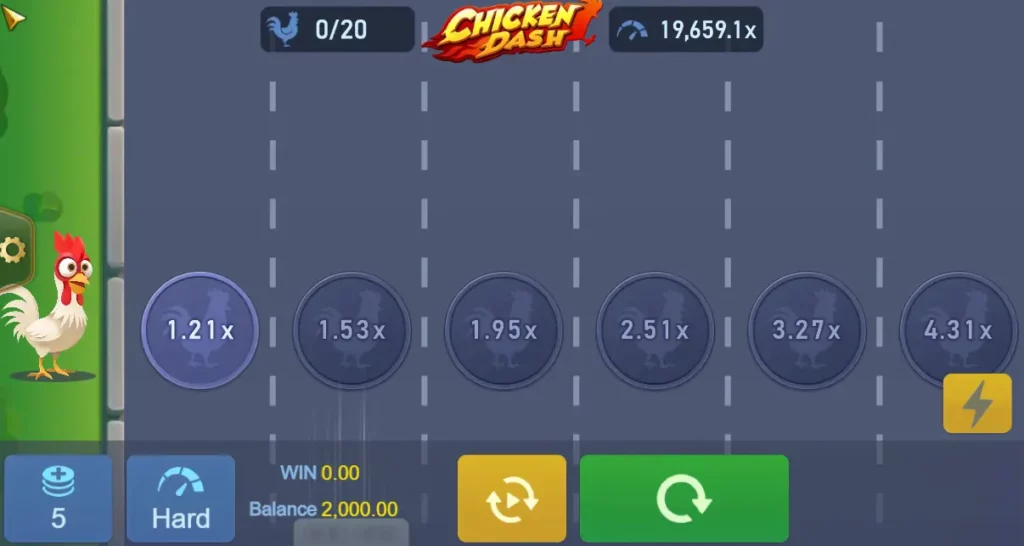
Chicken Dash is a road-crossing gambling game released by TaDa Gaming on October 14, 2025. Mechanically it belongs to the same family as InOut Games’ Chicken Road and Chicken Road 2, and reviewers have described it as near-identical gameplay under a fresh name. There are no reels, paylines, or free spins, which matters because a separate TaDa slot also called Chicken Dash does have all of those things. That naming overlap is the single biggest source of confusion in the coverage of this game.
TaDa Gaming is a young studio with a catalogue of more than one hundred titles, certified for platforms operating under authorities such as the Malta Gaming Authority and the UK Gambling Commission. Chicken Dash is one of several near-interchangeable “cross the road” releases that chased the format’s popularity through 2025.
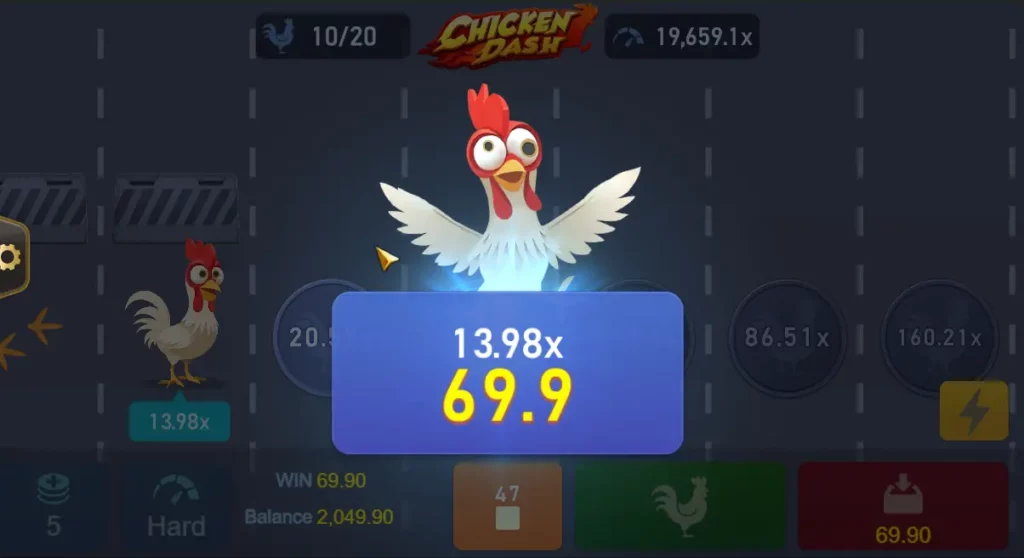
A round begins when you choose two things: your stake, anywhere from $0.10 to $100, and your risk mode. When you commit the bet, the chicken jumps to the first lane, where either a car hits it, ending the round and losing the stake, or the lane resolves as safe. When you are safe, you face the only real decision the game offers: collect the multiplier on that lane, or tap again for the next one. Only the first jump is charged against your stake; every subsequent step is free, so the money at risk each round is fixed the moment you commit to that opening jump.
What the random number generator determines, and precisely when, is not documented by TaDa for this title. Games of this class typically fix the hazardous lanes when the round starts and reveal them tap by tap, but because TaDa has not published the implementation, a player cannot confirm whether outcomes are locked at the start or drawn at each step. Either way, each tap is a gamble on whether the lane is fatal, and the current multiplier is shown after every successful step.
The three risk modes change the shape of the road, not merely the size of the prizes. Easy mode lays out roughly 28 lanes with sparse traffic, so survival per step is high but the multiplier climbs slowly and caps near 14.54x; the medium setting runs about 24 lanes and caps near 43.15x; Hard mode compresses the run to about 20 lanes packed with cars, so the chance of being hit on any step is far higher, but the multiplier grows steeply and reaches roughly 19,659x, feeding the headline 20,659x ceiling. Two random modifiers sit on top: a “Chicken Dash” effect that occasionally shunts the chicken forward two or three lanes safely, and “Bonus Bags” that pay an extra prize when the round resolves. Crucially, there is no auto-cashout and no autoplay. Every step is a manual tap and a manual decision, a meaningful difference from Aviator-style crash games where players routinely set an automatic exit multiplier.
Here is the honest problem with Chicken Dash’s numbers: there is no first-party RTP to anchor to. TaDa Gaming has not published a definitive figure, and the third-party pages that quote one disagree. Some list 95.5%, others 96.85%, and at least one affiliate page claims a round 97%. Separately, a figure of 96.20% circulates widely, but that belongs to the identically named TaDa video slot, not this road-crossing game. If a review hands you a single confident RTP for Chicken Dash, it is quoting an unverified aggregator or possibly the wrong game entirely.
If the RTP is genuinely 97%, the house retains about $3 of every $100 wagered over a large number of rounds; if it is closer to the 95.5% some sites list, the house keeps about $4.50 per $100. The formula is straightforward: expected loss per hour equals the house edge multiplied by rounds per hour multiplied by the average stake per round. Assume a brisk but realistic pace of 100 manually tapped rounds per hour. At a $1 opening stake, a 3% edge costs about $3 per hour and a 4.5% edge about $4.50 per hour. At a $5 opening stake, the same assumptions produce roughly $15 per hour at 3% and about $22.50 at 4.5%. These are long-run averages, not predictions for a single session, and they scale with how fast you play and how large your opening bet is.
This is where volatility diverges from that long-run average. Over a short session you can easily finish well ahead, because a single Hard-mode run can return thousands of times your stake, and the house edge only asserts itself across a large sample. Big outcomes are rare and small busts frequent, so the mathematics can feel generous for an evening and stay unfavourable over a month. Choosing Hard does not improve your expected value; in games of this design the return-to-player is intended to stay roughly constant across modes, with higher risk buying a longer-tailed distribution, a lower probability of any win in exchange for a fatter, rarer top prize.
This is the section most reviews of Chicken Dash handle dishonestly, so it deserves a plain statement: there is no documented provably fair mechanism for this game. A genuinely provably fair game gives you three things you can check yourself: a server seed that the operator commits to by publishing its hash before you bet, a client seed contributed by you or your browser, and a nonce, all combined through a cryptographic hash function such as HMAC-SHA256 so that afterwards you can independently reproduce the result and confirm nothing was altered. That is what “provably fair” means in practice: not a trust badge, but a step you perform yourself.
Chicken Dash, as distributed to regulated operators, does not publish that path. TaDa’s titles rely on a certified random number generator audited by independent testing labs for the licensed markets they operate in. That certification is real, but it is not the same as provably fair verification: a lab audit confirms the system behaved correctly during a test window, but it cannot let you verify your own individual round. The affiliate pages that advertise “provably fair checks you can verify” for Chicken Dash do not describe any seeds, hash function, or verifier, because there is no published implementation to describe. The consequence is direct: you rely on the operator’s certification and licensing for fairness, not on cryptography you can audit yourself.
The core loop is clean and immediate. There is exactly one decision to make, bank or continue, and new players understand it within a single round without a tutorial. The interface is uncluttered, the animations are crisp, and reviewers consistently note that it loads quickly and plays smoothly in a mobile browser.
The three risk modes give the game more range than a single-difficulty title. Switching between a long, gentle Easy road and a short, brutal Hard one lets a player match the session to their bankroll without changing games. The random Chicken Dash advance and the Bonus Bags add small moments of variance without any bet-buy or side wager, so they do not quietly widen the house edge. A free demo is also widely available, and because the only skill on offer is cash-out discipline, it genuinely helps a player rehearse setting and holding a threshold before any money is involved.
The most serious failing is transparency around the numbers. A player cannot get a straight, developer-confirmed RTP for Chicken Dash, the figures floating around the web conflict by more than a percentage point, and one widely repeated number belongs to a different game. For a product whose value proposition is a fair gamble, being unable to state the house edge with confidence is a real problem. Between an unconfirmed RTP and no player-auditable fairness check, you are asked to take more on trust than a well-documented crash game would require.
Originality is thin. Independent reviewers have described Chicken Dash as competent but derivative, essentially a reskin of Chicken Road 2, and little in the mechanic distinguishes it from the crowd of road-crossing releases around it. The lack of auto-cashout also removes a discipline tool many players of this genre rely on. Organic player discussion is thin too: coverage is dominated by affiliate and aggregator pages rather than independent community threads, making honest accounts of long-session behaviour hard to find. Finally, the headline 20,659x ceiling is real but astronomically unlikely, and treating it as a target rather than a mathematical boundary is the fastest way to lose money here.
The player who will get the most from Chicken Dash wants a fast, low-commitment loop and treats it as paid entertainment rather than an earning method. They set a fixed session budget, play small opening stakes on Easy or Medium, pick a modest cash-out multiplier in advance, and hold it.
The player who should consider an alternative is anyone who values independent fairness verification or a clearly published RTP. If the ability to audit your own rounds matters to you, a road-crossing or crash game that publishes a full provably fair implementation, with seeds and a verifier you can actually use, will serve you better, and you would give up nothing mechanically since the format is near-identical across competitors.
The player who should avoid Chicken Dash entirely is the one drawn to Hard mode by that 20,659x number. Its steep multiplier ladder is paired with a high per-step chance of being hit, engineered to end most runs early. A player who chases the ceiling, escalates stakes after losses, or plays without a firm loss limit will find this the most efficient way the game has to empty a bankroll.
Road-crossing and crash games are built for speed: rounds are short, outcomes are instant, and losses can accumulate far faster than in slower formats like table games or traditional slots. The one-tap rhythm makes it easy to play round after round without noticing how many have gone by, and setting a cash-out multiplier can impose some discipline but does nothing to change the underlying house edge. Decide on a loss limit before you start playing, not in the middle of a losing streak, and treat any money staked as the cost of entertainment rather than an investment. If gambling is stopping being fun or you feel you are chasing losses, support is available: GambleAware at begambleaware.org, GamCare at gamcare.org.uk, the National Council on Problem Gambling in the US at ncpgambling.org or 1-800-522-4700, and Gambling Therapy internationally at gamblingtherapy.org. 18+ only.
Chicken Dash is a clean, competent road-crossing game let down badly by how little it will tell you about its own math. The single strongest reason to play it is the format itself: a fast, genuinely simple bank-or-continue loop that rewards discipline. The most important reason to be cautious is transparency, because you cannot get a developer-confirmed RTP, the third-party figures disagree, and there is no provably fair path to verify a round yourself. It is right for the casual player who wants a short, low-stakes diversion on Easy or Medium and treats a fixed budget as the point; anyone who needs a documented house edge or auditable fairness should skip it for a better-documented competitor, since the gameplay left behind is essentially identical. The one fact most reviews leave out is also the most important: the RTP they hand you is unverified, and the 96.20% several of them quote is not Chicken Dash’s number at all, it belongs to a different TaDa game that only shares the name.
It is not confirmed by the developer. TaDa Gaming has not published a definitive return-to-player figure for the road-crossing game, and third-party sources conflict, citing numbers between 95.5% and 97%. A widely repeated 96.20% actually refers to a separate TaDa slot that shares the name, so treat any single confident figure with caution.
No documented provably fair mechanism exists for this game. It relies on a certified random number generator audited for regulated markets, which is not the same as cryptographic provably fair verification. There are no published seeds, hash details, or verifier that would let a player independently check an individual round.
The maximum win is 20,659x your stake, reachable only in Hard mode by surviving a long run across the road. This figure is documented consistently across third-party sources rather than developer materials, and the odds of reaching it are extremely small.
You place a bet and tap a chicken forward one lane at a time across a busy road. Each safe lane raises your multiplier, and you can cash out after any successful step. The round ends if the chicken is hit by a car. Only the first jump is charged to your stake, and there is no auto-cashout.
Based on the unverified aggregator RTP figures of 95.5% to 97%, the house edge is roughly 3% to 4.5%. Because no first-party RTP is published, this range cannot be confirmed, and the exact edge a player faces is not independently verifiable.
There is no evidence it is rigged; TaDa Gaming’s titles are certified by independent testing labs for the licensed markets they operate in. However, because the game does not offer provably fair verification, a player cannot personally audit any individual round and instead relies on that third-party certification and the operator’s licensing.

Chicken Halloween is BGaming's October 2026 seasonal reskin of Chicken Shot, a casual instant-win game where every shot at a costumed chicken is a separate wager with a published win chance and a fixed multiplier from x1.1 to x64.

High Flyer is a multiplayer plane crash game from Pragmatic Play, released in September 2024, in which players cash out before the aircraft flies away. It publishes a 97% RTP, offers two independent bet spots with auto-cashout and advertises multipliers of up to 1,000,000x.

Space XY is a multiplayer crash game from BGaming in which a rocket climbs across an X-Y graph and players cash out before it explodes. It has a published 97% RTP, two bet panels per round and a €250,000 win cap.
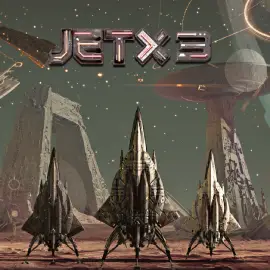
JetX3 is a crash game from SmartSoft Gaming in which three jets take off together, each with its own independent crash point. Players can bet on one, two or all three jets, collect from each separately and reach up to 2,000x per jet.