Author Spencer Thorne
September 1, 2026

The most useful thing to know about Chicken Road Race is a number that appears nowhere inside the game itself. Aggregator listings put its return to player at 95.5 percent, which is a full 2.5 percentage points worse than the 98 percent InOut Games advertises for the original Chicken Road. Same studio, same step mechanic, same chicken, roughly double the house edge. A player who tries the Race edition because they enjoyed the original is accepting materially worse mathematics without being told.
| Detail | Information |
|---|---|
| Developer / provider | InOut Games |
| Game type | Step based instant win minigame (marketed as crash) |
| RTP | 95.5% |
| House edge | 4.5% (derived from the aggregator figure) |
| Max multiplier | x3,608,855.25 (source: SlotCatalog) – not shown in the game client |
| Min stake | $0.01 (in game rules panel) |
| Max stake | $1,000,000 in the reviewed client; operator configured |
| Risk level settings | Yes, four: Easy, Medium, Hard, Hardcore |
| Provably fair | Claimed by third party listings; mechanism not documented in the client |
| Auto-cashout | No; progression is manual, cash out at any step |
| Demo available | Yes |
| Mobile compatible | Yes, browser based |
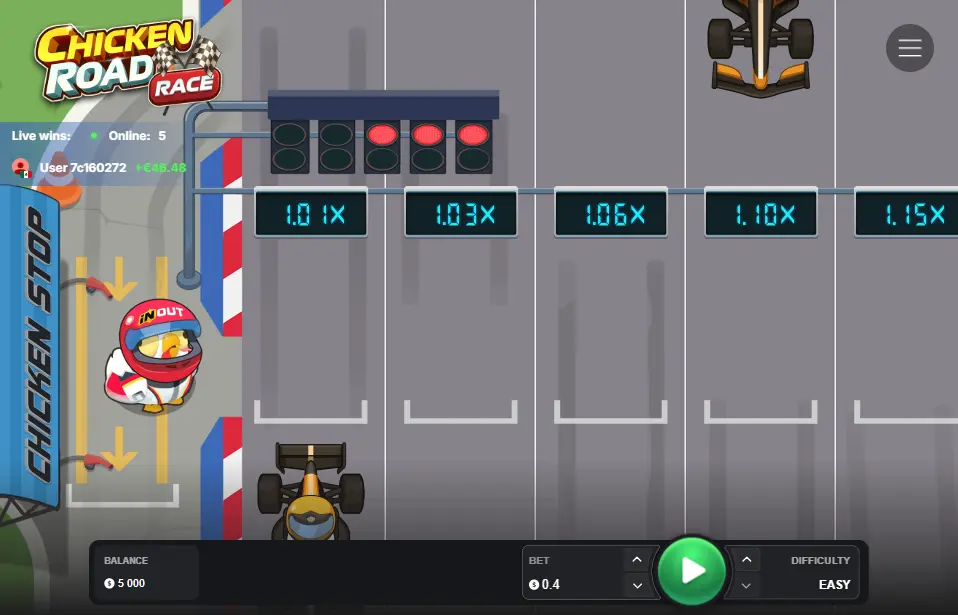
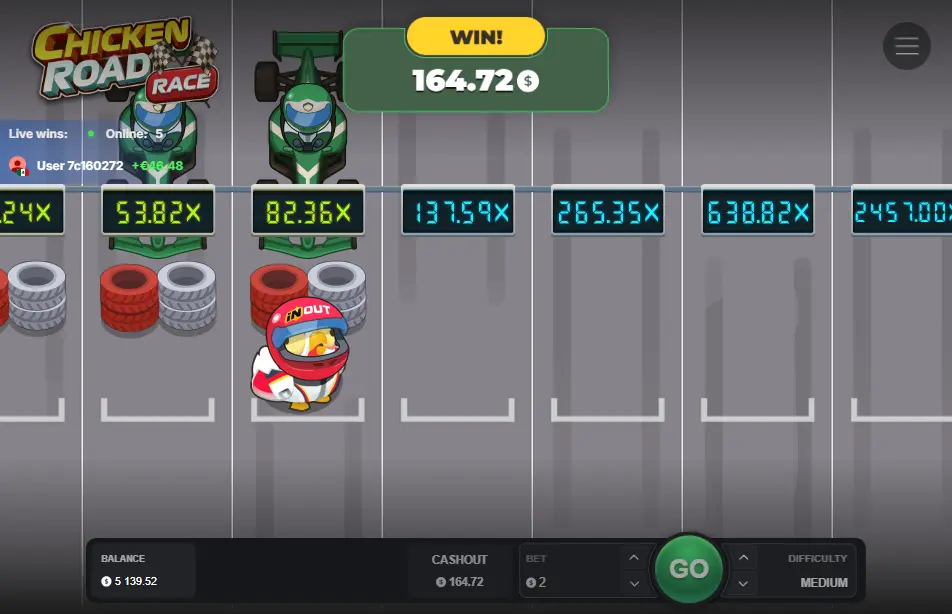
Chicken Road Race is a step based gambling minigame released by InOut Games in 2025, the racing themed entry in the studio’s long line of chicken titles that began with Chicken Road in 2024. The player stakes an amount, selects one of four difficulty levels, and moves a helmeted chicken forward across a series of road lines, each displaying a multiplier. Every line crossed safely locks in a higher multiplier. The round ends in one of two ways: the player presses cash out and collects the stake times the current multiplier, or the chicken is hit by a car on a line and the stake is lost.
It is routinely filed under crash games, and that classification is wrong in a way that matters. A crash game runs a multiplier upward on a timer against a hidden termination point, and the player races the clock. Chicken Road Race has no timer and no rising curve. Nothing happens until the player chooses to step. It is a ladder style instant win game, closer to Mines or Spire than to Aviator.
A round begins when the stake is set, a difficulty is chosen and the play button is pressed. From that point the game presents a horizontal track of road lines, each labelled with the multiplier the player holds after crossing it. On Easy the ladder opens at 1.01x, then 1.03x, 1.06x, 1.10x and 1.15x, climbing progressively along 30 lines. Each forward move is a discrete bet resolution: the game checks whether that specific line is a losing line, and either the chicken crosses and the displayed multiplier becomes the player’s current position, or a car strikes the chicken and the round ends with the stake gone. Between steps the player may stop at any time and press cash out, which pays stake times the last multiplier reached. There is no auto-cashout target as in timer based crash games, because there is no timer to beat; the closest equivalent is an optional keyboard shortcut that advances the chicken with the space bar, which speeds input but changes nothing about the odds.
The four difficulty levels change the geometry of the track. According to the in game help panel, Easy runs 30 lines, Medium 25, Hard 22 and Hardcore 18, and the chance of being hit rises with each level. Fewer lines with a higher per step failure probability means the multiplier ladder climbs much faster per step, but each step is also far more likely to end the round. The outcome of each step is determined by the game’s random number generator at resolution time; the player has no way to observe which lines are dangerous in advance. The developer does not publish the exact per line failure probabilities for each difficulty in the client.
The return figure requires careful handling. The game client reviewed here discloses bet limits in its rules panel but no RTP at all. The 95.5 percent figure comes from SlotCatalog’s aggregator listing, and several affiliate sites repeat it while noting the value can vary with operator configuration. Since InOut Games does not display the figure in the game itself, players cannot confirm it before staking. Taking the aggregator figure at face value, the house retains approximately $4.50 of every $100 wagered over a large number of rounds, roughly double the $2 retained by the original Chicken Road at its advertised 98 percent.
That edge converts into a concrete hourly cost. Expected loss per hour equals house edge times rounds per hour times average stake. A player making steady decisions will comfortably complete around 80 rounds per hour. At a $1 stake, 0.045 times 80 times $1 comes to an expected loss of $3.60 per hour. At a $5 stake the same arithmetic gives $18 per hour. These are long run averages, not session predictions: a single Hardcore run that survives deep into an 18 line track can put a session massively in profit, and a string of first step busts on Easy can lose twenty stakes in ten minutes. Volatility determines what a session feels like; the house edge determines what a thousand sessions add up to. The two are independent, and no cash out habit, stopping pattern or difficulty choice changes the expected value.
The advertised maximum deserves the same scrutiny. The theoretical top multiplier of x3,608,855.25 sits at the end of the Hardcore track, but what it pays depends entirely on the operator’s win cap. The client reviewed here lists a maximum win of $1,000,000,000, under which the full multiplier is payable at stakes up to roughly $277. Aggregator listings, however, report configurations capping wins at $20,000, and under such a configuration the full multiplier would exceed the cap even at the $0.01 minimum stake, where it would nominally pay about $36,088. In those lobbies the advertised ceiling is arithmetically unreachable at any permitted stake. Before playing anywhere, open the game rules panel and read the actual cap, because the marketing number and the payable number are frequently not the same number.
Third party listings describe Chicken Road Race as provably fair, and InOut Games uses SHA-256 based verification in other titles in the Chicken Road family, where a bet history entry exposes seed data that can be checked after the round. For this specific title, however, the client examined for this review documents no verification mechanism: the help panel covers difficulty levels and controls, the rules panel covers bet limits, and neither describes server seeds, client seeds, hash commitments or a verification workflow.
The distinction matters because provably fair is a specific technical claim, not a quality label. A genuine implementation commits to outcomes before the round by publishing a hash of the server seed, lets the player contribute a client seed, and reveals the server seed afterwards so the player can recompute the hash and confirm the result was fixed in advance. A weaker implementation publishes a hash only after the round, which proves little, and RNG certification alone is a lab audit, not something a player can check. Until InOut documents which of these Chicken Road Race actually implements, the accurate statement is that fairness verification for this title is not publicly documented, and a player is relying on the operator’s licensing and the studio’s general reputation rather than on anything they can personally verify.
The strongest feature is self paced risk. Because nothing moves until the player steps, there is no timer pressure, no race against a curve, and every decision can be taken with full information about the current position. Reviewers of the format consistently note this as the meaningful difference from Aviator style games. For players who dislike being rushed, the structure is genuinely better.
The difficulty system is a real volatility control rather than a cosmetic toggle. Moving from a 30 line track to an 18 line track with a higher per step failure rate changes the shape of the payout distribution substantially. Round pacing is also honest work: sessions load fast, rounds resolve in seconds, restarts are immediate, and the overhead track view keeps the position readable at all times. A full demo mode reproduces the mechanics with virtual credits, which is the correct way to learn how quickly each difficulty punishes greed.
The documentation gap is the central weakness. No RTP in the client, no published per line probabilities, no documented verification mechanism, and a headline multiplier whose payable value depends on an operator cap the marketing does not mention. The absence of disclosure forces players to rely on third party aggregators for the single most important number about the product.
The return itself is the second problem. At the reported 95.5 percent, the Race edition gives up 2.5 points against the original Chicken Road and sits below several competing step games. There is no gameplay justification visible for the worse figure; the racing theme is a reskin of the same loop. The game is also thin as a product: one bet per round, no multiplayer element, no live feed or chat, and no feature beyond the step ladder itself. Community discussion around the wider Chicken Road brand adds a further caution, because the brand’s popularity has spawned standalone apps and clone sites that are not InOut products at all, and forum complaints about rigging and blocked withdrawals frequently trace back to those imitations.
The player this suits is one who wants full control of pacing and volatility in very short sessions, understands that the difficulty picker is a variance dial rather than a skill setting, and stakes small against a fixed loss limit. For that player the game delivers exactly what it promises: clean, fast, self paced risk decisions with a known worst case per round.
The player who should consider an alternative is anyone choosing between this and the original Chicken Road, or any step game with a published return above 97 percent. The Race edition offers the same experience at roughly double the reported house edge, and a player who cares about cost per hour has no reason to pay it. Anyone who values in game RTP disclosure and documented verification should equally look at titles that publish both.
The player who should avoid it entirely is anyone drawn by the x3,608,855 headline. The near miss structure of a step game, where the next multiplier is always visible one line away, is precisely the mechanism that keeps a chasing player stepping, and Hardcore mode concentrates that pull into 18 high failure lines. Under a $20,000 style cap the headline number cannot be paid anyway, which makes chasing it doubly irrational.
Chicken Road Race is built for fast play: rounds resolve in seconds, restarts are instant, and losses can accumulate far more quickly than in slower casino formats. The self paced structure helps some players stay deliberate, but no stopping habit changes the underlying house edge, and a loss limit only works if it is set before the first round rather than after a losing streak. Decide the maximum the session may cost, treat that figure as spent entertainment money, and stop when it is gone. Support is available internationally from GambleAware at begambleaware.org and Gambling Therapy at gamblingtherapy.org, in the UK from GamCare at gamcare.org.uk, and in the US from the National Council on Problem Gambling at ncpgambling.org or 1-800-522-4700. 18+ only.
Chicken Road Race is a competently built step game wrapped in a documentation problem: the mechanics are clean and genuinely self paced, but the numbers that define its value are either missing from the client or worse than the studio’s own flagship. The strongest reason to play it is the pacing, since no other decision structure in this category gives the player this much time and this much volatility control per round. The most important reason for caution is that the reported 95.5 percent return is both undisclosed in game and clearly inferior to the original Chicken Road’s advertised 98 percent, meaning roughly double the expected cost for the same loop. It fits disciplined small stakes players who want short self paced sessions and already understand variance. On balance it is worth playing only with specific caveats: confirm the win cap in your client’s rules panel, prefer the original title where both are available, and treat the maximum multiplier as decoration. The fact most reviews omit is the simplest one: in some documented configurations the advertised x3,608,855.25 cannot be paid at any permitted stake, because even the minimum bet would breach the operator’s win cap.
Third party aggregator listings report 95.5 percent, but the game client itself does not display an RTP figure. Because affiliate pages note the value can vary with operator configuration, check the game information panel at your specific operator and treat the aggregator number as unconfirmed until you see it there.
Third party listings claim it is, and InOut Games implements SHA-256 seed verification in related titles, but the Chicken Road Race client examined for this review documents no verification mechanism. Until the studio publishes the implementation, players cannot independently verify round outcomes and are relying on licensing and RNG certification instead.
The theoretical top multiplier is x3,608,855.25, but the payable amount is set by each operator’s win cap, which ranged from $20,000 in aggregator listings to $1,000,000,000 in the client reviewed here. Under a $20,000 cap the full multiplier exceeds the limit even at the $0.01 minimum stake, so always read the cap in the game rules before playing.
The player stakes, picks one of four difficulty levels, and manually steps a chicken across road lines, with each safe line raising the multiplier and a cash out available before any step. Easy uses 30 lines, Medium 25, Hard 22 and Hardcore 18, with the chance of being hit rising at each level, and a hit ends the round with the stake lost.
Based on the aggregator reported 95.5 percent RTP, the house edge is 4.5 percent, meaning about $4.50 retained per $100 wagered long term. At a $1 stake and roughly 80 rounds per hour that works out to an expected loss of about $3.60 per hour, double the cost of the original Chicken Road at its advertised 98 percent.
There is no evidence the InOut Games title manipulates outcomes, and it is distributed through licensed operators on certified RNG systems, but the absence of documented player verification means fairness must be taken on institutional trust. Note that many online rigging complaints concern imitation Chicken Road apps and clone sites that are not InOut products, so playing only through licensed casino lobbies matters.
Yes, a demo mode with virtual credits is widely available and reproduces the difficulty levels, multiplier ladders and pacing of the real money version. It is the sensible way to learn how quickly each difficulty ends rounds before any money is staked.

Chicken Halloween is BGaming's October 2026 seasonal reskin of Chicken Shot, a casual instant-win game where every shot at a costumed chicken is a separate wager with a published win chance and a fixed multiplier from x1.1 to x64.

High Flyer is a multiplayer plane crash game from Pragmatic Play, released in September 2024, in which players cash out before the aircraft flies away. It publishes a 97% RTP, offers two independent bet spots with auto-cashout and advertises multipliers of up to 1,000,000x.

Space XY is a multiplayer crash game from BGaming in which a rocket climbs across an X-Y graph and players cash out before it explodes. It has a published 97% RTP, two bet panels per round and a €250,000 win cap.

JetX3 is a crash game from SmartSoft Gaming in which three jets take off together, each with its own independent crash point. Players can bet on one, two or all three jets, collect from each separately and reach up to 2,000x per jet.