Author Spencer Thorne
July 16, 2026

The number that defines Diver is not its return to player figure. It is the ceiling. Diver caps out at x100, which means the game has no lottery tail at all. In most crash games, a small slice of the theoretical return sits in outcomes almost nobody ever reaches, the four-figure and five-figure multipliers that make up the highlight reels. Diver deletes that slice. Every cent of its return is delivered through multipliers a player can realistically hit, and the game still keeps five cents of every dollar staked. That is an unusual combination, and it is the single most useful thing to understand before playing: this is a crash game with the upside removed and the house edge left intact.
| Detail | Information |
|---|---|
| Developer / provider | InOut Games |
| Game type | Crash (rising multiplier) |
| RTP | 95.00% (source: casino and aggregator listings including Stake, which publishes a 5.00% edge for this title, and bf1.io) |
| House edge | 5.00% |
| Max multiplier | x100 (reported consistently by aggregator listings; InOut’s public game page does not display a spec sheet) |
| Min stake | $0.01 (operator configurable; some operators set $0.10) |
| Max stake | $200 (operator configurable; some operators set $20) |
| Risk level settings | No |
| Provably fair | Not publicly documented for this title |
| Auto-cashout | Yes |
| Demo available | Yes |
| Mobile compatible | Yes |
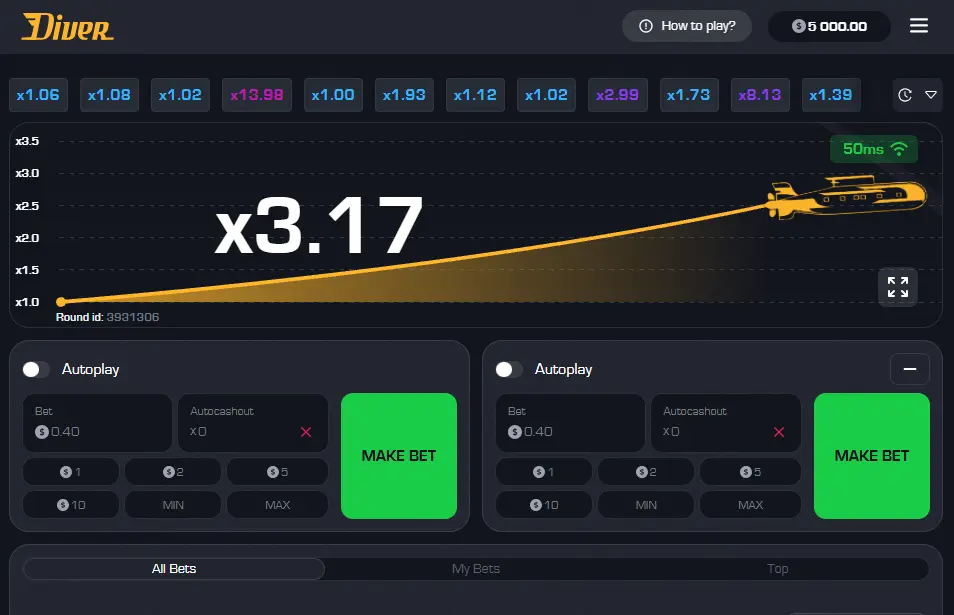
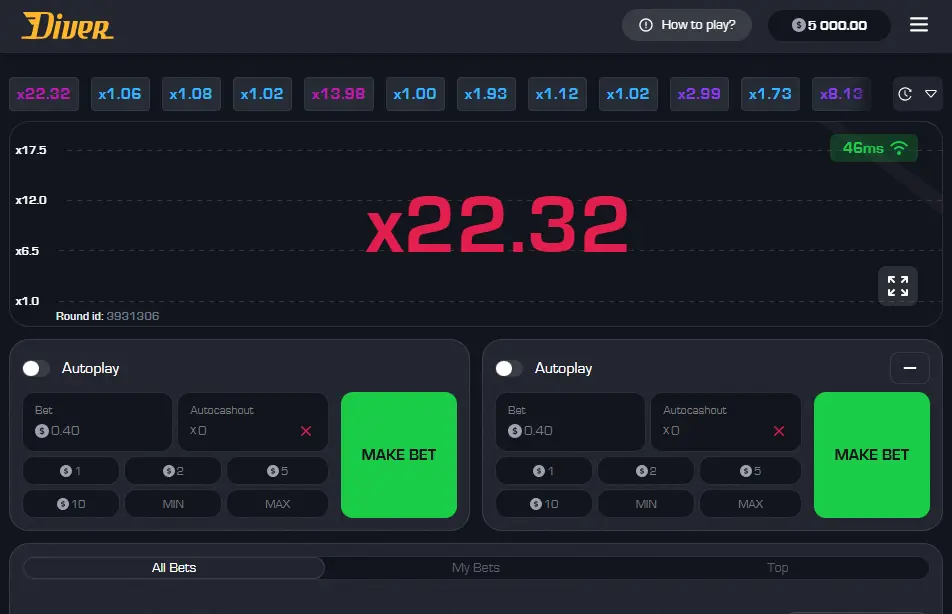
Diver is a crash game. A round begins, a yellow submarine starts moving, a multiplier climbs from x1.00 upward, and at a random point the round ends. If the player has cashed out before that moment, the stake is returned multiplied by the value on screen. If not, the stake is lost. There are no reels, no symbols, no free spins and no bonus rounds, despite what several automated aggregator pages claim. It is one decision per round, repeated.
The game was built by InOut Games and released in December 2022. It is one of the studio’s earliest titles, produced well before the formats that later made the studio widely known. The design lineage is openly Aviator: same core loop, different theme.
Each round runs on a fixed cycle. During a short betting window between rounds, the player sets a stake and optionally an auto-cashout target. Diver supports two simultaneous bets in the same round, each with its own stake and its own cashout setting. When the window closes, the round begins and the submarine starts moving, with the multiplier rising continuously from x1.00 alongside it.
The critical point is when the outcome is decided. It is not decided while the multiplier is rising. The bust point for the round is generated by the random number generator before the visual sequence plays, and the animation is a presentation of a result that already exists. Nothing the player does during the round influences where it ends, and the speed at which the multiplier appears to accelerate carries no information about how far it will go. Rounds resolve quickly, typically within a window of a few seconds to a few tens of seconds, with the longest rounds being the rarest.
The cashout button replaces the bet button once the round is live. Auto-cashout removes the reaction time problem: the player sets a target such as x1.50, and the game closes the position the moment the multiplier reaches it. The limitation is important and often glossed over. Auto-cashout does not protect the stake if the round busts below the target, and a round that ends at x1.42 with a target set at x1.50 is a total loss of that stake. Auto-cashout controls behaviour, not risk. It converts a reflex game into a probability game, which is a real benefit, but it does not change what the probabilities are.
Diver has no risk level settings, no partial cashout, no difficulty selector and no side features. What is described above is the entire game.
Diver is listed at 95.00% RTP across casino and aggregator listings, and Stake publishes a 5.00% house edge for the title, which is the same statement expressed from the other side. If the RTP is 95%, the house retains approximately $5 of every $100 wagered over a large number of rounds.
The cost of play follows directly. Expected loss per hour equals house edge multiplied by rounds per hour multiplied by average stake. Crash games typically run 50 to 100 rounds per hour depending on round length and how quickly the player re-enters, so the calculation below assumes 80 rounds per hour.
At a $1 average stake: 0.05 x 80 x $1 = $4.00 expected loss per hour. At a $5 average stake: 0.05 x 80 x $5 = $20.00 expected loss per hour. A player using both bet slots at $1 each stakes $2 per round, so double the first figure. These are averages of a distribution, not deductions from a balance.
That distinction matters because volatility, not the house edge, is what a player actually experiences. Assuming the edge is applied uniformly across cashout points, as standard crash mathematics does, the chance of reaching a given multiplier is approximately the RTP divided by that multiplier. Cashing out at x1.20 succeeds roughly 79% of the time. At x2.00 it succeeds roughly 47.5% of the time. At x5.00, roughly 19%. At x10.00, roughly 9.5%. At the x100 ceiling, roughly 0.95%, or about once in every 105 attempts. Every one of those strategies has the same expected value, because the payout scales exactly as the probability falls, minus the 5% the house keeps. A player who banks at x1.20 will win most rounds and still lose money over time. A player who chases x50 will lose most rounds and can be far ahead after an hour purely by variance.
There are no risk settings to configure, so the only lever is the cashout target, and moving it does not change the cost of playing.
Not in any documented way. InOut publishes provably fair descriptions for several of its later titles, referencing server seeds, client seeds, a nonce and pre-round hash commitments. No equivalent published implementation exists for Diver. Third party pages that describe the game as fair typically point at the presence of an RNG, which is a different claim entirely.
A provably fair system commits to the outcome before the bet by publishing a hash of the server seed, then reveals the seed afterwards so the player can hash it, confirm it matches the commitment, and recompute the round result from the seed pair and nonce. If the player cannot retrieve a pre-round hash and a revealed server seed for a completed round, there is nothing to verify. That is the situation with Diver as documented today.
In practice this means the player is relying on the provider’s RNG and the operator’s integrity, backed by whatever licensing and testing regime the operator sits under, exactly as with a conventional slot. That is not an accusation of manipulation, and there is no evidence of any. It is simply an accurate description of the trust model. If independent verifiability is a requirement, this game does not offer it, and the word fair appearing on a promotional page is not a substitute.
The interface is genuinely good at the one thing it needs to do. It is minimal, loads fast, holds up on older phones and weak connections, and puts the multiplier, the cashout button, the recent round history and the live bet list where they belong. Reviewers testing it on modern handsets and tablets report stable performance without animation stutter, which matters in a format where a delayed frame can cost a cashout.
The dual bet system is the strongest design decision in the game. Running one stake on an auto-cashout at a low multiplier while playing a second manually is a coherent way to structure a session, and it is a feature many simpler crash clones omit.
The learning curve is close to zero. A player who has never seen a crash game will understand Diver inside a minute, and a demo mode is widely available for practising cashout timing at no cost.
The value proposition is the problem. At 95%, Diver returns less than the genre benchmark it copied, and it does so while capping wins at x100. A player accepting a higher house edge is normally compensated with a longer tail, and here they are not compensated at all. There is no mathematical argument for choosing this game over better-returning titles running the identical mechanic, including several from InOut’s own later catalogue.
The feature set is thin even by crash standards. No risk levels, no partial cashout, no meaningful progression, nothing to explore once the loop is understood. What is left is a fast, well presented, empty game.
Documentation is the third weakness. InOut’s public page for Diver is marketing copy with no specification table, so the RTP and the x100 cap have to be pieced together from operator and aggregator listings. Those listings agree, but a player should not have to triangulate a game’s core numbers from third parties. Worse, several automated aggregator pages describe Diver as a slot with scatters, wilds, free spins and progressive jackpots. None of that exists. Anyone researching this game will read confident descriptions of features that were never in it.
The player who gets the most from Diver is someone new to crash games who wants to learn the format cheaply and deliberately. They will set an auto-cashout at a modest multiplier, treat the demo as a training ground, budget the roughly $4 per hour that $1 stakes cost, and stop when that budget is spent. For that player, the missing features are not a loss, because they would not have used them.
The player who should look elsewhere is the one who wants upside. The x100 cap is a hard structural ceiling: at $1 a round, $100 is the most that can ever be won, no matter how long the session runs. A player chasing a large multiplier is chasing something this game does not contain, and a better-returning crash title with a higher ceiling does the same thing for less money per bet.
The player who should avoid Diver entirely is the one who plays fast and chases losses. The round cycle is short, the stake reset is instant, and there is no structural friction anywhere in the loop. A player prone to escalating after a bad run can move through a great deal of money here in a short time, and the game contains nothing that will slow them down.
Crash games are built for speed. A round can resolve in seconds, the next bet is one tap away, and at 80 rounds an hour a session accumulates far more wagering than the same wall-clock time spent on a slower casino format, which means losses accumulate faster too. Auto-cashout at a fixed multiplier imposes useful discipline on decision making, but it does not change the house edge and it does not make the game profitable at any target. Set a loss limit before the first round, not after a losing streak, and treat the expected hourly cost as the price of the entertainment rather than as an investment. Help is available from GambleAware at begambleaware.org, GamCare at gamcare.org.uk, the National Council on Problem Gambling at ncpgambling.org or 1-800-522-4700, and Gambling Therapy at gamblingtherapy.org. 18+ only.
Diver is a competently built game with a weak deal attached to it. The strongest reason to play it is clarity: the interface is clean, the loop is instantly legible, the dual bet system is well implemented, and as a first encounter with the crash format at small stakes it does the job without confusing anyone. The most important reason for caution is that the numbers are simply worse than the alternatives, a 5% edge paired with an x100 cap that removes the only compensation a higher edge normally buys. This is a game for the curious beginner playing small and short, and for almost nobody else. Worth playing with specific caveats: keep stakes low, use auto-cashout, and understand that you are paying a premium for the theme rather than the mathematics. The fact most reviews of Diver omit: the maximum win figure that operators list, 20,000 in casino currency, is not a jackpot at all, it is simply the x100 cap applied to the $200 maximum stake, which means every player betting below the cap has a proportionally smaller ceiling and no player has ever had access to a large win here.
Diver is listed at 95.00% RTP. This figure appears consistently across casino and aggregator listings, including Stake, which publishes a 5.00% house edge for the title. InOut’s own public game page does not display a specification table, so the figure is sourced from operator and aggregator listings rather than a first party spec sheet.
Not in any publicly documented way. InOut publishes provably fair descriptions for several later titles, but no equivalent implementation is documented for Diver, and there is no published process for retrieving a pre-round server seed hash and verifying a completed round. Players are relying on the provider’s RNG and the operator’s licensing regime.
The multiplier is capped at x100, and operator listings report a maximum win of 20,000 in casino currency, which is the cap applied to the maximum stake of 200. At a $1 stake, the most that can be won in a round is $100.
The player places a stake before a round begins, a submarine starts moving, and a multiplier rises from x1.00. The player cashes out manually or via a preset auto-cashout target before the round ends at a randomly determined point. Cashing out in time pays the stake multiplied by the current value. Failing to cash out loses the stake.
5.00%, the inverse of the 95% RTP. Over a large number of rounds the house retains approximately $5 of every $100 wagered. At 80 rounds per hour and a $1 stake, that is an expected loss of about $4.00 per hour.
There is no evidence that Diver is rigged, and none of the sources reviewed here allege manipulation. The honest answer is that a player cannot independently verify individual rounds, because no provably fair implementation is documented for this title, so fairness rests on the provider’s RNG and the operator’s licence rather than on cryptographic proof.
No. There are no difficulty settings, no partial cashout, no free spins and no bonus rounds. Aggregator pages describing scatters, wilds or progressive jackpots in Diver are incorrect and appear to be automatically generated.
No. Every cashout target carries the same expected value, because the probability of reaching a multiplier falls in proportion to the payout it offers. Auto-cashout enforces discipline and removes reaction time from the equation, but it does not alter the 5% edge.

Chicken Halloween is BGaming's October 2026 seasonal reskin of Chicken Shot, a casual instant-win game where every shot at a costumed chicken is a separate wager with a published win chance and a fixed multiplier from x1.1 to x64.

High Flyer is a multiplayer plane crash game from Pragmatic Play, released in September 2024, in which players cash out before the aircraft flies away. It publishes a 97% RTP, offers two independent bet spots with auto-cashout and advertises multipliers of up to 1,000,000x.

Space XY is a multiplayer crash game from BGaming in which a rocket climbs across an X-Y graph and players cash out before it explodes. It has a published 97% RTP, two bet panels per round and a €250,000 win cap.

JetX3 is a crash game from SmartSoft Gaming in which three jets take off together, each with its own independent crash point. Players can bet on one, two or all three jets, collect from each separately and reach up to 2,000x per jet.