Author Spencer Thorne
June 11, 2026

Drop The Billionaire launched on 9 June 2026, which means that at the time this review was written the game was only days old, and that single fact tells you more about it than any payout figure could. InOut Games has published exactly two firm numbers for this title: a 96% return-to-player figure and a release date. Everything else a cautious player might want before staking money (the maximum multiplier, the precise round mechanic, whether outcomes can be independently verified) is undocumented. This guide states what the developer has actually documented, marks clearly what it has not, and explains why those gaps matter.
| Detail | Information |
|---|---|
| Developer / provider | InOut Games |
| Game type | Instant multiplier title (marketed under InOut’s crash/instant range) |
| RTP | 96% (source: InOut Games official game page) |
| House edge | 4% (derived from the published RTP) |
| Max multiplier | Not publicly documented |
| Min stake | Not publicly disclosed |
| Max stake | Not publicly disclosed |
| Risk level settings | Not documented (a Bonus Buy is the only stated player-side option) |
| Provably fair | Not documented for this title |
| Auto-cashout | Not documented |
| Demo available | Yes |
| Mobile compatible | Yes (HTML5, per developer) |
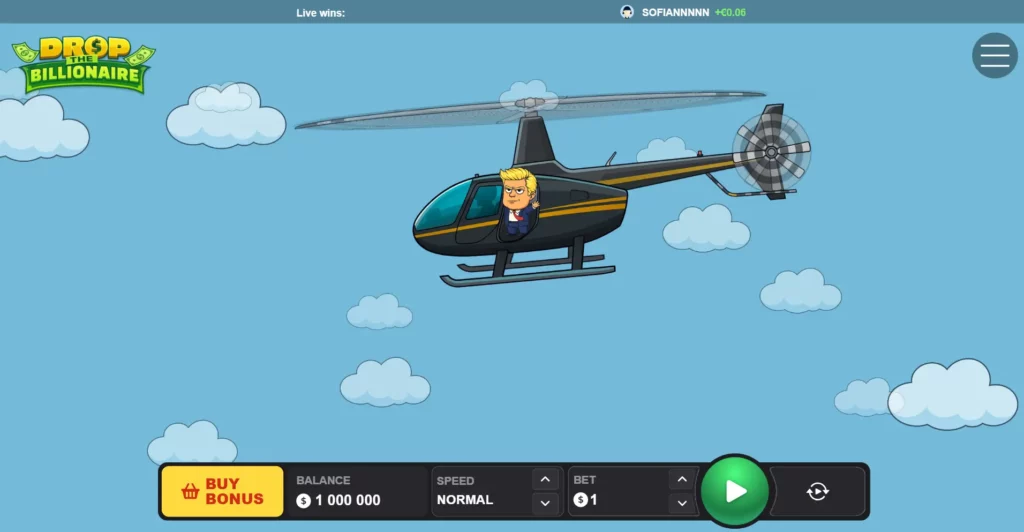
Drop The Billionaire is an instant multiplier game from InOut Games, a Curaçao-licensed business-to-business studio that launched in 2024 and built its name on fast, short-session titles such as Chicken Road and MegaBlock. This release leans into a comedic, deliberately over-the-top theme drawn from modern pop culture and American media aesthetics, carrying the tagline “Make Instant Great Again.” The on-screen premise is a billionaire character tumbling through clouds, multipliers and assorted chaotic events, with a fast, busy visual style and no complex feature set. It is a single-player title, and the developer highlights a Bonus Buy option as the main way to reach the more intense portions of the game more quickly. Mechanically, the documented picture is thin, and honesty requires saying so. The developer describes multipliers that build as the round progresses and a sense of the character moving closer to bigger wins, which places the game broadly in InOut’s crash-and-instant family. What is not stated anywhere on the official page is the part that actually defines how you win or lose: whether you time a manual or automatic cashout against a rising multiplier, or whether each round simply resolves to a predetermined multiplier. Those are two very different games to play, and at launch InOut has not told players which one this is.
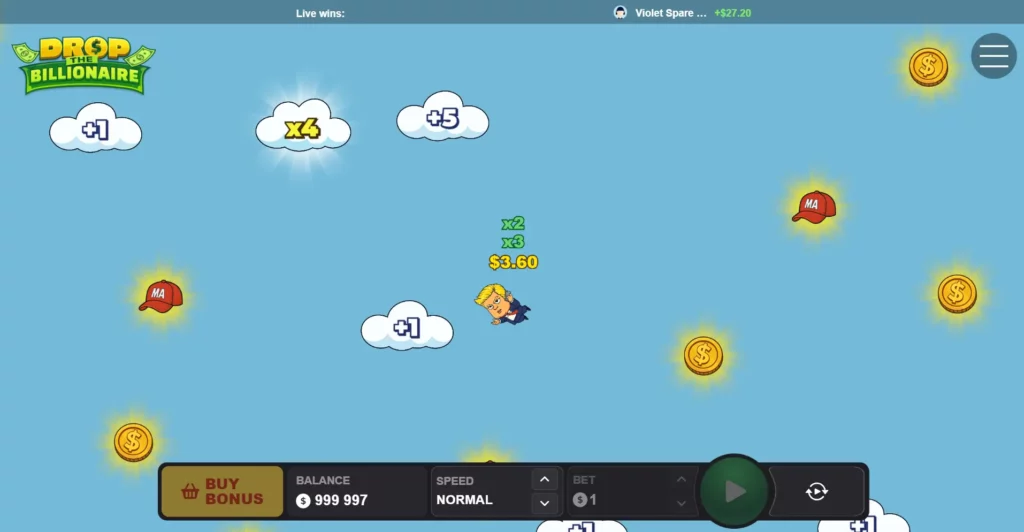
The general loop of an InOut instant title is straightforward. You set a stake, start a round, and a multiplier value resolves, either climbing live until an end event or landing on a result the round was always going to produce. With Drop The Billionaire, the developer frames this around the falling billionaire and a stream of multipliers and “unexpected events,” but stops short of explaining what determines the outcome of any round, or how that outcome is communicated to you before you commit. That detail is not minor: in a player-timed crash game your skill is the cashout decision, whereas a fixed-outcome instant title has no cashout decision at all.
The one player-facing feature InOut does confirm is Bonus Buy, which pays an elevated stake to jump straight into the most active phase of play rather than reaching it through ordinary rounds. It is a way to buy variance, not value: you pay more per click to access higher-swing outcomes faster. It is not a risk-level selector in the sense some crash games offer, where a low, medium or high setting reshapes the bust probability and multiplier distribution. No such selector is documented for this title, so the practical levers available to a player appear to be stake size and whether or not to use Bonus Buy.
Start with the only published return figure. InOut’s official page lists Drop The Billionaire at a 96% RTP. If the RTP is 96%, the house retains approximately $4 of every $100 wagered over a large number of rounds. That 4% house edge governs the long run, and it does not change with streaks or cashout timing.
Translating that into the cost of a session takes one formula: expected loss per hour equals the house edge percentage multiplied by rounds per hour multiplied by the average stake per round. Instant and crash titles run fast, typically fifty to a hundred rounds an hour, so assume sixty rounds per hour as a middle estimate. At a $1 average stake, the expected hourly cost is 0.04 multiplied by 60 multiplied by $1, which is $2.40 an hour. At a $5 average stake, the same calculation gives 0.04 multiplied by 60 multiplied by $5, which is $12 an hour. At a hundred rounds an hour those figures rise to $4 and $20. None of these are a prediction of any single session; they are what the game costs on average if you keep playing.
This is where volatility and the house edge part company. The 4% edge is a long-run average measured over enormous numbers of rounds. Across a single evening you can finish well ahead, because variance (the natural swing of short-run results) is far larger than the slow, steady drag of the house edge. What this is not is evidence that the game is beatable: the edge works underneath the variance, and the longer you play, the more your results converge toward that 4% loss. Bonus Buy amplifies the swing in both directions without touching the underlying edge.
This is the section most reviews of new crash and instant titles either skip or handle dishonestly, so it deserves a direct answer. For Drop The Billionaire specifically, there is no published provably fair verification mechanism. The official game page documents a theme, a release date and an RTP, and nothing about a server seed, a client seed, a hash function, or any step-by-step process a player could use to confirm a result was generated fairly.
It is worth separating two things InOut tends to market together, because they are not the same. Across its catalogue, the studio describes certified RNG technology with server-seeded, hashed outcomes, and elsewhere uses the phrase “provably fair.” Those are categorically different claims. Certified RNG means an independent test house has examined the generator and the operator commits to using it, so you are trusting that certification. Cryptographically provably fair means you are handed the cryptographic inputs and can mathematically verify your own result after the fact, trusting no one. For Drop The Billionaire, neither a certificate nor a verification tool is documented at the title level, which means in practice you rely entirely on the developer and the operating casino to deliver fair outcomes. A player who cannot describe how to verify a result is not being protected by the word “fair” appearing in marketing.
The headline strength is the published RTP. At 96%, Drop The Billionaire sits in the competitive middle of the instant-game range and ahead of many traditional video slots, which often land around 95% to 96.5%. The fact that InOut publishes a per-title figure at all, rather than hiding behind a vague catalogue average, is a small point in its favour. The theme is the other genuine differentiator: the comedic billionaire-falling concept and the loud, fast visual treatment give the game a clear identity in a category where many titles feel interchangeable.
Finally, a demo is available. Because so much about the live-money mechanic is undocumented, the demo is the only way to actually learn how a round resolves, how fast the pacing really is, and what Bonus Buy does before any real money is at stake.
The weaknesses are mostly about what is missing rather than what is broken. No maximum multiplier is documented, so a player cannot see the ceiling on a win before staking. The core round mechanic is undocumented, so you cannot tell from the official materials whether your decisions affect the outcome at all. And there is no published provably fair process, so independent verification is off the table. For a game built around multipliers and chance, those three gaps together are significant.
The newness compounds all of it. Released on 9 June 2026, the game has no community track record: no forum threads, aggregator data, or player experience to weigh against the marketing. That absence is not a flaw in the game so much as a reason for caution, and it is why this review refuses to quote player sentiment that does not yet exist. The Bonus Buy emphasis is the last concern: positioning a paid shortcut to the most intense gameplay as a headline feature nudges players toward higher variance and faster spending without improving their expected return.
The player who will get the most from Drop The Billionaire wants a short, fast, visually loud novelty and treats the cost as entertainment spending rather than an investment. They play small, set a fixed loss limit before they start, and do not need to verify outcomes themselves to enjoy a few rounds. For that person, the comedic theme and the competitive 96% RTP make for a reasonable light session.
The player who should consider an alternative is the one who plays crash games specifically for the cashout decision: timing an exit against a rising multiplier, ideally with an auto-cashout setting and a published maximum win to plan around. None of that is confirmed here, so a player who wants that control would be better served by an established crash title that clearly documents its round mechanic, its multiplier ceiling, and a player-verifiable fairness process.
The player who should avoid this game entirely is the one drawn to Bonus Buy as a fast route to “intense” play, particularly anyone who has chased losses before. A fast instant format, a paid variance booster, and no independent way to verify results is the wrong environment for someone prone to rapid, escalating spending; the speed that makes the game fun for a casual user is what makes losses accumulate quickly for someone who cannot stop at a limit.
Crash and instant games are designed for fast play. Rounds are short, decisions come quickly, and losses can accumulate far faster than in slower casino formats, where a sixty-round hour can pass in what feels like minutes. An auto-cashout at a set multiplier, where a game offers it, can impose some discipline by removing reaction-time disadvantage, but it does not change the underlying house edge, and no feature in this or any game converts a 4% edge into a profit. Set a loss limit before you start, not after a losing streak, and treat any stake as money you are prepared to lose. If gambling stops feeling like entertainment, support is available: GambleAware (international) at begambleaware.org, GamCare (UK) at gamcare.org.uk, the National Council on Problem Gambling (US) at ncpgambling.org or 1-800-522-4700, and Gambling Therapy (international) at gamblingtherapy.org. 18+ only.
Drop The Billionaire is a competent, deliberately silly novelty instant title with a fair published 96% RTP and a distinct comedic identity, and that is roughly the whole story at launch. The single strongest reason to play it is that RTP, which is genuinely competitive for the format and is published per-title rather than buried. The single most important reason for caution is that you cannot independently verify any outcome, and the core mechanic, the maximum win, and the fairness process are all undocumented, so you are trusting the developer and operator entirely. It is right for a small-stakes player who wants a quick, light session and accepts it as entertainment, and the wrong choice for anyone who values verifiable fairness or wants a strategic crash game with documented rules. The honest recommendation is to try the demo first, and to commit real money only at small stakes and only if the missing documentation does not bother you. The fact most reviews will leave out is the simplest one: this game is days old, the developer has published a release date and an RTP and almost nothing else, and any review presenting player feedback, a confirmed multiplier ceiling, or a verified provably fair system for it right now is inventing what it cannot yet know.
The RTP is 96%, as stated on InOut Games’ official game page. That figure is the developer’s published return-to-player rate and implies a 4% house edge over the long run, though as with any business-to-business title, individual casinos can in some jurisdictions deploy configurable versions, so it is worth confirming the rate shown in the game’s own info screen.
No player-verifiable provably fair mechanism is documented for this title. InOut describes certified RNG and uses “provably fair” language across its wider catalogue, but the game page publishes no server seed, client seed, or hash process you could use to check a result, so verification rests on certification and operator honesty rather than your own confirmation.
The maximum win and maximum multiplier are not publicly documented by the developer at launch. Any specific cap quoted elsewhere is unverified, and a player cannot currently see the ceiling before staking.
It is a single-player instant multiplier title themed around a billionaire falling through clouds and multipliers, with a Bonus Buy option to reach more intense play faster. The precise round mechanic (whether you time a cashout against a rising multiplier or each round resolves to a set result) is not documented, which the demo is the best way to clarify.
The house edge is approximately 4%, derived from the published 96% RTP. Over many rounds the game is built to retain about $4 of every $100 wagered, regardless of streaks or Bonus Buy use.
There is no evidence that it is, but there is also no published tool for you to prove that it is not. It runs on InOut’s RNG under a Curaçao licence, so fairness depends on that certification and the operator rather than on independent player verification, which is the meaningful distinction to keep in mind.

Chicken Halloween is BGaming's October 2026 seasonal reskin of Chicken Shot, a casual instant-win game where every shot at a costumed chicken is a separate wager with a published win chance and a fixed multiplier from x1.1 to x64.

High Flyer is a multiplayer plane crash game from Pragmatic Play, released in September 2024, in which players cash out before the aircraft flies away. It publishes a 97% RTP, offers two independent bet spots with auto-cashout and advertises multipliers of up to 1,000,000x.

Space XY is a multiplayer crash game from BGaming in which a rocket climbs across an X-Y graph and players cash out before it explodes. It has a published 97% RTP, two bet panels per round and a €250,000 win cap.
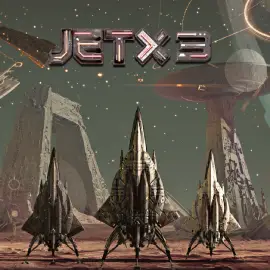
JetX3 is a crash game from SmartSoft Gaming in which three jets take off together, each with its own independent crash point. Players can bet on one, two or all three jets, collect from each separately and reach up to 2,000x per jet.