Author Spencer Thorne
June 19, 2026

The most useful thing to know about Ice Fish is that almost everything currently written about a game with this name is about a different game. Search the title and you will mostly find Evolution Gaming’s “Ice Fishing,” a live wheel show with a published 97.10% return figure: a different product, from a different studio, in a different genre. The game this review covers is InOut Games’ instant title “Ice Fish,” released on 11 June 2026. It is eight days old, and beyond a paragraph of developer copy and one published RTP figure, almost nothing about it has been independently documented. That absence is the central fact before deciding whether to put money on it.
| Detail | Information |
|---|---|
| Developer / provider | InOut Games |
| Game type | Instant / step-progression crash-style |
| RTP | 95.5% (source: InOut Games official game page, inout.games) |
| House edge | 4.5% (derived: 100% minus RTP) |
| Max multiplier | Not publicly documented |
| Min stake | Not publicly disclosed |
| Max stake | Not publicly disclosed |
| Risk level settings | Implied by developer copy (“choose your target”), not formally documented |
| Provably fair | Not documented for this specific title |
| Auto-cashout | Not documented for this specific title |
| Demo available | Yes |
| Mobile compatible | Yes |
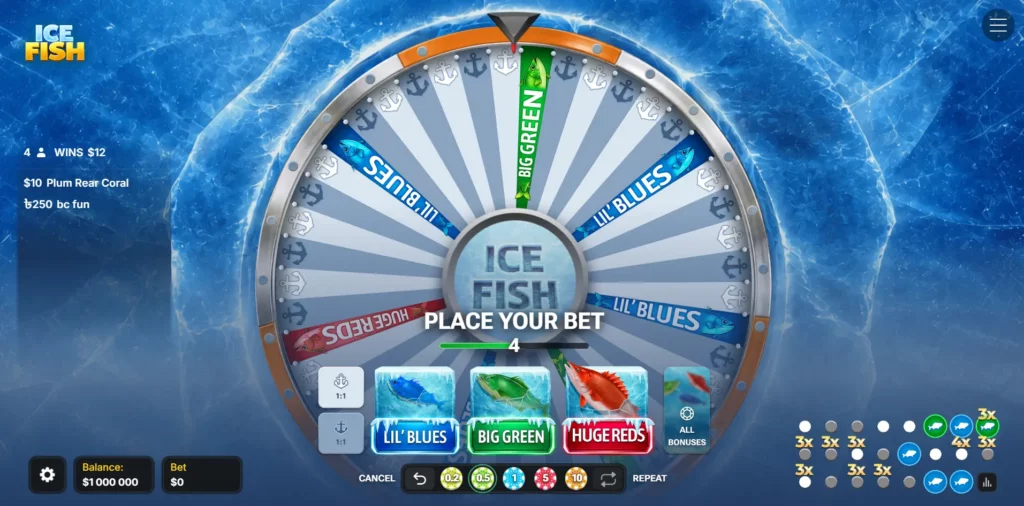
Ice Fish is an instant casino game from InOut Games, a Curaçao-licensed studio behind fast, short-session crash and step-multiplier titles such as the Chicken Road series, Fish Road and Fish Boom. The developer describes it as turning the familiar idea of ice fishing into a fast instant format, where a player picks a target and follows a catch that progresses through several stages before a final result is revealed. That places it among the studio’s other step-progression games, not the live game show category the name suggests.
What the description does not do is explain the mechanics precisely, and no independent source has filled the gap, because the game launched on 11 June 2026. There is no published paytable, no stated maximum multiplier, no confirmed stake range and no documented bust rule. What can be confirmed from first-party material is the studio, the release date, the 95.5% RTP, a free demo and mobile compatibility. Everything else is undocumented.
From InOut’s own description, a round of Ice Fish begins when a player sets a stake and selects a target, then watches a catch sequence advance through several stages, with a result revealed at the end. The phrase “choose your target” suggests some form of risk or difficulty selection before the round starts, consistent with the studio’s other titles, which use selectable difficulty modes. Whether Ice Fish works the same way is not stated on the game page, and no independent review has tested it, so anyone citing an exact step count, bust probability or multiplier ceiling for this title today is guessing.

In a step-progression instant game, the random number generator does not decide the outcome gradually as the multiplier rises on screen; it fixes the result before or at the moment the round resolves, and the climbing animation simply presents an outcome that is already set. The multiplier increases as the catch advances, and the round ends either when the player secures the current value or when the sequence terminates without a payout. If Ice Fish includes auto-cashout, as several InOut titles do, it would let a player set a target multiplier so a win is banked automatically. That imposes discipline on one decision but does nothing to the mathematics; it cannot turn a negative expectation into a positive one. Auto-cashout is not confirmed for this title.
Here the picture is clearer, because there is a published number. InOut lists Ice Fish at a 95.5% RTP on its official game page, which makes the house edge 4.5%. In concrete terms, if the RTP holds, the house retains approximately $4.50 of every $100 wagered over a large number of rounds. That is the long-run cost, and no in-game decision changes it.
Translating the edge into time costs makes it concrete. Expected loss per hour equals house edge multiplied by rounds per hour multiplied by average stake. Instant games run fast, typically 50 to 100 rounds per hour. Taking 60 rounds per hour and a $1 average stake, the expected loss is 0.045 times 60 times $1, or $2.70 per hour. At a $5 average stake under the same pace it is 0.045 times 60 times $5, or $13.50 per hour. Push to 100 rounds per hour at $5 and it rises to $22.50. These are averages over many sessions, not predictions of any one, and they assume the published RTP is accurate and not operator-adjusted.
Over a single hour, variance dominates and the edge is barely visible; a player can finish well ahead, and many will, because short runs are noisy. The 4.5% edge only asserts itself over thousands of rounds, so being up after an hour is not evidence the game is beatable, only that an hour is a small sample. If Ice Fish offers selectable risk, the trade-off would follow the genre’s standard pattern: a higher-risk setting lowers the chance of a successful catch while raising the multiplier ceiling, making outcomes more extreme without improving the long-run return. Higher risk redistributes the same expected value into rarer, larger wins; it does not buy a better edge.
For a brand-new release this is the section that matters most, and the honest answer is that Ice Fish does not currently come with documented, player-verifiable fairness. InOut markets its catalogue as provably fair at the studio level, and its Fish Road title has been described as using SHA256 hashing to let players confirm outcomes. But the Ice Fish page makes no such claim, and there is no published verification guide for this title.
Provably fair is often used as a trust badge with no explanation. A genuine system works like this: before a round, the operator commits to a server seed by publishing its cryptographic hash, so it cannot be changed afterward, and the player contributes a client seed. After the round, the operator reveals the original seed, the player hashes it to confirm it matches the commitment, then combines both seeds to reproduce the outcome and check it was not altered. If a player cannot perform those steps, the words “provably fair” do no work. For Ice Fish, no such process is documented today, so a player is relying on the operator’s honesty and the studio’s general certification rather than on anything they can check themselves.

The clearest point in its favour is the published RTP. At 95.5%, Ice Fish sits in the middle of InOut’s own range and is broadly typical for the crash and step-multiplier category, where titles commonly land between 94% and 97%. It is not a standout figure, but it is disclosed and traceable to a first-party source, which is more than several competing games offer.
The format also has practical strengths. A free demo lets a player learn the rhythm and interface before risking money, and the game is mobile compatible, built in HTML5 so it runs in a browser without a download. The “choose your target” framing, if it maps to selectable difficulty as it does in the studio’s other games, would let players match the volatility to their own tolerance. Short rounds suit players who want a game they can pick up and put down, and InOut has a consistent record of shipping this style cleanly.
The dominant weakness is information, and it is a serious one. Eight days after launch there is no published maximum multiplier, no stated stake range, no paytable, no confirmed bust mechanic and no documented provably fair process. A player cannot fully assess the win ceiling, the stake floor, or the fairness of a result, because the developer has not published those details and no independent party has tested the game. For a category built on a single core number and a fairness claim, those are not minor gaps.
There is also a thinness to the concept. The studio’s own copy leans on the idea being “familiar and proven,” which is candid but tells you this is a reskin of a well-worn step-progression formula with an arctic theme rather than a mechanical departure, so it is unlikely to offer anything a Fish Road or Chicken Road player has not seen. Finally, the naming is a real problem: sharing a name with Evolution’s far better-documented “Ice Fishing” means most search results describe a different game with different numbers. A player who reads a 97.10% RTP and a 5,000x maximum and assumes they apply here would be wrong on both counts.
The player who gets the most from Ice Fish already enjoys InOut’s step-progression games, treats the session as paid entertainment with a fixed budget, and is comfortable playing a new title on a published 95.5% RTP without waiting for confirmation of the finer details. This player tries the demo first, sets a strict loss limit, keeps stakes small, and is there for the rhythm of short rounds rather than a promised jackpot.
The player who should consider an alternative wants to know exactly what they are buying first. If a documented maximum multiplier, stake range, paytable and verifiable fairness process matter to you, this game does not yet provide them, and an older, better-documented title in the same genre offers more to assess. Waiting for independent testing would also be reasonable, since none exists yet.
The player who should avoid Ice Fish entirely is anyone who chases losses or struggles to stop once a session starts. A fast instant game with short rounds and a 4.5% edge is structurally efficient at draining a bankroll, and the speed that makes it engaging is what makes it dangerous for someone who finds it hard to walk away. The undocumented ceiling also leaves a player prone to “one more big catch” thinking with no figure to anchor expectations.
Crash and instant games like Ice Fish are designed for fast play, and that speed is the main risk to a player’s money. Rounds resolve in seconds, so losses can accumulate far more quickly than in slower formats like table games or standard slots, and the 4.5% house edge applies to every round regardless of how a session is going. Auto-cashout or a target multiplier, where available, can impose discipline on individual decisions, but does not change the mathematics, which stay unfavourable over time. The single most effective habit is to set a loss limit before you start and treat it as fixed, rather than deciding how much you are willing to lose in the middle of a losing streak when judgement is at its worst. Decide your budget in advance, keep stakes small, and stop at your limit whether you are up or down. If gambling is causing harm, support is available: GambleAware (international) at begambleaware.org, GamCare (UK) at gamcare.org.uk, the National Council on Problem Gambling (US) at ncpgambling.org or 1-800-522-4700, and Gambling Therapy (international) at gamblingtherapy.org. 18+ only.
Ice Fish is a competent but unremarkable arctic reskin of a step-progression formula InOut has shipped many times, and right now it is impossible to fully evaluate because the developer has published almost nothing beyond a 95.5% RTP. The strongest reason to play is that the RTP is disclosed and reasonable for the genre, with a free demo to test the feel first; the most important reason for caution is that the maximum multiplier, stake range, paytable and any verifiable fairness process are all undocumented eight days after launch, leaving a player relying on trust rather than verification. It suits an existing InOut fan who wants a quick, low-stakes session and is content with a published RTP and little else; for everyone else it is worth playing only with the caveat that this is an unproven, thinly documented title, and most would lose nothing by waiting for independent testing. The one fact almost no other coverage gives straight: the InOut Ice Fish is not the Evolution Ice Fishing live show, and the 97.10% RTP and 5,000x maximum attached to that name elsewhere do not apply to this game.
The RTP of Ice Fish is 95.5%, according to InOut Games’ official game page, which gives a house edge of 4.5%. The figure cannot currently be independently verified, and whether operators can adjust it is not documented.
There is no documented provably fair verification process for Ice Fish at present. InOut markets its catalogue as provably fair at the studio level, and its Fish Road title has been described as using SHA256 hashing, but the Ice Fish page makes no such claim and publishes no verification guide, so a player cannot currently check a result independently.
The maximum multiplier and maximum win for Ice Fish are not publicly documented. The developer has not published a paytable or a stated ceiling, and any specific maximum you see attached to the name almost certainly belongs to Evolution Gaming’s separate “Ice Fishing” game rather than this one.
Ice Fish is an instant step-progression game where a player sets a stake, chooses a target, and follows a catch that advances through several stages before a result is revealed. The precise rules, including how a round ends and whether risk levels are selectable, are not documented for this title, though the format matches InOut’s other step-multiplier games.
The house edge on Ice Fish is approximately 4.5%, derived from the published 95.5% RTP. Over a large number of rounds, the house retains about $4.50 of every $100 wagered, regardless of any in-game decisions a player makes.
There is no evidence that Ice Fish is rigged, but there is also no published way for a player to verify any individual result, since no provably fair documentation exists for the title yet. InOut operates under a Curaçao licence and markets certified RNG technology across its catalogue, which means a player is relying on that licensing and certification rather than on independent verification.
There is no evidence that Ice Fish is rigged, but there is also no published way for a player to verify any individual result, since no provably fair documentation exists for the title yet. InOut operates under a Curaçao licence and markets certified RNG technology across its catalogue, which means a player is relying on that licensing and certification rather than on independent verification.

Chicken Halloween is BGaming's October 2026 seasonal reskin of Chicken Shot, a casual instant-win game where every shot at a costumed chicken is a separate wager with a published win chance and a fixed multiplier from x1.1 to x64.

High Flyer is a multiplayer plane crash game from Pragmatic Play, released in September 2024, in which players cash out before the aircraft flies away. It publishes a 97% RTP, offers two independent bet spots with auto-cashout and advertises multipliers of up to 1,000,000x.

Space XY is a multiplayer crash game from BGaming in which a rocket climbs across an X-Y graph and players cash out before it explodes. It has a published 97% RTP, two bet panels per round and a €250,000 win cap.

JetX3 is a crash game from SmartSoft Gaming in which three jets take off together, each with its own independent crash point. Players can bet on one, two or all three jets, collect from each separately and reach up to 2,000x per jet.