Author Spencer Thorne
July 28, 2026

The number BGaming puts on the poster is 12,000x. The number in its own specification table is a maximum win of 240,000 currency units. Those two figures agree at exactly one stake: 20 units per round. Play at the 100 unit ceiling reported by early coverage and the highest multiplier you can actually be paid is 2,400x, because the cash cap bites first. The advertised ceiling does not scale with your bet. The larger your stake, the smaller the multiplier you are really playing for.
| Detail | Information |
|---|---|
| Developer / provider | BGaming (Stable Games Ltd, MGA/B2B/785/2020) |
| Game type | Crash, filed by the developer under its Casual category |
| RTP | 96.00% (source: BGaming official game page, retrieved July 2026) |
| House edge | 4.00% (derived from the published RTP) |
| Max multiplier | 12,000x, subject to a 240,000 unit maximum win |
| Min stake | Reported at 1 unit by third party coverage, not published by BGaming |
| Max stake | Reported at 100 units by third party coverage, not published by BGaming |
| Risk level settings | Yes, three dynamic risk options per pipe |
| Provably fair | Not documented for this title |
| Auto-cashout | Not documented |
| Demo available | Yes |
| Mobile compatible | Yes |

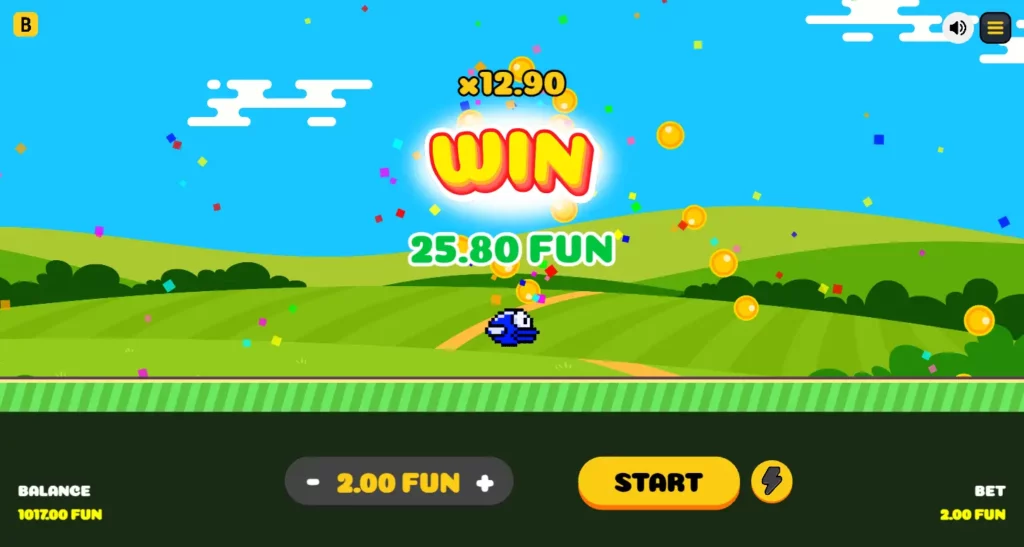
Lucky Birds is a crash game released by BGaming on 13 July 2026, built as an open homage to Flappy Bird. Three birds fly toward a series of green pipes. You stake, pick one, and each pipe it clears raises your multiplier; a collision ends the round and the stake is gone.
Search results here are cluttered. An unrelated Lucky Birds video slot from Playson has existed since 2019, and several aggregators describe the BGaming release as a slot when it has no reels, no paylines and no spin button. BGaming holds a Maltese B2B critical gaming supply licence, and its product page flags the game as available on limited servers, so distribution remains partial.
Three birds appear, each carrying a visible risk percentage above its head: the chance that bird collides with the upcoming pipe. Launch reporting states that exactly one of the three crashes at each set of pipes, which makes those percentages a partition of a single guaranteed casualty rather than three independent probabilities. BGaming has published nothing confirming that, but if it holds, the figures sum to roughly 100% and the safest bird still carries real risk.
Survive, and the multiplier increases. The percentages are then reshuffled across the three birds and you decide again: switch, stay, or take the money. BGaming calls this Smart Crash, and a long round therefore contains a chain of decisions rather than the single cash out call the genre usually offers.
Cashing out is not continuous. Winnings can only be secured in designated safe zones between pipe sets, when the cashout button becomes active; once you have committed to a bird, you are locked in until the obstacle resolves. BGaming documents no auto-cashout here, and a preset multiplier target would not map onto a gated window anyway, so anyone relying on that automation for discipline should assume it is unavailable. The risk levels are not fixed difficulty settings either. They regenerate every pipe, so low risk is a position that moves between the red, yellow and blue birds rather than a mode you select. A higher displayed percentage buys a larger multiplier increment on survival and a lower one buys less, but because the theoretical return is fixed, no selection pattern changes what the game pays back, only the shape of the distribution.
BGaming publishes a theoretical RTP of 96.00% on its official product page, a figure repeated in trade coverage of the launch. The house retains approximately 4 units of every 100 wagered over a large number of rounds. That is standard for the category, but it is a rate applied to turnover, not to deposits, which is the distinction most players get wrong.
Expected loss per hour equals house edge multiplied by rounds per hour multiplied by average stake. Crash formats typically run 50 to 100 rounds per hour, and because this one demands a decision at every pipe, 60 rounds per hour is the assumption used here. At a 1 unit average stake: 0.04 x 60 x $1 = $2.40 per hour. At a 5 unit average stake: 0.04 x 60 x $5 = $12.00 per hour. At 100 rounds per hour those become $4.00 and $20.00. Across twenty hours a month at 5 units that is roughly $240, and no selection strategy alters it.
BGaming calls the game low volatility and lists a hit rate of 1.67 without stating a unit; read as one win per 1.67 rounds it implies a win rate near 60%. At least one independent listing contradicts the developer and calls it high volatility, so the classification is disputed. A low volatility profile means most rounds resolve at modest multipliers and losing runs are shallower, which flatters short sessions: you will often finish an hour ahead. That is variance, not edge. The 4% is extracted from every unit wagered whether you happen to be winning at the time or not.
The 12,000x ceiling deserves scepticism. In a standard crash structure the chance of reaching a multiplier M is approximately RTP divided by M, placing 12,000x at roughly one round in 12,500, and the declared low volatility profile almost certainly makes it rarer still. That is a derived estimate, not a published figure. Combined with the 240,000 cap, the headline number is a marketing artefact for almost everyone.
BGaming operates a documented provably fair system at company level. Its published method calculates the round outcome in advance, generates a random string called the Secret, hashes Result plus Secret with SHA-256, and shows that hash to the player before the bet. The player supplies or accepts a Client Seed; afterwards Result and Secret are revealed, so you can rehash them, confirm the hash matches the pre-bet commitment, and confirm the Client Seed produced the outcome shown.
It is not documented for Lucky Birds. The official product page never mentions provably fair, and its FAQ, asked directly whether the game is safe, answers with certified RNG instead: a materially different claim meaning a laboratory audited the generator at some point, not that you can check your own round. No BGaming source located for this review confirms the fairness widget appears in this title.
In practice, assume you cannot verify an individual round unless you open the game and find a widget exposing a seed and a hash. Without one you are relying on the Maltese licence, laboratory certification and the operator’s honesty, the same trust position as any regulated slot. That is not an accusation of wrongdoing, but any review citing the studio’s provably fair reputation as a verified feature of this game is stating something it has not checked.
The per pipe decision structure is a real design contribution rather than a reskin. Most crash titles reduce the player to a single binary at an arbitrary moment; this one substitutes a sequence of discrete choices with the risk stated numerically before you commit. Reviewers covering the launch consistently identified it as the standout element; continuous player input at this level is uncommon.
The transparency of the display is unusual: an explicit crash probability above each bird is a real number rather than a vague risk label, and more than an aviation style curve gives you at any point in a round. The documentation is above average for the category too, with RTP, volatility, hit rate, maximum multiplier and maximum win all listed and dated on the developer’s own page, where many crash titles publish none of it.
The gap between the advertised 12,000x and the 240,000 cap is disclosed nowhere in the marketing, and it should be. A player staking 50 units per round is playing a 4,800x game while being sold a 12,000x one, a ceiling reduction driven by nothing the player did wrong, and no source found for this review flagged it.
Fairness verification is the second problem, and the missing auto-cashout compounds it, since the one automation tool that enforces cashout discipline in a fast format appears unavailable while the safe zone restriction removes the escape hatch that defines the genre. Content depth is thin, a point German language coverage made directly: the loop repeats heavily with few additional features. There is no community around the title yet either, and this review found no substantive Reddit, forum or streamer discussion beyond aggregator listings and syndicated launch copy. That is unsurprising two weeks after a limited release, but it means nobody can yet tell you how the game behaves over a large sample.
The player who gets the most from Lucky Birds enjoys casino games for the decisions rather than the outcomes and is content with low variance at small stakes. If weighing a displayed 22% against a displayed 41% appeals, the per pipe structure gives you far more to do than a standard crash curve. A flat one or two unit stake with a fixed session budget suits it.
The player who should look elsewhere wants a large tail outcome. The 240,000 cap and the low volatility distribution make this a poor vehicle for chasing a life changing result, and stake escalation works against you, since raising your bet lowers the maximum multiplier payable. A high volatility title with a stake proportional cap delivers that ambition more honestly, and anyone who wants to verify their own results should look for an exposed fairness widget.
The player who should avoid it entirely leans on auto-cashout to stay honest. This game removes both halves of that tool: no documented auto-cashout, and cashing out only in windows the game chooses. A format demanding a live decision every few seconds, under time pressure, at the exact moment a losing run makes you want to push further, is wrong for anyone whose difficulty is impulse rather than budgeting.
Crash games are built for speed. Rounds are short, the next begins immediately, and losses accumulate far faster than in slower formats because the number of decisions per hour is many times higher. A 4% house edge sounds small until it is applied 60 or 100 times an hour to your whole stake. Auto-cashout at a fixed multiplier can impose useful discipline where it exists, but it does not change the underlying edge, and no selection strategy or bankroll system alters the expected return. Set a loss limit before you start, not after a losing run, and treat staked money as spent rather than invested. If gambling has stopped being entertainment, support is free and confidential: GambleAware at begambleaware.org, GamCare at gamcare.org.uk, the National Council on Problem Gambling in the US at ncpgambling.org or 1-800-522-4700, and Gambling Therapy at gamblingtherapy.org. 18+ only.
Lucky Birds is a competently built, unusually well documented crash game with a genuine mechanical idea and a headline number that does not survive contact with its own specification sheet. The strongest reason to play it is the per pipe risk display, which hands you explicit probabilities before every decision. The most important reason for caution is that the 240,000 cap silently shrinks the advertised ceiling as your stake rises, and no fairness verification appears to be documented for this specific title despite the studio’s reputation. It suits the low stakes, decision oriented player who prefers a slow bleed to a lottery ticket, and it is wrong for anyone chasing a tail outcome or relying on automation for self control. Worth playing with those caveats, at small stakes, in demo mode first. The fact almost no other review includes: because exactly one of the three birds crashes at every pipe set, the percentages shown are a partition of a certainty rather than three independent chances, so there is never a safe bird on screen, only a less exposed one.
The RTP is 96.00%, published by BGaming on its official product page and repeated in trade coverage of the July 2026 launch. Operators can deploy alternative configurations, so check the figure in the game’s information panel.
Not as far as any public documentation shows. BGaming operates a company level provably fair system using SHA-256 commit and reveal, but the Lucky Birds page does not mention it and answers the fairness question by citing certified RNG. Certification means a laboratory audited the generator; it does not let you verify your own round.
The maximum multiplier is 12,000x, but the maximum win is capped at 240,000 currency units, which is the binding constraint at most stakes. At a 20 unit stake the two figures coincide. At a 100 unit stake the effective ceiling is 2,400x, because the cash cap is reached first.
You stake, then choose one of three birds, each showing its own probability of hitting the next pipe. Clearing a pipe raises the multiplier, after which the percentages are reshuffled and you choose again. You can cash out only in the safe zones between pipe sets, and the round ends when you cash out, your bird crashes, or you reach 12,000x.
The house edge is 4.00%, derived directly from the published 96.00% RTP. At 60 rounds per hour and a 5 unit average stake, that is an expected cost of about $12.00 per hour, calculated as 0.04 multiplied by 60 rounds multiplied by $5.
There is no evidence of it. BGaming holds a Maltese B2B licence and its games carry independent laboratory certification, so the RNG has been audited. The caveat is that certification is not verification: without a fairness widget exposing seeds and hashes, you cannot check any individual round yourself.

Chicken Halloween is BGaming's October 2026 seasonal reskin of Chicken Shot, a casual instant-win game where every shot at a costumed chicken is a separate wager with a published win chance and a fixed multiplier from x1.1 to x64.

High Flyer is a multiplayer plane crash game from Pragmatic Play, released in September 2024, in which players cash out before the aircraft flies away. It publishes a 97% RTP, offers two independent bet spots with auto-cashout and advertises multipliers of up to 1,000,000x.

Space XY is a multiplayer crash game from BGaming in which a rocket climbs across an X-Y graph and players cash out before it explodes. It has a published 97% RTP, two bet panels per round and a €250,000 win cap.
JetX3 is a crash game from SmartSoft Gaming in which three jets take off together, each with its own independent crash point. Players can bet on one, two or all three jets, collect from each separately and reach up to 2,000x per jet.