Author Spencer Thorne
June 23, 2026

The first thing worth correcting about Outsourced: Payday is that it is not a crash game, despite being routinely grouped with them. There is no rising multiplier and no cash-out button; the actual crash title in this series is a separate release, Outsourced: Slash Game. Payday is a claw-machine game, and its most counterintuitive feature follows from that: you can pay 997 times your stake for the God Mode bonus buy, which guarantees the maximum-win symbol appears on the belt, and still walk away with nothing, because the claw can fail to grab it or drop it on the way up. A guaranteed symbol is not a guaranteed win, and that gap between marketing and mechanic is the whole story of this game.
| Detail | Information |
|---|---|
| Developer / provider | Nolimit City (Nolimit Labs division) |
| Game type | Claw-machine instant-win game, not a crash game |
| RTP | 96.00% default (source: Nolimit City, via AboutSlots), with operator variants of 94.01% and 92.02% |
| House edge | 4.00% at the 96.00% setting, higher on the lower variants |
| Max multiplier | 10,000x the bet (max win, roughly 1 in 1.3 million rounds) |
| Min stake | $0.20 |
| Max stake | $100 |
| Risk level settings | Yes, via Nolimit Boosters and bonus buys |
| Provably fair | No; standard certified RNG, no player-verifiable seed system |
| Auto-cashout | No, not applicable to this mechanic (Autoplay is available) |
| Demo available | Yes |
| Mobile compatible | Yes |
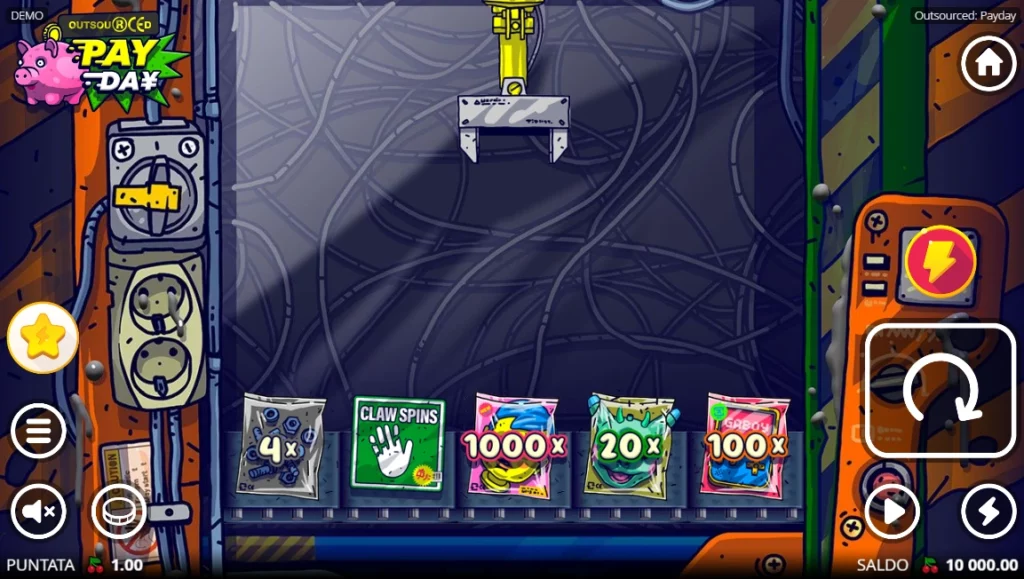
Outsourced: Payday is an instant-win game released by Nolimit City on 17 December 2024 through its experimental Nolimit Labs division. It abandons the spinning reels and paylines most players associate with the studio and replaces them with a conveyor belt and a mechanical claw. Each round, five symbols slide across the screen from right to left and a claw above the belt attempts to grab one. Hold a paying symbol and you win the multiplier printed on it, applied to your stake; grab nothing, drop what you grabbed, or land on a zero-value symbol, and the round pays nothing. Structurally it is five reels with a single one-symbol row and no paylines, essentially a claw machine in slot-game plumbing.
The theme continues the studio’s satirical Outsourced universe, where a factory has replaced its human workforce with claws that, as Nolimit City puts it, never unionise or take coffee breaks. It is the third entry in a line that began with the original Outsourced slot and continued through Outsourced: Slash Game, and reviewers rate it medium volatility, around six out of ten on Nolimit City’s scale, noticeably tamer than the studio’s high-variance flagships.
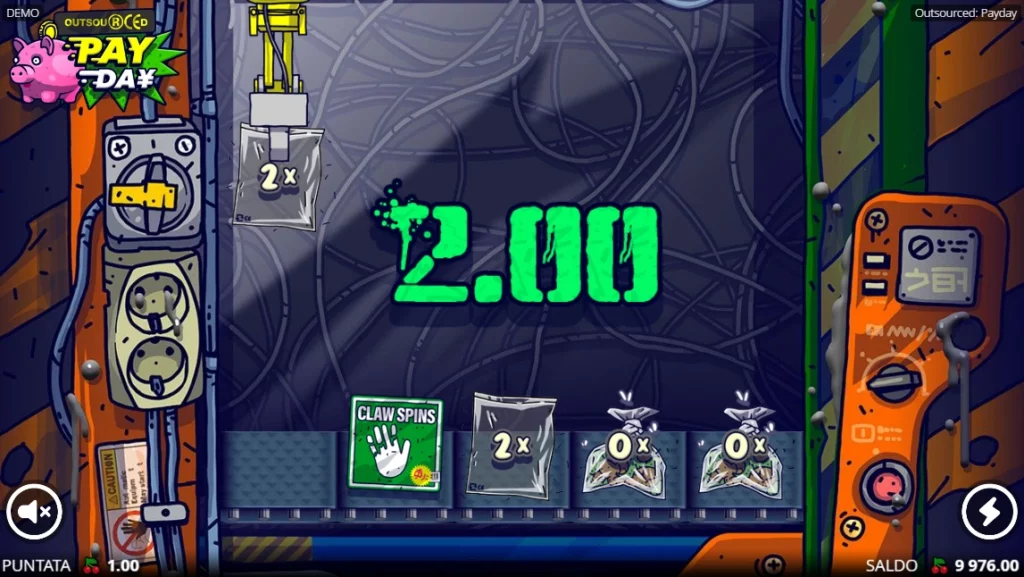
A round begins when you select a stake and press spin, and the belt delivers five symbols: transparent prize bags carrying multiplier values reported across reviews as 0x, 2x, 4x, 10x, 20x, 50x, 100x and a top regular value of 1,000x, alongside a Claw Spins bonus symbol. There is no wild. The random number generator decides everything the moment you commit the round, including which symbols appear, which one the claw targets, and whether it holds or fumbles it. What you watch afterward is animation. The dropped-prize moment is not a live event you can influence but a predetermined loss dressed up as bad luck with a real claw.
The bonus is Claw Spins. When the claw grabs and holds the bonus symbol, you get three free rounds with the zero-value symbols removed, so every position carries at least 2x. Free spins trigger at roughly one in 94 rounds, the base hit frequency is about 15 percent, and the 10,000x maximum win arrives only about once in every 1.3 million rounds.
Because this is not a crash game, there is no auto-cashout. Instead there are paid modifiers charged on top of your stake: xBet (6x the bet, guarantees a bonus symbol), Safe Claw Mode (1.6x, a grabbed symbol cannot be dropped), Three Claws (4x), and Five Claws (10x). The bonus-buy menu sells Claw Spins directly at 35x for one claw, 150x for three, 400x for five, and God Mode at 997x, which forces the maximum-win symbol onto the belt. These are not risk dials in the crash sense; they change your wager and the variance, not the house’s margin, and reviews report booster modes still run near 96.0 percent.
The published return to player at the standard setting is 96.00 percent, attributed to Nolimit City and reproduced by aggregators including AboutSlots. That means a 4.00 percent house edge: over a large number of rounds, the game retains about $4 of every $100 wagered. Two operator-configurable variants exist at 94.01 percent and 92.02 percent, pushing the edge to roughly 6 and 8 percent. So the figure on the box is not necessarily what you are playing: a casino can deploy the 92.02 percent build unless the info screen says otherwise.
Here is what an hour costs at the default setting. The formula is simple: expected loss per hour equals the house edge times rounds per hour times average stake. The honest variable is rounds per hour; this is a single-button instant-win game with short rounds, so a brisk but realistic manual pace is around 500 rounds an hour. At a $1 stake that is 0.04 × 500 × $1, or roughly $20 lost per hour; at a $5 stake, 0.04 × 500 × $5, or roughly $100. On the 92.02 percent variant those same sessions cost closer to $40 and $200. Boosters worsen this further by raising the wager per round: God Mode at 997x stakes nearly $1,000 on a single $1-base round. The percentage edge holds, but the absolute loss scales with everything you spend.
Volatility separates a session from the long-run average. At medium variance you can finish whole sessions ahead, because rare large wins from the 10,000x ceiling and the 1,000x symbols sit atop frequent small and zero outcomes. Being up after an hour tells you nothing about the edge, only that the rare outcomes fell your way this time, while the 4 percent margin asserts itself over thousands of rounds, not the dozen that shaped your evening. The boosters mostly redistribute variance rather than reduce the edge: Safe Claw Mode removes dropped-prize losses for a fee, while extra claws and bonus buys concentrate spending into higher-stakes rounds with bigger swings both ways.
Outsourced: Payday is not provably fair, and this review will not pretend otherwise. In its real meaning, provably fair is a cryptographic system common to crypto-native crash and dice games: the operator commits to a hashed server seed before the round, you supply a client seed, the two combine to produce the result, and the server seed is later revealed so you can hash it yourself and confirm it matches the commitment. A player who cannot perform that check is not being offered provable fairness, only the word “fair.”
This game offers none of that. It runs on a conventional random number generator whose fairness rests on the studio’s licensing and independent testing, not on anything you can verify yourself. Nolimit City operates under regulators including the Malta Gaming Authority and Ontario’s Alcohol and Gaming Commission, whose rules oblige certified games to return at their stated rates, and laboratories test the RNG behind the scenes. In practice you rely on the regulator and testing house rather than on a result you can audit yourself. That is a reasonable basis for trust, but a different thing. If self-verification matters to you, this game does not provide it, and that absence is worth knowing before you play.
The mechanic is genuinely novel, which is not a small thing in a market saturated with near-identical reel clones. The conveyor belt and claw create a moment of real tension as the grip descends, and reviewers credit the studio for building something that feels different rather than reskinned. The presentation carries the trademark Nolimit City humour and a sharp, scribbly art style with strong audio, and the satirical anti-corporate framing gives the game a personality most instant-win titles lack.
It is also more accessible than the studio’s reputation suggests. The rules are easy to grasp in seconds, the medium volatility makes for a less punishing ride than the high-variance flagships, and several reviewers singled it out as one of the more enjoyable Labs experiments. The free-spins trigger at roughly one in 94 is reasonably frequent, the demo lets you learn the loop at no cost, and it runs smoothly on mobile.
The base game becomes repetitive quickly, the culprit being the zero-value symbols clogging the belt. Players report frequent dead rounds where the claw grabs nothing of value, and the novelty wears thin the longer you sit with it. The dropped-prize design, charming once or twice, curdles into frustration when the thing slipping from the claw is a high-value or maximum-win symbol you have paid extra to chase.
The bonus underdelivers. Claw Spins awards only three free rounds unless you retrigger, so it is frequently over almost as soon as it begins, and unremarkable payouts are common; one tester reported a best result of just 18x across multiple bonus entries. The studio’s signature depth is largely absent; fans drawn by Nolimit City’s layered slots often find Payday thin.
Two transparency gaps deserve emphasis. The operator-configurable RTP means you cannot assume the advertised 96 percent without checking the in-game information, and the lower 92.02 percent build is materially worse value. And God Mode is sold on the promise of the maximum-win symbol, yet because the claw can still fail to secure it, spending 997x your stake can return nothing, a structure that flatters the upside while quietly preserving the downside.
The player who gets the most from this game is the curiosity-driven low-stakes recreational player who values novelty over depth and treats a session’s cost as entertainment spending. They set a small fixed budget, enjoy the claw mechanic and the satire, perhaps use Safe Claw Mode to soften dropped grabs, and walk away when the budget is gone. For that player, the game delivers exactly what it promises: a short, different, faintly funny experience.
The player who should look elsewhere is the engagement-seeker who came for classic Nolimit City complexity. If you want layered mechanics, long feature chains, and strategic depth, this Labs experiment will feel thin within an hour, and a feature-rich title would sustain attention better.
The player who should avoid it entirely is anyone drawn to the bonus-buy and God Mode shortcuts as a way to force a big result. The mechanic guarantees a symbol, not an outcome, and the claw’s failure-to-grab design means those large purchases can vanish completely. Anyone inclined to chase losses by escalating into 400x or 997x buys is at the most expensive and least forgiving part of the game, and that is where real money disappears fastest.
Instant-win and claw-style games are built for fast, repeated play: rounds are short, the spin button is always one tap away, and losses can accumulate far more quickly than in slower formats, because there is almost no natural pause between bets. The boosters and bonus buys compress that further by letting you stake many times your base amount in a single round. Decide on a loss limit before you start and treat it as fixed, rather than raising it after a losing run, and remember that no booster or purchase changes the underlying house edge. If gambling stops being fun, support is available: GambleAware at begambleaware.org, GamCare at gamcare.org.uk, the National Council on Problem Gambling at ncpgambling.org or 1-800-522-4700, and Gambling Therapy at gamblingtherapy.org. 18+ only.
Outsourced: Payday is a clever, well-presented novelty that is honest about being exactly that. The single strongest reason to play it is the conveyor-belt-and-claw mechanic, one of the few genuinely original ideas in a copycat market and worth seeing once in the free demo. The most important reason for caution is the God Mode trap: the game sells guaranteed symbols, not guaranteed wins, and its most expensive features can return nothing, which makes it actively hostile to anyone chasing losses. This is a game for the low-stakes player who wants something different for a short session, not for the depth-seeker or high-roller, so the verdict is worth playing with caveats: keep stakes small, treat the demo as the main event, and steer clear of the high-multiple buys. The fact most reviews miss is the one that matters most: this is not a crash game at all; that is its sibling, Outsourced: Slash Game, and several write-ups go further and describe Payday with reel mechanics it lacks, such as cascading reels and sticky wilds, which belong to the unrelated original Outsourced slot.
The default RTP is 96.00 percent, attributed to Nolimit City. Operators can also deploy lower-return variants of 94.01 percent and 92.02 percent, so the version you play depends on the casino, and you should check the in-game information screen to confirm which build is active.
No. It uses a conventional certified random number generator, not a cryptographic provably-fair system, so there is no server seed, client seed, or hash you can verify yourself. Its fairness rests on Nolimit City’s licensing and independent RNG testing rather than on player-side verification.
The maximum win is 10,000x your bet. It is extremely rare, occurring on average roughly once every 1.3 million rounds, and even the God Mode bonus buy that guarantees the maximum-win symbol on the belt does not guarantee the claw will successfully grab it.
A conveyor belt delivers five multiplier symbols each round and a claw attempts to grab one; if it lifts and holds a paying symbol, you win that multiplier times your stake. There are no reels or paylines in the traditional sense, and grabbing the bonus symbol triggers a three-round Claw Spins feature.
At the default 96.00 percent RTP the house edge is 4.00 percent, meaning the game keeps about $4 of every $100 wagered over the long run. On the 94.01 percent and 92.02 percent variants the edge rises to roughly 6 percent and 8 percent.
There is no evidence it is rigged; it is a certified RNG game from a studio licensed by regulators including the Malta Gaming Authority and Ontario’s AGCO, which require games to pay at their stated rates. It is not, however, provably fair, so you are relying on regulatory oversight rather than on a result you can independently audit.

Chicken Halloween is BGaming's October 2026 seasonal reskin of Chicken Shot, a casual instant-win game where every shot at a costumed chicken is a separate wager with a published win chance and a fixed multiplier from x1.1 to x64.

High Flyer is a multiplayer plane crash game from Pragmatic Play, released in September 2024, in which players cash out before the aircraft flies away. It publishes a 97% RTP, offers two independent bet spots with auto-cashout and advertises multipliers of up to 1,000,000x.

Space XY is a multiplayer crash game from BGaming in which a rocket climbs across an X-Y graph and players cash out before it explodes. It has a published 97% RTP, two bet panels per round and a €250,000 win cap.
JetX3 is a crash game from SmartSoft Gaming in which three jets take off together, each with its own independent crash point. Players can bet on one, two or all three jets, collect from each separately and reach up to 2,000x per jet.