Author Spencer Thorne
June 4, 2026

The number every Stellar review repeats — a 97% return to player — does not actually come from Orbital Gaming. It comes from third-party demo-listing sites, and because Orbital builds rebrandable provider software rather than running its own casino, the figure running where you actually play may differ. It also sits on a deeper truth about every crash game: whether you cash out at 1.3x or chase the advertised 5,000x ceiling, your expected return over the long run is identical. The big multiplier changes how it feels, not what it costs.
| Detail | Information |
|---|---|
| Developer / provider | Orbital Gaming (founded 2019, Tbilisi, Georgia) |
| Game type | 3D crash game |
| RTP | 97% (source: third-party aggregators LiveBet and Temple of Games) — not published by Orbital itself |
| House edge | Approximately 3% if the cited 97% RTP is accurate — not first-party disclosed |
| Max multiplier | 5,000x (source: LiveBet) |
| Min stake | Operator-dependent — not publicly documented for Stellar |
| Max stake | Operator-dependent — not publicly documented for Stellar |
| Risk level settings | No (risk is controlled through your chosen cashout target) |
| Provably fair | Yes — SHA-2 based, RNG certified by iTech Labs; verification depends on the operator’s implementation |
| Auto-cashout | Yes |
| Demo available | Yes |
| Mobile compatible | Yes (mobile-first HTML5) |
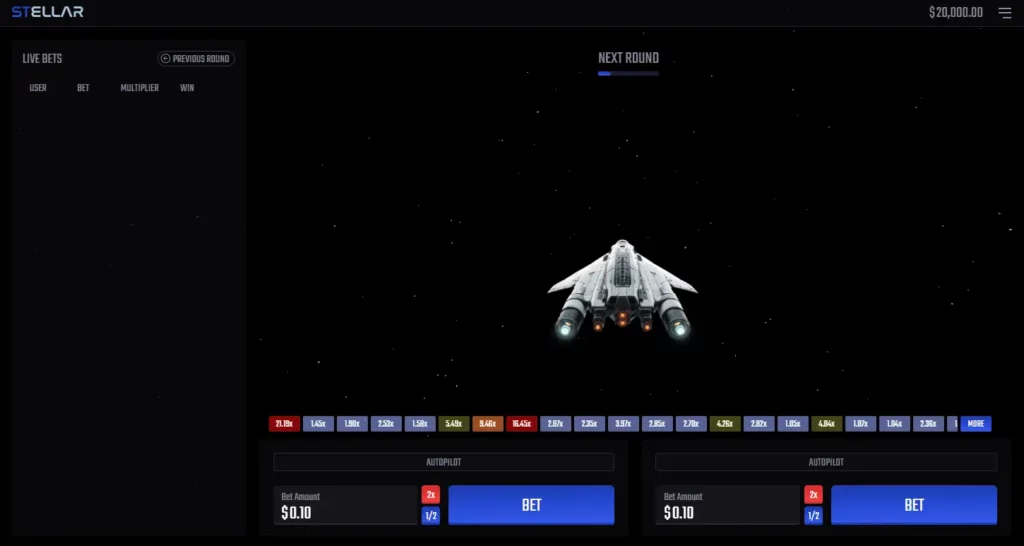
Stellar is a crash game: a multiplier climbs from 1.00x and your job is to cash out before it stops. A round begins with a space shuttle preparing to launch; once it flies, a win multiplier rises as the shuttle gains altitude, and you collect your bet times whatever value is on screen when you cash out. If the shuttle explodes first, the round ends and any uncollected stake is lost. What sets Stellar apart is that it renders this in 3D rather than the flat graph most crash games use, with a dual-betting interface for two independent wagers on one flight.
Orbital Gaming, the developer, was founded in October 2019 in Tbilisi, Georgia, and launched Stellar in January 2023 as its first 3D crash game — a step up from earlier, simpler titles like Dice and Astro. Orbital is a business-to-business provider: it does not run a casino but licenses games to operators, who rebrand them with their own logos and colours. The studio holds a Curacao licence and an iTech Labs RNG certification.
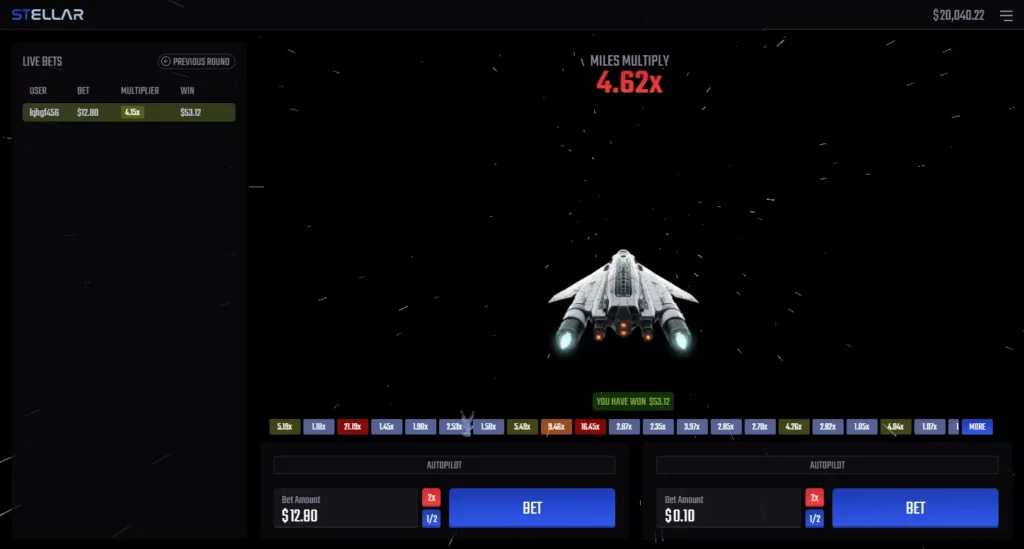
A round runs on a fixed loop. During a short betting window you set your stake and, optionally, an auto-cashout target. When the window closes the shuttle launches and the multiplier rises from 1.00x. The crucial point is that the outcome — the multiplier at which the shuttle explodes — is not decided as the curve climbs; it is fixed the instant the round is generated, by a random algorithm, before the curve is drawn. Your only live input is timing: tap before the explosion and you keep stake times multiplier, fail to tap and the stake is gone.
Auto-cashout removes timing risk by collecting automatically when the multiplier hits a value you set in advance. This matters because manual cashout depends on reaction speed and latency — a lagging connection can cost a win you had earned — whereas auto-cashout executes server-side at your target. Its limitation is just as important: it does nothing to the odds. It only guarantees you exit at your chosen multiplier if the round reaches it, improving discipline, not expectation. The dual-bet interface extends this — commonly one bet auto-cashes low to cover the round’s cost while the second rides toward a larger payout.
Stellar has no tiered risk-level selector like the one in some Orbital titles such as Wheel. Risk here is expressed entirely through your cashout target: a low target wins often for small amounts, a high target wins rarely for large amounts. The curve is the same for everyone; your cashout target is the only dial.
If the RTP is 97% as the aggregator listings state, the house retains about $3 of every $100 wagered over a large number of rounds and returns roughly $97. That 3% is the house edge, and it is the entire reason the game exists commercially. The caveat: Orbital does not appear to publish this figure itself — it surfaces on third-party demo sites. Because the game is rebrandable and RTP in provider crash titles can be operator-configurable, treat 97% as a reported figure to verify in the game’s information panel, not a certified guarantee — when a number cannot be traced to the developer, your ability to assess the true cost of play is weaker than it looks.
Using the cited 3% edge, the expected cost of an hour follows a simple formula: expected loss per hour equals house edge × rounds per hour × average stake. Crash games typically run 50 to 100 rounds per hour; assume 60. At a $1 average stake that is 0.03 × 60 × $1, about $1.80 per hour; at a $5 stake, 0.03 × 60 × $5, about $9.00 per hour. This is calculated on turnover — total wagered — so re-staked winnings push the real cost higher if you keep recycling a balance.
Volatility is why none of this shows in a single session: the 3% edge is a long-run average over thousands of rounds, and over a short session variance dominates — you can be well up or wiped out without contradicting it. The 5,000x ceiling and rare large multipliers make the payout distribution extremely skewed, producing streaks that feel like skill or bad luck but are only noise around a fixed negative expectation. The most counterintuitive consequence is that expected value is identical at every cashout target. The probability of reaching multiplier M is roughly the RTP divided by M, so at 97% the chance of reaching 2x is about 48.5%, of 10x about 9.7%, and of 100x under 1%. Multiply payout by its probability at any target and you land on the same negative number — cashing out low or high is a different experience of volatility, not a different bet against the house.
Orbital states its games, Stellar included, use provably fair technology built on the SHA-2 hash family, and carries an iTech Labs RNG certification. The standard model works like this: before a round, the operator generates a server seed and publishes only its hash, committing to a value it cannot later change without the hash failing to match. A client seed comes from your side, so the operator cannot pre-calculate a result against you. Server seed and client seed, with a per-round nonce, are combined and hashed to produce the crash multiplier, which is fixed before the curve appears. After the seed is rotated, the operator reveals the original server seed; you hash it yourself to confirm it matches the hash shown earlier, then re-run the combination to confirm the crash point. If both checks pass, the round was not manipulated.
The honest qualification: provably fair is only as useful as the tools you are given. I could not locate first-party, step-by-step verification documentation or a public verifier from Orbital for Stellar specifically. The architecture is real and certified, but your ability to verify depends on the casino exposing the seed hash, the revealed seed, your client seed and a working verification panel in the game. Treat the label as a question to test, not a badge to trust: if you cannot find the seeds and recompute a result yourself, the guarantee is theoretical, and you are relying on the operator’s honesty.
The clearest strength is presentation. Stellar was among the first crash games to move from a flat graph to a genuine 3D launch sequence, and that polish, with mobile-first HTML5 delivery, makes it smooth on phone and desktop alike.
The dual-bet interface is genuinely useful rather than a gimmick: two independent wagers on one flight let you build a structured approach — a conservative auto-cashout to recover the round’s cost paired with a second stake left to ride. With reliable server-side auto-cashout, it gives a disciplined player real control over how their volatility is shaped. The supporting infrastructure is also in place — a Curacao licence, iTech Labs RNG certification, SHA-2 provably fair architecture, and a free demo that runs without registration, letting you learn the timing and test the mechanic at no financial risk before committing real money.
The weakest point is transparency around the numbers. For a provider that markets itself on fairness, the absence of a clear, first-party, certified RTP is a meaningful gap. The 97% everyone cites traces to demo-listing aggregators, not Orbital, and because the game is rebrandable and RTP can be operator-set, you cannot be confident the figure you read matches the one running where you play.
The second issue is the near-total absence of independent player scrutiny. Unlike the genre’s flagship titles, Stellar has almost no substantive discussion on forums such as Reddit or Bitcointalk; searches surface demo landing pages and search-optimised “reviews” rather than real player consensus. That is not evidence of a problem, but it means a thin independent track record. Distribution and feature breadth are limited too: at least one major game database notes the title is not widely offered, and the feature set, while clean, is modest. Stellar competes more on looks than depth.
The player who will get the most from Stellar treats it as paid entertainment, not a financial activity. They want a good-looking, fast crash game for short sessions, set a fixed small budget before starting, use the free demo first to learn the timing, and use the dual-bet mechanic deliberately with a conservative auto-cashout around 1.3x to 2x. Their bankroll is pre-committed, with a firm walk-away point.
The player who should consider an alternative cares most about verifiable fairness and first-party documentation. If knowing the exact certified RTP and being able to independently recompute every result matters to you, look for a crash title whose provider publishes its certified RTP and a documented, working verifier — not a provably-fair label alone.
The player who should avoid Stellar entirely is anyone inclined to chase losses or treat the 5,000x ceiling as a route to money. The cadence is fast, with new flights every few seconds, so turnover and losses accumulate quickly. The skewed distribution dangles rare enormous multipliers engineered to provoke fear of missing out, most dangerous for the players least able to stop. If you cannot set a loss limit in advance and hold to it, the speed works against you.
Crash games are designed for fast play: rounds are short, the next launch is always seconds away, and losses can accumulate far more quickly than in slower casino formats. Auto-cashout at a set multiplier can impose useful discipline by removing in-the-moment decisions, but it does not change the underlying house edge — every cashout target carries the same negative expectation over time. Decide on a loss limit before you start, not in the middle of a losing streak when judgement is worst, and treat any money wagered as the cost of entertainment rather than an investment. If gambling stops feeling optional, support is available: GambleAware (international) at begambleaware.org, GamCare (UK) at gamcare.org.uk, the National Council on Problem Gambling (US) at ncpgambling.org or 1-800-522-4700, and Gambling Therapy (international) at gamblingtherapy.org. 18+ only.
Stellar is a competently built, visually distinctive crash game with the right fairness scaffolding — SHA-2 provably fair architecture, an iTech Labs RNG certification, a Curacao licence — but it is good rather than exceptional, and its defining weakness is transparency. The strongest reason to play is presentation: the genuine 3D launch, smooth mobile experience and useful dual-bet mechanic make it one of the more pleasant crash games to play as entertainment. The most important caution is that the 97% RTP underpinning the math is not published by Orbital and may be operator-configurable, so verify both the figure and the provably-fair tools in the actual client before depositing. It is right for the casual player who wants a good-looking crash experience under strict, pre-set limits, and wrong for anyone seeking maximum transparency or treating it as income — so the verdict is worth playing, with specific caveats. The fact most reviews leave out: the repeated “97%” is third-party-sourced rather than disclosed by the developer, the game is a rebrandable white-label product whose RTP can vary by operator, and there is almost no genuine independent player feedback — so much of the confidence you will read about Stellar is manufactured rather than earned.
Third-party aggregator listings (LiveBet and Temple of Games) state an RTP of 97%, implying a house edge of about 3%. This figure is not in Orbital’s own documentation, and because the game is rebrandable, the RTP at a given casino may differ — verify it in the game’s information panel.
Yes, Orbital states Stellar uses provably fair technology based on the SHA-2 hash family and holds an iTech Labs RNG certification. In practice, whether you can verify a result depends on the operator exposing the seeds and a working verification tool inside the game.
The maximum multiplier is 5,000x your stake, per listings on LiveBet. Reaching it is extremely improbable — at 97% RTP the chance of any round reaching even 100x is under 1%.
You place a stake, a shuttle launches, and a multiplier rises from 1.00x until the shuttle explodes at a point fixed randomly before the round is shown. You win stake times multiplier if you cash out before the explosion and lose the stake if you do not; auto-cashout and a dual-bet interface let you automate and split wagers.
If the cited 97% RTP is accurate, the house edge is about 3% — the operator retains roughly $3 of every $100 wagered over many rounds. Because the RTP is not first-party-disclosed, treat this as a reported rather than guaranteed figure.
There is no evidence Stellar is rigged; it carries an iTech Labs RNG certification and a SHA-2 provably fair architecture meant to let players confirm results were not manipulated. But provably fair only guarantees outcomes are not tampered with — it does not remove the house edge, and the game stays negative expectation over time.

Chicken Halloween is BGaming's October 2026 seasonal reskin of Chicken Shot, a casual instant-win game where every shot at a costumed chicken is a separate wager with a published win chance and a fixed multiplier from x1.1 to x64.

High Flyer is a multiplayer plane crash game from Pragmatic Play, released in September 2024, in which players cash out before the aircraft flies away. It publishes a 97% RTP, offers two independent bet spots with auto-cashout and advertises multipliers of up to 1,000,000x.

Space XY is a multiplayer crash game from BGaming in which a rocket climbs across an X-Y graph and players cash out before it explodes. It has a published 97% RTP, two bet panels per round and a €250,000 win cap.
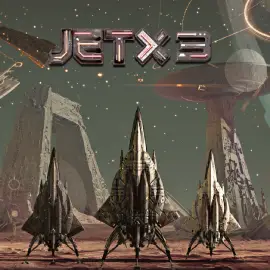
JetX3 is a crash game from SmartSoft Gaming in which three jets take off together, each with its own independent crash point. Players can bet on one, two or all three jets, collect from each separately and reach up to 2,000x per jet.